Knowledge Base • 11 Min Read
Hot Stamping Process: Why 90% of Packaging Fails at the "Triangle of Variables"
Table of Contents
The 90% Surge: Why Everyone is Asking "How to Stamp?"
The answer isn’t in the machine—it’s in the Adhesion Physics. If you treat the Hot Stamping Process like a simple “heat-and-press” job, you’re going to lose margins to rejects. Here is the unfiltered, factory-floor truth about mastering the foil transfer.
The "Success Triangle": Heat, Pressure, and Dwell Time
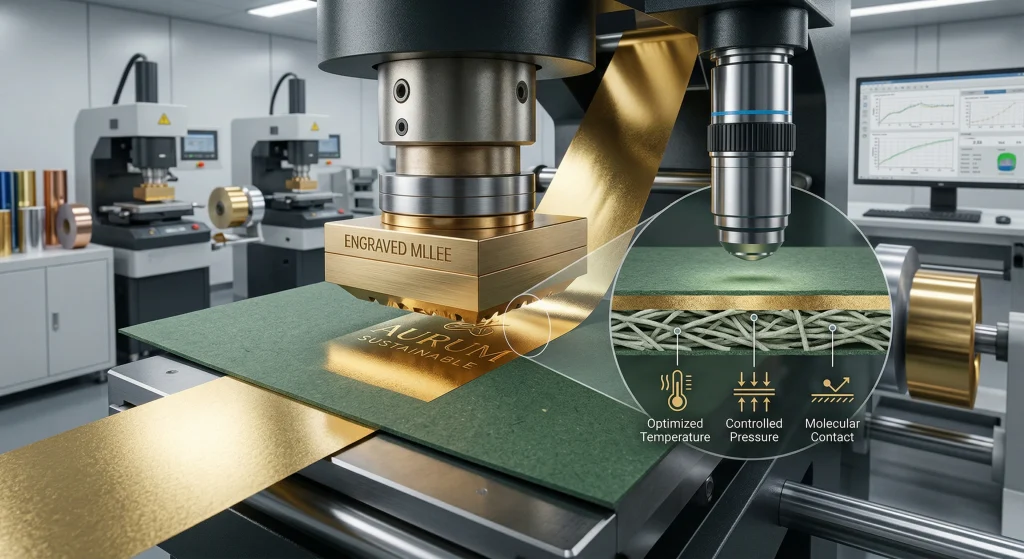
- Heat (The Catalyst): Most of our Luxury Packaging Foils activate between 110°C and 130°C. If you go too high, the PET carrier distorts; too low, and the adhesive layer never “bites” the paper fibers.
- Pressure (The Bond): This isn’t just about “heavy” or “light.” It’s about PSI (Pounds per Square Inch). For fine scripts, you need concentrated pressure. For large solids, you need a perfectly leveled bed to avoid “Pinholing.”
- Dwell Time (The Release): This is the millisecond the die stays in contact with the foil. On high-speed Bobst or Gietz machines, you have almost zero room for error. This is where the Release Force of the foil becomes the hero—or the villain.
The Die Dilemma: Brass vs. Magnesium
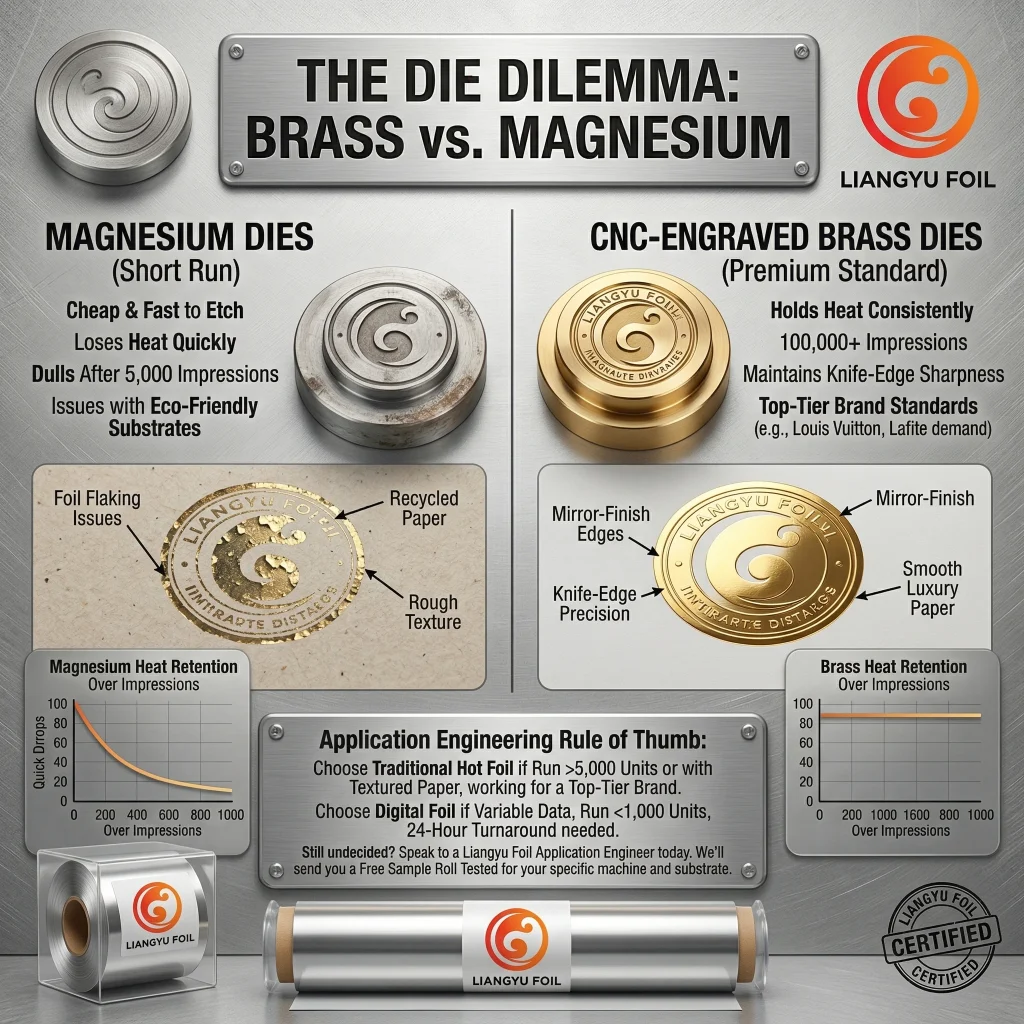
A major part of the Hot Stamping Process is the tooling.
- Magnesium Dies: Cheap and fast to etch. Great for short runs, but they lose heat quickly and the edges dull after 5,000 impressions.
- Brass Dies: The industry gold standard. CNC-engraved brass dies hold heat consistently and can run for 100,000+ impressions without losing the “knife-edge” sharpness that brands like Louis Vuitton or Lafite demand.
At Liangyu Foil, we always tell our clients: If you’re using our premium pure gold foil, don’t kill the quality by using a cheap magnesium die.
Why Substrates are Changing the Rules
These materials have low surface energy (Dyne levels). If your foil’s adhesive isn’t chemically tuned for “low-dyne” surfaces, you’ll get “Bridging” (where foil sticks to the gaps in letters) or “Flaking” (where it peels off with a fingernail).
Our R&D team at Jiangsu Liangyu Laser New Material Co., Ltd. has developed a specific range of Matte Pigment Foils with an aggressive “High-Grab” adhesive layer specifically for these difficult 2026 substrates.
The "Dirty" Secrets of Quality Control
Why did we invest 100 million yuan in 12 advanced coating lines and RTO systems?
- Uniformity: If the release layer is 0.1 micron too thick on one side of the roll, your machine operator will spend 4 hours trying to fix a “patchy” transfer.
- RTO Stability: Our Regenerative Thermal Oxidizing system ensures the air in our coating workshop is clean and temperature-stabilized. This prevents “Micro-Bubbles” in the aluminum layer—the #1 cause of Holographic Foil failure.
Troubleshooting the Process: A Quick Factory Guide
If your Hot Stamping Process is failing, check these three things before calling the manufacturer:
- Dust on the Board: The biggest enemy of foil is paper dust. It creates “hollow spots” in the foil.
- Die Leveling (Make-ready): 80% of “poor coverage” issues are solved by better shimming, not by increasing the heat.
- The “Tape Test”: Apply 3M 600-series tape to the foiled area and rip it off. If the foil comes with it, your Dwell Time was too short or your Heat was too low.
Master the Process, Own the Market
The Hot Stamping Process isn’t a commodity; it’s an art backed by rigorous chemistry. Ready to stop troubleshooting and start producing? Contact our application engineers today. We don’t just sell you a roll of foil; we help you calibrate your entire Hot Stamping Process.