Knowledge Base • 12 Min Read
Cold Foil vs Hot Foil: 7 Best Packaging Tips for Labels, Wine Labels, Cosmetic Boxes and Flexible Packaging
Table of Contents
- 1. What Is the Difference Between Cold Foil vs Hot Foil?
- 2. Packaging and Label Decision Table
- 3. When Should You Choose Cold Foil for Labels?
- 4. When Should You Choose Hot Foil for Packaging?
- 5. Wine Labels: Cold Foil vs Hot Foil
- 6. Cosmetic Boxes: Cold Foil vs Hot Foil
- 7. Flexible Packaging and Narrow-Web Printing
- 8. Cost, MOQ, and Speed Comparison
- 9. Quality Problems to Check Before Mass Production
If you are choosing between cold foil vs hot foil for packaging or labels, the right answer depends on run length, substrate, artwork detail, press setup, finish quality, cost target, and whether the job needs embossing. Cold foil is usually better for fast inline label production, while hot foil is better for premium cartons, fine detail, textured stocks, and tactile luxury effects.
For packaging buyers, this is not just a technical debate. The wrong foiling method can create waste, delayed approvals, weak shelf impact, poor adhesion, or a finish that looks different from the approved sample. A wine label, cosmetic folding carton, soft-touch gift box, flexible pouch, and narrow-web pressure-sensitive label can all use foil, but they do not need the same process.
Cold foil vs hot foil comes down to speed versus depth. Cold foil uses UV adhesive and pressure, making it efficient for roll labels and narrow-web printing. Hot foil uses heat, pressure, and a die, making it better for luxury cartons, wine labels, textured boards, embossing, and sharper metallic detail.
| Best choice | Use it when… | Typical packaging fit |
|---|---|---|
| Cold foil | You need fast inline production and metallic areas over printed graphics | Pressure-sensitive labels, wine labels, beverage labels, flexible labels |
| Hot foil | You need crisp detail, premium depth, embossing, or difficult stocks | Cosmetic boxes, luxury cartons, gift boxes, book covers, premium wine labels |
| Both | You need speed for large areas and hot foil for tactile accents | Multi-SKU labels, limited-edition packaging, premium retail sets |
What Is the Difference Between Cold Foil vs Hot Foil?
The main difference between cold foil vs hot foil is the transfer mechanism. Cold foil bonds foil to a printed UV adhesive. Hot foil transfers foil through a heated die under pressure. That difference changes cost, speed, artwork limits, substrate compatibility, and final visual depth.
| Factor | Cold foil | Hot foil |
|---|---|---|
| Transfer method | UV adhesive + pressure + curing | Heat + pressure + metal die |
| Tooling | Usually no engraved hot stamping die | Requires die or stamping plate |
| Best production format | Inline roll-fed labels | Sheet-fed cartons, labels, covers, plastics, leather |
| Speed | Faster for narrow-web label runs | Slower setup, but premium result |
| Fine detail | Good, depends on adhesive control | Excellent with the right die |
| Embossing/debossing | Not the usual strength | Strong fit for combined luxury effects |
| Large metallic areas | Efficient, especially inline | Possible, but may use more setup control |
| Textured substrates | Needs testing; adhesive can spread or miss fibers | Often better with pressure control and correct foil grade |
Cold foil often feels like a printing process because the adhesive image is printed first. Hot foil feels more like a finishing process because the die, heat, dwell time, and pressure shape the result. Neither is automatically “better”; the better process is the one that fits your packaging structure and production line.
Packaging and Label Decision Table
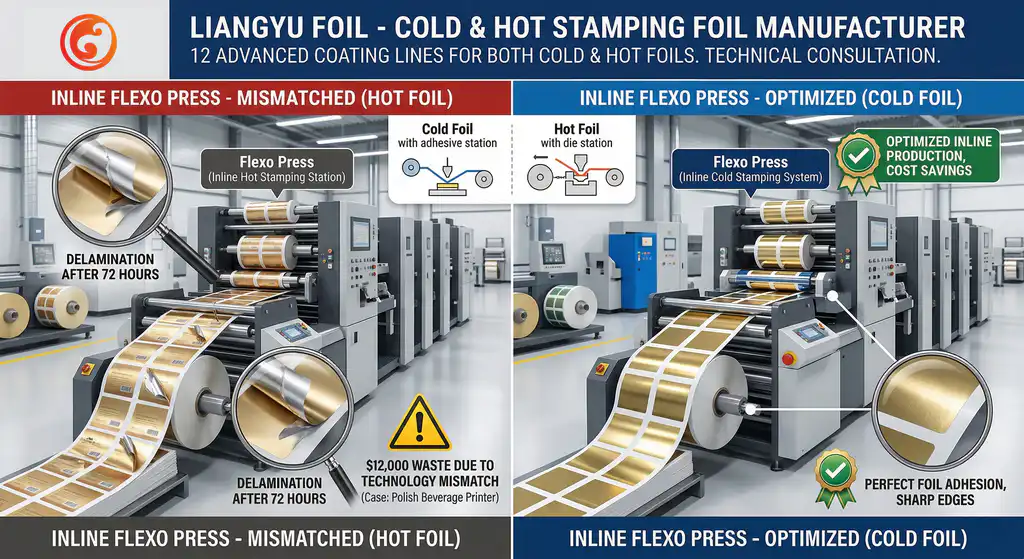
For labels and packaging, cold foil vs hot foil should be chosen by application rather than by finish name alone. A gold logo on a cosmetic carton has different requirements from a metallic wine label background or a foil accent on a flexible pouch.
| Packaging type | Better first choice | Why | Watch-outs |
|---|---|---|---|
| Pressure-sensitive labels | Cold foil | Efficient inline production on narrow-web presses | Adhesive control, UV curing, overprint varnish compatibility |
| Wine labels | Depends on design | Cold foil for larger decorative areas; hot foil for premium logos and embossing | Paper texture, wet-strength stock, registration, scuff resistance |
| Cosmetic folding boxes | Hot foil | Premium shine, crisp logo detail, emboss/deboss options | Lamination, coating, alcohol or handling resistance |
| Flexible packaging | Cold foil or tested specialty process | Better for roll-fed production and continuous webs | Film surface energy, adhesive compatibility, heat sensitivity |
| Luxury gift boxes | Hot foil | Strong tactile value and premium perception | Die cost, make-ready, pressure balance |
| Plastic tubes and caps | Hot foil for plastic | Adhesive layer can be matched to PE, PP, PET, ABS, PVC | Surface treatment, rub testing, alcohol resistance |
| Security labels | Holographic cold foil or hot foil | Adds motion, authentication, and premium shelf visibility | Pattern registration and anti-counterfeit requirements |
| Book covers and cards | Hot foil | Clean edges and traditional premium finish | Textured stock and small serif text need testing |
When Should You Choose Cold Foil for Labels?
Choose cold foil when your packaging job is roll-fed, label-heavy, speed-sensitive, and designed for inline embellishment. It works especially well for labels that need metallic areas combined with printed graphics, varnish, and fast press throughput.
Cold foil is a strong fit for:
- Wine and beverage labels with metallic backgrounds or decorative zones.
- Cosmetic labels where shelf shine matters but embossing is not required.
- Food labels using coated label papers or compatible films.
- Promotional labels with changing designs or multiple SKUs.
- Narrow-web flexo or offset label production.
- Holographic label effects where inline decoration is preferred.
The biggest production advantage is speed. A converter can print adhesive, transfer foil, cure, print over it, and finish the label inline, depending on press configuration. This is why cold foil is common in narrow-web label shops that handle repeat SKUs and brand programs.
But cold foil still needs disciplined setup. If adhesive volume is too heavy, edges can spread. If curing is weak, adhesion may suffer. If the foil release layer is mismatched, the image can look patchy or dull. If the substrate is too rough, fibers can interrupt the foil layer.
When Should You Choose Hot Foil for Packaging?
Choose hot foil when your packaging needs premium depth, crisp edges, small logos, tactile value, textured stock compatibility, embossing, or a luxury retail feel. Hot foil remains the stronger choice for cosmetic boxes, rigid boxes, book covers, high-end cards, leather, and many premium wine labels.
Hot foil is a strong fit for:
- Cosmetic folding cartons with small brand marks.
- Wine labels that require embossing or deep metallic accents.
- Rigid gift boxes and luxury packaging.
- Book covers, certificates, premium cards, and invitations.
- Textured paperboard where pressure helps foil contact the surface.
- Plastic caps, tubes, or components using plastic-compatible foil.
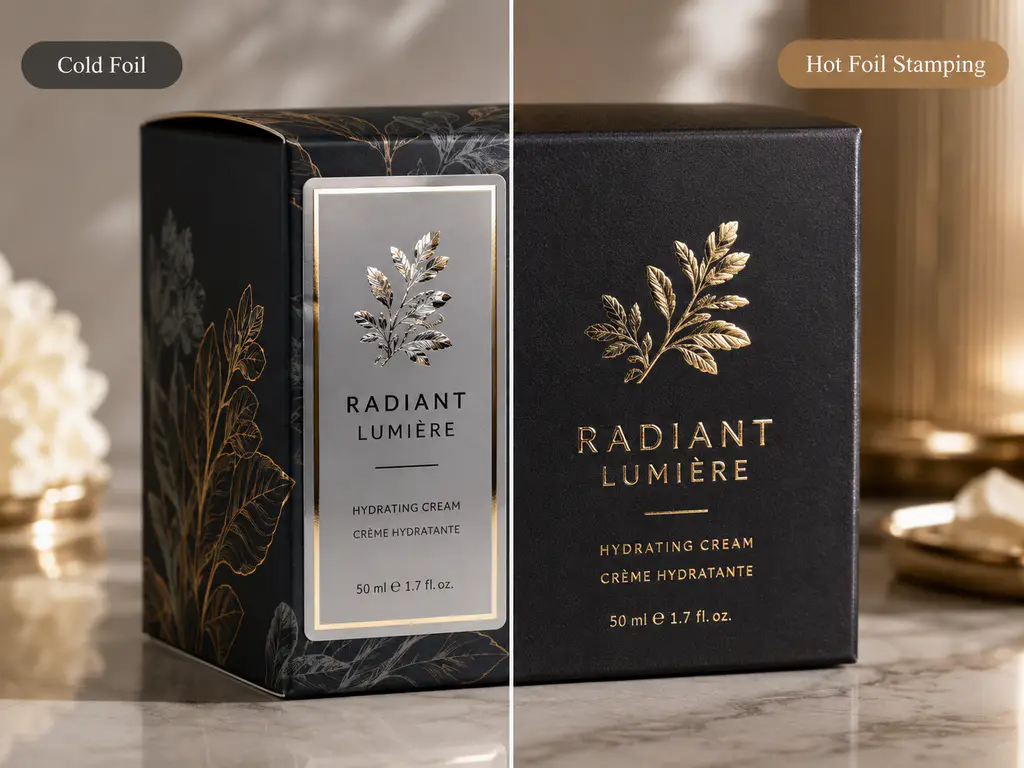
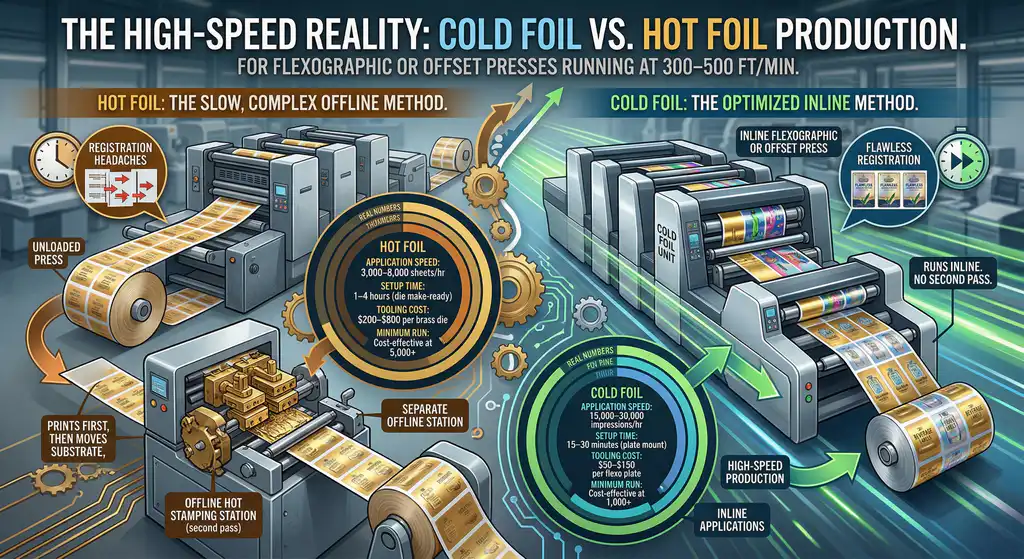
The advantage is control. A properly made die can deliver precise edges, consistent pressure, and strong release. If the job combines foil with embossing or debossing, hot foil is usually the practical path. The trade-off is setup cost, make-ready time, and slower changeover compared with cold foil.
Wine Labels: Cold Foil vs Hot Foil
For wine labels, cold foil vs hot foil depends on whether the design needs fast metallic coverage or a premium tactile mark. Cold foil is efficient for larger metallic design areas, while hot foil is better for logos, crests, fine borders, embossing, and textured wine papers.
| Wine label requirement | Better choice | Reason |
|---|---|---|
| Large metallic background | Cold foil | Efficient inline coverage on label presses |
| Small crest or winery logo | Hot foil | Sharper die-controlled detail |
| Foil plus embossing | Hot foil | Better alignment with emboss/deboss tooling |
| Multiple SKUs with similar label layout | Cold foil | Faster repeat production |
| Textured uncoated wine stock | Hot foil, after testing | Pressure can help transfer into uneven surfaces |
| Holographic limited edition | Cold foil or hot foil | Depends on pattern registration and finish depth |
Wine labels should be tested for rub resistance, moisture exposure, label stock texture, overprint varnish, and bottle handling. A label may look perfect flat but scuff after bottling, packing, shipping, or ice bucket exposure.
Cosmetic Boxes: Cold Foil vs Hot Foil
For cosmetic boxes, hot foil often wins when the brand needs luxury, fine detail, and a controlled premium finish. Cold foil can work for label-style decoration or larger metallic graphics, but folding cartons often benefit from hot foil’s pressure, edge control, and embossing compatibility.
Cosmetic packaging often includes soft-touch lamination, matte varnish, UV coating, folding scores, product oils, alcohol exposure, or heavy retail handling. These details affect foil choice. A metallic logo on a matte black carton, for example, may need a different foil grade than a gold accent on a coated white board.
Use hot foil when:
- The logo is small or detailed.
- The design includes embossing or debossing.
- The carton needs a luxury shelf impression.
- The stock is textured, laminated, or heavily coated.
- The brand requires tight color and gloss consistency.
Use cold foil when:
- The job is label-based rather than carton-based.
- Metallic areas are larger and integrated with printed graphics.
- The converter has a stable UV cold foil system.
- The project needs faster inline production across many SKUs.
Flexible Packaging and Narrow-Web Printing
In flexible packaging and narrow-web printing, cold foil vs hot foil usually favors cold foil when the job runs on a roll-fed press and needs inline metallic effects. However, film chemistry, adhesive compatibility, and curing control matter more than the process name.
Flexible packaging introduces different risks:
- Film may be heat-sensitive.
- Surface energy may be too low for reliable adhesion.
- Adhesive may not wet the surface evenly.
- Foil may crack during pouch forming or flexing.
- Overprint inks and varnishes may change the metallic effect.
- Food or cosmetic packaging may require stricter migration and compliance review.
For narrow-web label converters, the practical question is not “which method is shinier?” but “which method fits my press, adhesive, substrate, finishing sequence, and waste target?” Cold foil can reduce offline steps, but only if the press setup is stable. Hot foil can deliver a more premium mark, but it may require a separate finishing pass.
Cost, MOQ, and Speed Comparison
For cold foil vs hot foil, cold foil often has lower tooling friction for inline label work, while hot foil can be more cost-effective for premium repeat packaging where the die is reused and the value of the finish justifies setup.
| Cost factor | Cold foil | Hot foil |
|---|---|---|
| Tooling | Often lower, no hot stamping die | Die cost required |
| Setup time | Faster if press is configured | More make-ready and pressure balancing |
| Run speed | Strong for roll-fed labels | Depends on press and finishing setup |
| Waste risk | Adhesive/curing issues can create waste | Heat/pressure/die setup can create waste |
| Best MOQ logic | Better for repeat inline label runs | Better when premium finish supports setup cost |
| Sampling | Press proof recommended | Die proof or stamped sample recommended |
| Reorders | Efficient with stable adhesive and press | Efficient if die and foil grade are retained |
A common mistake is comparing only the foil material cost. The real cost includes die making, adhesive, press time, waste, setup labor, sampling, finishing sequence, rework risk, freight, and approval delays.
Quality Problems to Check Before Mass Production
Before approving cold foil vs hot foil for labels or packaging, test the actual substrate, artwork, and finishing sequence. Most failures come from mismatched materials, not from the foiling process alone.
| Problem | More common risk | What to check |
|---|---|---|
| Patchy transfer | Both | Substrate smoothness, pressure/nip, foil release, adhesive laydown |
| Weak adhesion | Cold foil or plastic hot foil | Surface energy, UV curing, adhesive layer, contamination |
| Dull metallic effect | Both | Foil grade, overprint varnish, heat, pressure, storage |
| Edge spread | Cold foil | Adhesive volume, plate, anilox, curing, image detail |
| Broken fine lines | Both | Artwork minimum line width, die quality, adhesive control |
| Cracking on folds | Hot foil on cartons | Score location, foil area, coating, board flexibility |
| Registration drift | Both | Press control, web tension, die alignment, label layout |
Buyer Checklist: How to Choose Between Cold Foil vs Hot Foil
Use this checklist before asking for a final quote:
- What is the substrate: coated paper, uncoated paper, textured paper, film, plastic, laminated board, or leather?
- Is the job sheet-fed or roll-fed?
- Does the artwork include fine lines, small text, large solids, or reverse details?
- Does the finish need embossing, debossing, or tactile depth?
- Will the package be folded, squeezed, rubbed, chilled, filled, or exposed to alcohol?
- Is the job a one-time launch, a seasonal SKU, or a repeat program?
- What is the expected quantity and delivery schedule?
- Does the buyer need mirror gold, matte metallic, pigment foil, holographic foil, or transparent foil?
- Is recyclability or sustainability claim language involved?
- Can the supplier test the actual material before mass production?
If the project is visually important, do not approve based only on a digital mockup. Request a physical proof or a foil sample on the closest available substrate.
Bottom Line: Which Method Should Packaging Buyers Choose?
For cold foil vs hot foil, choose cold foil for fast roll-fed label production, large metallic areas, inline efficiency, and narrow-web printing. Choose hot foil for premium boxes, wine-label crests, cosmetic cartons, textured papers, embossing, plastic decoration, and sharp luxury details.
The best packaging teams often use both. Cold foil can create high-speed metallic effects across label programs, while hot foil can add the hero logo, tactile detail, or premium accent that makes the final package feel more valuable.
FAQ: The Questions Your Competitors Can't Answer
Is cold foil better than hot foil for labels?
Cold foil is often better for roll-fed labels because it can run inline with UV adhesive and high-speed printing. Hot foil is better when the label needs embossing, sharper details, textured paper compatibility, or a more premium tactile finish.
Is hot foil better for cosmetic boxes?
Hot foil is usually better for cosmetic boxes that need crisp logos, matte-board contrast, embossing, debossing, or luxury shelf impact. Cold foil may still work for label-style decoration or larger metallic graphics if the converter has a stable cold foil setup.
Which is better for wine labels, cold foil or hot foil?
Cold foil is efficient for larger metallic areas on wine labels, while hot foil is better for crests, small logos, textured stocks, and foil plus embossing. Many premium wine labels use hot foil for the main brand mark.
Can cold foil be used on flexible packaging?
Cold foil is efficient for larger metallic areas on wine labels, while hot foil is better for crests, small logos, textured stocks, and foil plus embossing. Many premium wine labels use hot foil for the main brand mark.
Which process is cheaper, cold foil or hot foil?
Cold foil can be cheaper for inline label production because it avoids hot stamping dies and separate finishing steps. Hot foil can be cost-effective for premium repeat jobs where the die is reused and the finish adds enough value to justify setup.
Can cold foil and hot foil be used together?
Yes. Some packaging programs use cold foil for larger inline metallic areas and hot foil for premium accents, logos, embossing, or special editions. This hybrid approach can balance speed, cost, and shelf impact.
Not sure whether cold foil or hot foil fits your packaging?
Send your label stock, carton board, plastic part, artwork, target finish, quantity, and production process. Our team can help compare foil grades, sample options, and the safest route before mass production.