
Introduction
Choosing between cold stamping foil and hot stamping foil can make or break your project. Both deliver stunning metallic effects, but their processes, costs, and applications differ. This guide compares the two in detail to help you decide.
What is Cold Stamping Foil?
Cold stamping foil applies metallic effects using adhesive and UV light—no heat required. It’s integrated into printing presses, making it fast and efficient for high-volume runs.
What is Hot Stamping Foil?
Hot stamping foil uses heat and a custom die to transfer foil onto surfaces. It’s slower but excels at detailed, premium designs.
Detailed Comparison
Table 2: Cold vs. Hot Stamping Foil
| Feature | Cold Stamping Foil | Hot Stamping Foil |
|---|---|---|
| Process | UV adhesive + inline printing | Heat + die stamping |
| Speed | High (up to 500 ft/min) | Moderate (batch process) |
| Cost | Lower (no die needed) | Higher (die + setup costs) |
| Detail Level | Broad, flat designs | Intricate, embossed details |
| Substrates | Paper, some plastics | Paper, plastic, leather |
| Eco-Friendliness | Energy-efficient | Higher energy use |
Pros and Cons
- Cold Stamping Foil
- Pros: Cost-effective, fast, eco-friendly.
- Cons: Limited to simpler designs, less adhesion on textured surfaces.
- Hot Stamping Foil
- Pros: High precision, durable, versatile substrates.
- Cons: Higher cost, slower production.
Side-by-side comparison of a cold-stamped label (broad metallic effect) vs. a hot-stamped logo (fine detail) – captioned “Cold vs. Hot: See the Difference.”
When to Use Each
How to Choose the Right Manufacturer
Whether you opt for the high-speed efficiency of cold foil or the tactile luxury of traditional hot stamping, the final print quality depends heavily on the manufacturer’s coating technology. Liangyu Foil provides both premium hot and cold stamping foil master rolls, engineered for zero color shift and superior adhesion. If your current label production suffers from edge flaking or slow throughput, our technical R&D team can match the exact chemical formulation required for your specific printing press and substrate.
- Cold Stamping Foil: Ideal for large-scale food packaging, labels, or budget-conscious projects.
- Hot Stamping Foil: Perfect for luxury goods, book covers, or intricate branding.
“Cold vs. Hot Stamping: Which Wins?” – Embed a 3-minute explainer comparing processes and results.
Expert Tip
Test both on a small scale before committing. At Liangyufoil, we offer free samples to ensure you get the right fit.
Making the Right Choice for Your Production Line
When evaluating cold vs hot stamping foil, the decision ultimately comes down to your specific substrate, production volume, and budget. While cold foil excels in high-speed, inline rotary label printing on smooth surfaces, traditional hot foil remains the undisputed champion for deep, tactile embossing on textured wine labels and luxury cartons. Understanding the intricate nuances of cold vs hot stamping foil is essential for packaging engineers looking to minimize production waste and maximize shelf appeal.
At Liangyu Foil, we don’t just supply raw materials; we provide comprehensive, end-to-end finishing solutions. If you are still unsure which technology perfectly aligns with your current printing machinery, our dedicated technical support team is ready to conduct a thorough analysis of your design files. We can supply extensive sample rolls of both technologies, allowing you to run rigorous side-by-side trial runs. By directly testing the cold vs hot stamping foil applications on your own facility’s press, you can guarantee a flawless, brilliant metallic finish that will elevate your brand’s next major product launch above the competition.
Conclusion
Whether it’s speed or sophistication, we’ve got you covered with both cold and hot stamping foil solutions. Contact us today for a tailored recommendation! Dipiscing at in tellus integer.
Knowledge Base • 12 Min Read
Cold Foil vs Hot Foil: The Decision That Cost One Client $12,000 in Wasted Labels
Table of Contents
- 1. The Fundamental Physics: Heat vs. Adhesive
- 2. When Would You Use Cold Foil? (The Speed Argument)
- 3. When Is Hot Foil Still King?
- 4. The "Primer" Question Nobody Asks
- 5. What Happens When You Mix Vinegar and Aluminum Foil?
- 6. The Hybrid Approach: Why "Both" Is Often the Answer
- 7. The Decision Framework: A Checklist
Why This Comparison Matters More Than You Think
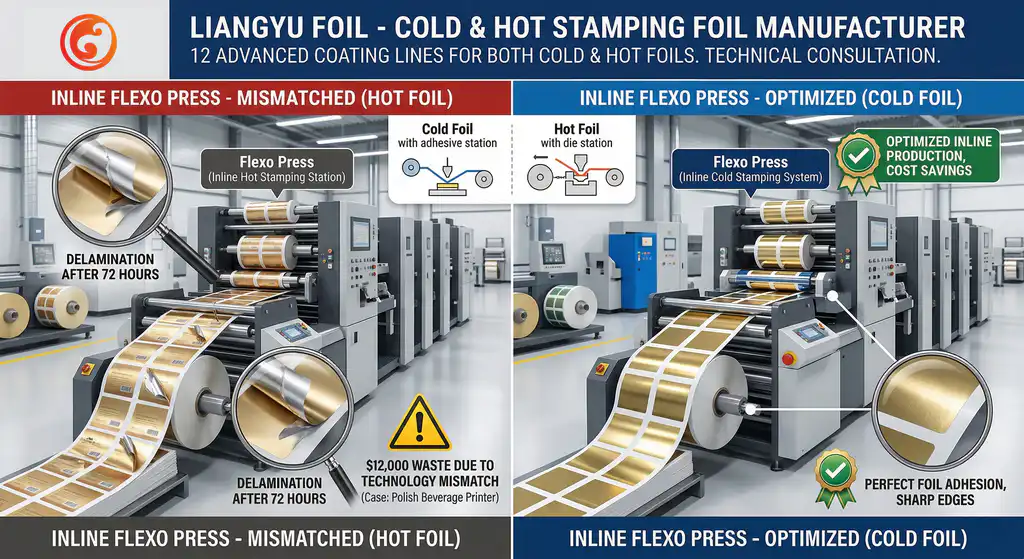
Cold foil vs hot foil — it sounds like a simple question. But last November, a beverage label printer in Poland called us in a panic. They had ordered 800,000 labels using hot foil on their new flexo press, and every single roll was delaminating after 72 hours on the shelf. The problem? Their press was designed for inline cold foil application. They used the wrong technology from day one.
The answer is always the same: you’re treating leather like paper. It’s not. Leather has oils, textures, and surface coatings that actively fight against foil adhesion. If you don’t understand the chemistry, you’ll burn through thousands in wasted materials before getting a single usable batch.
The Fundamental Physics: Heat vs. Adhesive
The core difference between cold foil vs hot foil comes down to how the metallic layer bonds to your substrate.
- Hot Foil uses a heated brass or magnesium die (typically 110°C–130°C) to physically press the foil onto the material. The heat activates a thermoplastic adhesive on the foil, creating a permanent mechanical bond. No UV system required.
- Cold Foil skips heat entirely. Instead, a UV-curable adhesive is printed onto the substrate first (usually via a flexo or offset plate), and the foil is then laminated over the wet adhesive. A UV lamp cures the adhesive in milliseconds, locking the foil in place. As described in the foil stamping process, each method serves fundamentally different production environments.
When Would You Use Cold Foil? (The Speed Argument)
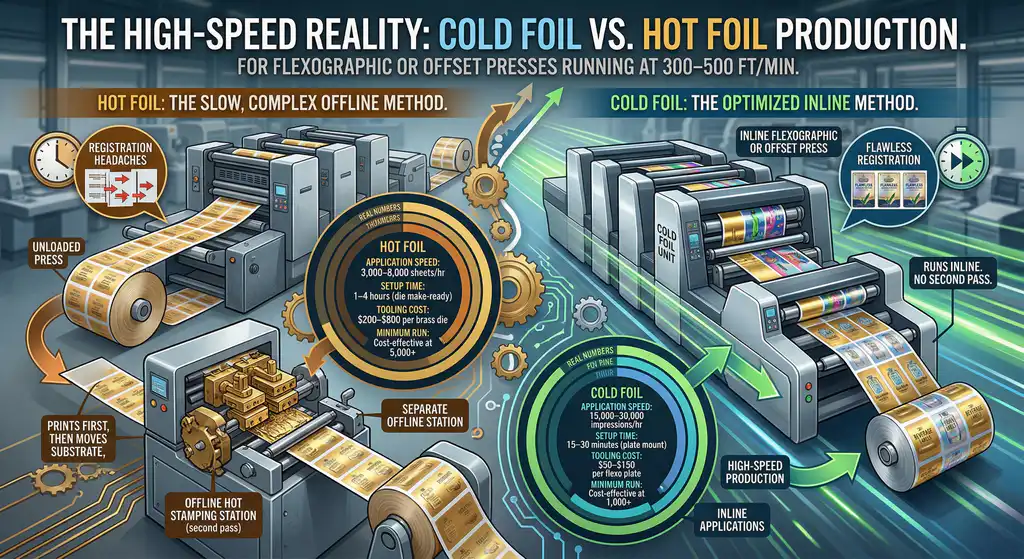
If your production line is a high-speed flexographic or offset press running beverage labels, shrink sleeves, or flexible packaging at 300–500 ft/min, cold foil is your only realistic option.
Why? Because hot stamping requires a separate offline station — you print first, then move the substrate to a stamping machine. Cold foil runs inline. No second pass. No registration headaches.
The Real Numbers from Our Factory Floor:
| Variable | Hot Foil | Cold Foil |
|---|---|---|
| Application Speed | 3,000–8,000 sheets/hr | 15,000–30,000 impressions/hr |
| Setup Time | 1–4 hours (die make-ready) | 15–30 minutes (plate mount) |
| Tooling Cost | $200–$800 per brass die | $50–$150 per flexo plate |
| Minimum Run | Cost-effective at 5,000+ | Cost-effective at 1,000+ |
When Is Hot Foil Still King? (The Quality Argument)
Speed isn’t everything. When a procurement manager at Moët Hennessy or Shiseido looks at a foiled label, they’re not asking “How fast was this printed?” They’re asking “Does it feel expensive?”
Hot foil wins on three fronts that cold foil cannot match:
- Tactile Depth: The heated die creates a micro-debossing effect — a physical indentation you can feel with your fingertip. Cold foil is flat. Always.
- Mirror Finish: Hot foil produces a true mirror-like reflection because the die pressure forces the aluminum layer into full contact with the substrate. Cold foil often has a slightly “diffused” look because the UV adhesive layer sits between the foil and the paper.
- Substrate Range: Hot foil works on paper, board, leather, plastic, fabric, and even wood. Cold foil is limited to smooth, non-porous surfaces where the UV adhesive can cure properly.
The "Primer" Question Nobody Asks (Until It's Too Late)
One of the most searched questions about cold foil is: “What primer is needed for foiling?”
Here’s the truth that most foil sellers won’t tell you: cold foil adhesion is entirely dependent on the UV adhesive formulation and the anilox roller specification. If your anilox volume is too low (below 6 BCM), the adhesive layer will be too thin, and the foil will “skip” across the substrate — especially on textured or uncoated stocks.
One of the most searched questions about cold foil is: “What primer is needed for foiling?”
What Happens When You Mix Vinegar and Aluminum Foil?
This question pops up constantly in search data, and it reveals a common confusion: cold foil is NOT aluminum foil.
Kitchen aluminum foil is a thick (15–25 micron) sheet of pure aluminum. Cold stamping foil is a multi-layered film — PET carrier, release coat, lacquer layer, vacuum-deposited aluminum (only 0.04 microns thick), and an adhesive coat. They share a name, but they are completely different products. If someone in your organization is confusing the two, it’s time for a technical briefing.
The Hybrid Approach: Why "Both" Is Often the Answer
In 2026, the smartest packaging houses aren’t choosing between cold foil vs hot foil. They’re using both.
A typical high-end wine label might use:
- Cold foil for the large background metallization (fast, cost-effective, full-bleed coverage).
- Hot foil for the brand logo on top (tactile, mirror-finish, prestige).
The Decision Framework: A Checklist from Our Engineering Desk
Stop overthinking it. Answer these four questions:
- Is your press inline (flexo/offset)? → Cold foil.
- Do you need embossed texture or mirror finish? → Hot foil.
- Is your run under 5,000 units? → Cold foil (lower tooling cost).
- Are you stamping on leather, fabric, or textured board? → Hot foil. Always.
FAQ: The Questions Your Competitors Can't Answer
What is the difference between cold foil and rainbow foil?
Which is better, hot or cold rolled steel?
This is a metallurgy question, not a printing question. But we get asked this surprisingly often — “cold foil” in packaging has nothing to do with cold-rolled steel.
Is cold foil safe for food packaging?
Yes, when the UV adhesive is fully cured. Our cold foils are tested for indirect food contact compliance. Always request our TDS for specific migration data.
The Right Foil for the Right Job
The cold foil vs hot foil debate has no universal winner. Cold foil is the champion of speed and cost. Hot foil is the master of luxury and tactile quality. The real skill is knowing which weapon to deploy — and that requires a manufacturer who produces both at scale.
11 Comments
Comments are closed.




doxycycline mono 100mg cap
doxycycline mono 100mg cap
lipitor generic
lipitor generic
generic antibiotics online pharmacy
generic antibiotics online pharmacy
doxycycline for acne 100mg
doxycycline for acne 100mg
zoloft no prescription
zoloft no prescription
lasix generic
lasix generic
cialis generic india
cialis generic india
cenforce 200 side effects
cenforce 200 side effects
what is cenforce 200mg
what is cenforce 200mg
cialis ed meds
cialis ed meds
stendra 100 mg price
stendra 100 mg price