Knowledge Base • 12 Min Read
Foil Stamping on Leather: Why Your Foil Keeps Peeling (and How We Fixed It for 200+ Clients)
Table of Contents
Let's Start with the Uncomfortable Truth
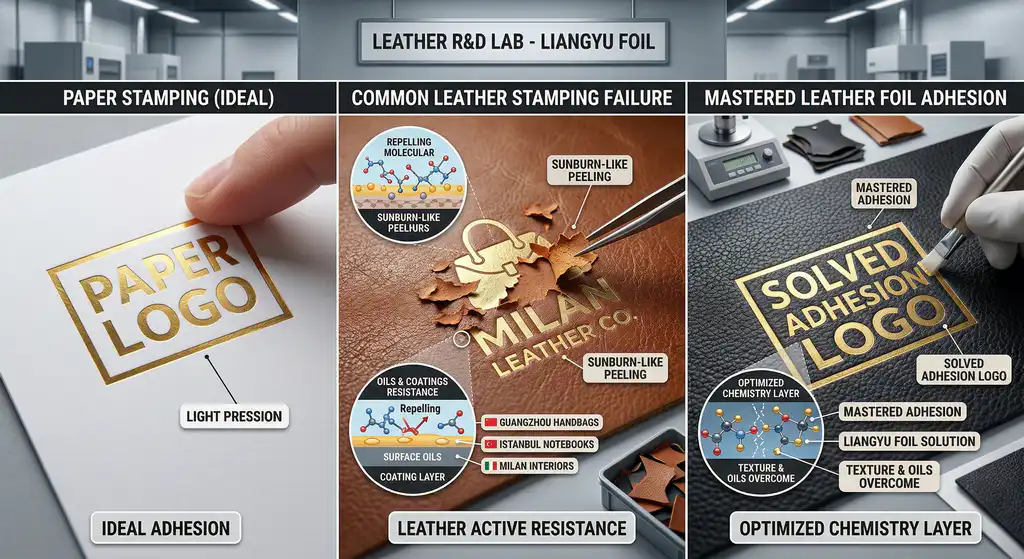
Foil stamping on leather is nothing like stamping on paper. If you walked into our Suqian factory five years ago, you’d have found a pile of rejected leather samples in the corner of our R&D lab—each one with foil peeling off like a bad sunburn.
We’ve since solved it. But every month, we still receive panicked calls from handbag factories in Guangzhou, notebook manufacturers in Istanbul, and automotive interior suppliers in Milan, all asking the same question: “Why won’t the foil stay on this leather?”
The answer is always the same: you’re treating leather like paper. It’s not. Leather has oils, textures, and surface coatings that actively fight against foil adhesion. If you don’t understand the chemistry, you’ll burn through thousands in wasted materials before getting a single usable batch.
The "Oil Problem": Why Leather Hates Your Standard Foil
Paper has a clean, predictable surface energy. Leather doesn’t.
Genuine leather contains natural oils and waxes (lanolin, paraffin) that migrate to the surface over time. These oils create an invisible barrier between your foil’s adhesive layer and the leather fibers. The result? Your foil looks perfect for 48 hours, then starts lifting at the edges.
The Temperature Trap: 110°C Will Ruin Everything
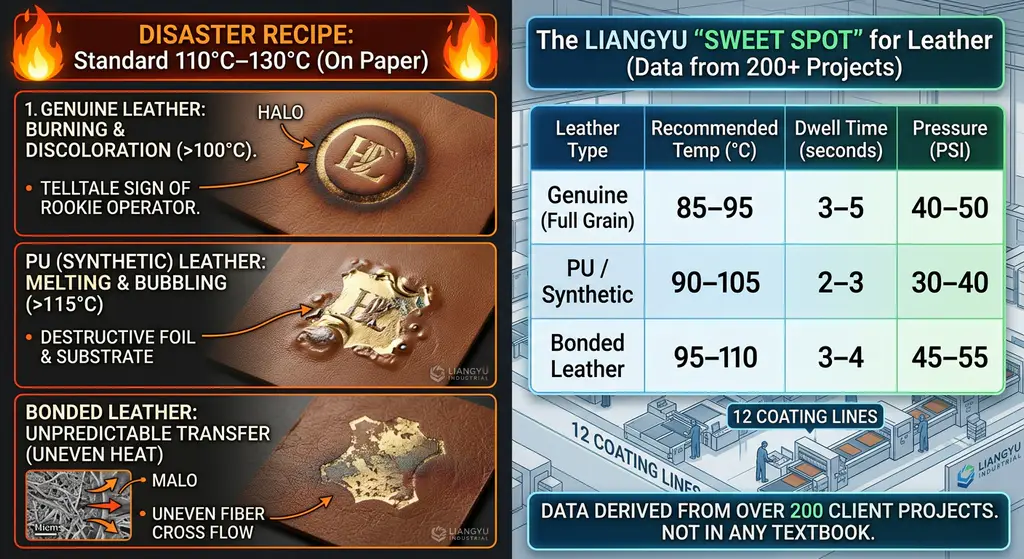
On paper, we recommend stamping between 110°C and 130°C. On leather, that’s a recipe for disaster. Here’s why:
- Genuine Leather: Burns and discolors above 100°C. You’ll see a dark “halo” around your stamped area—the telltale sign of a rookie operator.
- PU (Synthetic) Leather: The polyurethane coating melts and “bubbles” at anything above 115°C, destroying both the foil and the substrate.
- Bonded Leather: The most unpredictable. The mixed fiber content means heat distribution is uneven.
The Liangyu “Sweet Spot” for Leather:
| Leather Type | Recommended Temp (°C) | Dwell Time (seconds) | Pressure (PSI) |
|---|---|---|---|
| Genuine (Full Grain) | 85 – 95 | 3 – 5 | 40 – 50 |
| PU / Synthetic | 90 – 105 | 2 – 3 | 30 – 40 |
| Bonded Leather | 95 – 110 | 3 – 4 | 45 – 55 |
These numbers come from over 200 client projects processed through our 12 coating lines. They are not in any textbook.
Die Selection: Forget Magnesium
For paper stamping, magnesium dies are a cost-effective choice for short runs. For foil stamping on leather, magnesium is your enemy.
Why? Leather is soft and compressible. A magnesium die’s relatively blunt edges will “sink” into the leather grain, causing the foil to “bridge” across the texture valleys instead of following the surface contour. The result is a patchy, incomplete transfer that looks like the foil was applied with a worn-out rubber stamp.
Our Recommendation: Always use CNC-engraved brass dies with a polished face. Brass holds heat more evenly (critical at the lower temperatures leather demands) and its sharper edges ensure the foil breaks cleanly at the design boundaries. As we explained in our Complete Guide to Hot Stamping Foil, die quality is half the battle.
The "Prep" Step Everyone Skips
Before you even turn on the machine, the leather surface needs preparation. This is the step that separates the professionals from the amateurs.
- Degrease the Surface: Use a lint-free cloth with isopropyl alcohol (IPA) to remove surface oils. Wait 60 seconds for it to evaporate completely.
- Check the Dyne Level: Leather typically has a surface energy of 28-32 dynes/cm. For reliable foil adhesion, you need at least 36 dynes/cm. If it’s too low, apply a thin primer coat.
- Humidity Control: Leather absorbs moisture from the air. If your workshop humidity is above 65%, the water molecules will interfere with the adhesive bond. Our 25,000m² facility maintains a controlled environment precisely for this reason—it’s not a luxury, it’s a technical requirement.
Color Matters: Why Gold Works but Silver Doesn't (on Dark Leather)
This is something we learned the hard way in our lab.
Gold foil on dark leather (brown, burgundy, black) looks stunning because the warm tones complement the leather’s natural character. Silver foil, however, often looks “cold” and can appear grayish on dark hides because silver reflects the leather’s underlying color through its thinner pigment layer.
If your client insists on silver, we recommend our high-opacity silver series with an extra-thick aluminum deposit layer (0.08 microns vs. the standard 0.04 microns). This blocks the leather’s color from “bleeding through” and maintains that crisp, mirror-like finish.
The "Tape Test" and the "Bend Test": Your Quality Checkpoints
After stamping, don’t just eyeball the result. Run two tests:
- The 3M Tape Test: Press 3M 610 tape firmly onto the foiled area, wait 10 seconds, then pull it off at a 45° angle. If any foil transfers to the tape, your adhesion has failed. Go back to Step 4.
- The Bend Test: Fold the leather 180° at the stamped area. On genuine leather, micro-cracking is acceptable. On PU leather, the foil should flex without any visible fracturing. If it cracks, your Dwell Time was too short—the adhesive didn’t fully cross-link with the substrate.
Real-World Applications We've Delivered
In 2025, our team completed foil stamping on leather projects for:
- A Dubai-based luxury notebook brand that needed rose gold foil on full-grain Italian leather covers—we solved their peeling issue by adjusting the release force from 25g to 18g.
- A Turkish handbag manufacturer requiring holographic security foil on PU leather tags—anti-counterfeiting meets fashion.
- An automotive parts supplier in Germany needing consistent black foil on bonded leather dashboard panels—48-hour adhesion testing under 80°C heat cycling was required.
Conclusion: Leather Demands Respect
Foil stamping on leather is not a commodity process. It’s a discipline that requires specialized foil chemistry, precise temperature control, and an obsessive attention to surface preparation.
If your current foil supplier hands you the same roll they sell for paper and says “just lower the temperature,” find a new supplier.
FAQ: From the Leather Stamping Lab
Can I use cold foil on leather?
Does foil stamping work on suede?
Technically yes, but the napped (fuzzy) surface makes clean edges nearly impossible. We recommend limiting suede stamping to large, simple logos—no fine text.
How do I prevent the "dark halo" burn mark?
Drop your temperature to 85°C and increase your dwell time to 4-5 seconds. It’s counterintuitive, but slower heat transfer prevents the leather’s surface proteins from scorching.
Leather Demands Respect
The Hot Stamping Process isn’t a commodity; it’s an art backed by rigorous chemistry. Ready to stop troubleshooting and start producing? Contact our application engineers today. We don’t just sell you a roll of foil; we help you calibrate your entire Hot Stamping Process.