Knowledge Base • 12 Min Read
Cold Foil Heat Resistance: Stop Confusing Your Packaging Foil with Kitchen Aluminum
Table of Contents
- 1. The "Oil Problem": Why Leather Hates Your Standard Foil
- 2. The Temperature Trap: 110°C Will Ruin Everything
- 3. The "Which Side Goes Up?
- 4. Does Foil Leach into Food?
- 5. Color Matters: Why Gold Works but Silver Doesn't
- 6. The "Tape Test" and the "Bend Test"
- 7. Real-World Applications We've Delivered
The Question We Get Asked at Every Trade Show
At Drupa 2024, a brand manager from a Turkish confectionery company walked up to our booth, held up a foiled chocolate box, and asked: “If I foil my packaging with cold foil, can the box go into a hot warehouse at 55°C without the foil peeling off?”
Behind him, a German label printer laughed. But it’s not a stupid question. In fact, cold foil heat resistance is one of the most misunderstood topics in the packaging industry — partly because Google keeps mixing up industrial cold stamping foil with the aluminum roll in your kitchen drawer.
Kitchen Foil vs. Cold Stamping Foil: Two Completely Different Animals
Industrial cold stamping foil is a completely different product. It’s a multi-layer film:
| Layer | Material | Function |
|---|---|---|
| Carrier | PET (Polyester), 12 μm | Structural support during transfer |
| Release Coat | Wax/Silicone blend | Allows foil to separate from carrier |
| Lacquer Layer | Nitrocellulose or Acrylic | Color and gloss |
| Metal Layer | Vacuum-deposited Aluminum, 0.04 μm | The “shiny” part |
| Sizing Layer | UV-reactive adhesive receptor | Bonds to the UV adhesive on substrate |
Notice the aluminum layer: 0.04 microns. That’s 500 times thinner than kitchen foil. You’re not putting a “sheet of metal” on your package — you’re transferring a microscopic metallic film held together by organic polymers. And those polymers have thermal limits.
The Real Heat Limit: It's the UV Adhesive, Not the Metal
Here’s the technical truth about cold foil heat resistance that your foil supplier probably never explained:
The aluminum itself can survive 660°C (its melting point). That’s irrelevant. The weak link is the UV-curable adhesive that bonds the foil to your substrate. Most standard UV adhesives used in cold foil application begin to soften at 80-90°C and lose structural integrity at 120°C.
What This Means in Practice:
- Normal warehouse storage (20-35°C): Absolutely fine. Zero risk.
- Hot climate shipping containers (50-60°C): Safe, but monitor adhesion if containers sit in direct sun for days.
- Oven or autoclave environments (>100°C): The cold foil will delaminate. No exceptions.
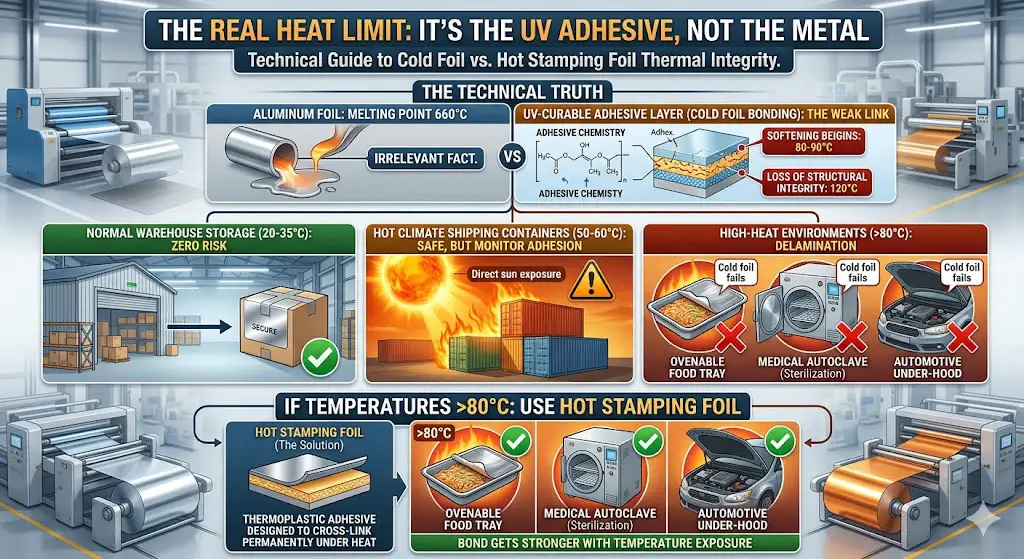
If your package needs to survive temperatures above 80°C — think ovenable food trays, sterilized medical packaging, or automotive under-hood labels — cold foil is the wrong technology. You need hot stamping foil, where the thermoplastic adhesive is designed to cross-link permanently under heat, creating a bond that actually gets stronger with temperature exposure.
The "Which Side Goes Up?" Myth (And What It Teaches Us About Foil Physics)
Another massively searched question is: “Which side of aluminum foil should face up?”
For kitchen foil, it genuinely doesn’t matter. The shiny side and matte side are simply a result of the milling process — two sheets are rolled simultaneously, and the sides that touch each other come out matte. There’s less than 2°C difference in heat reflection between the two sides.
But for industrial cold foil, “which side” matters enormously. The metallic layer faces the substrate, and the lacquer layer faces outward. If your press operator mounts the roll backwards, the foil won’t transfer at all — the UV adhesive can’t bond to the PET carrier side. We see this mistake at least once a month from operators new to cold foil printing.
Does Foil Leach into Food? The Industrial Packaging Answer
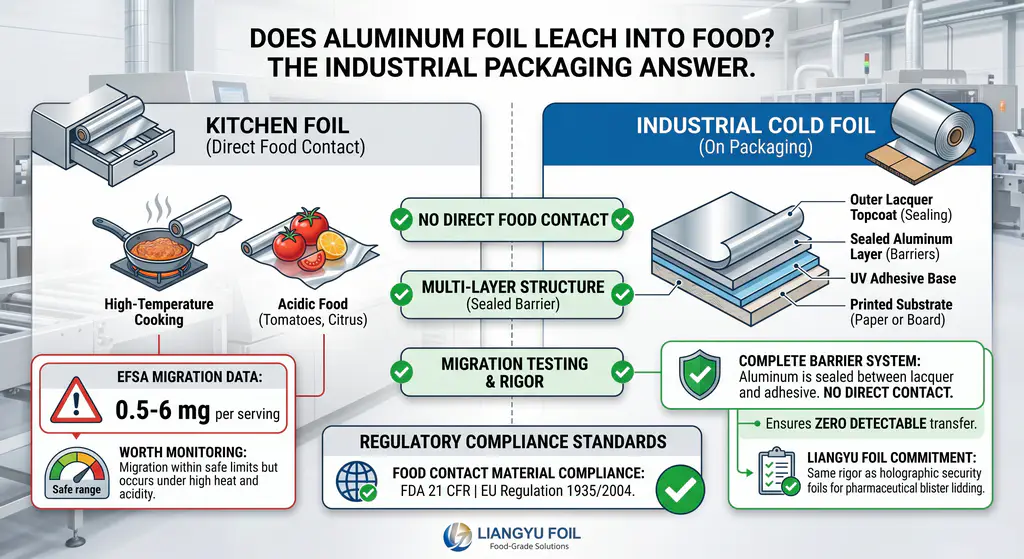
“Does aluminum foil leach into food when heated?” — this question terrifies food brand managers, and rightly so.
For cold foil on printed packaging, the situation is completely different:
- The aluminum layer is sealed between a lacquer topcoat and a UV adhesive base. It never contacts food directly.
- The printed substrate (paper or board) adds another barrier layer.
- Standard food packaging must comply with FDA 21 CFR or EU Regulation 1935/2004 for food contact materials.
At Liangyu Foil, our cold foil products for food packaging undergo migration testing to ensure zero detectable aluminum transfer through the lacquer and adhesive layers. This is the same level of rigor we apply to our holographic security foils used in pharmaceutical blister lidding.
When Cold Foil Fails: Three Real Cases from Our Lab
In the spirit of being honest — because that’s what builds trust in B2B — here are three situations where cold foil heat resistance was insufficient, and we had to redirect the client:
- Ovenable Pizza Box (Italy): Client wanted gold cold foil branding on a pizza box that goes into a 220°C oven. The foil vaporized. We switched them to a high-temperature hot stamping foil with ceramic-reinforced adhesive.
- Automotive Warning Label (South Korea): Label needed to survive under-hood temperatures of 150°C. Cold foil delaminated in 72 hours. Solution: specialized silicone-based hot stamping foil.
- Coffee Bag Valve Label (Brazil): The bag passes through a heat-sealing tunnel at 110°C. Cold foil softened and smeared. We reformulated the UV adhesive to a higher-Tg (glass transition temperature) variant — Tg of 95°C vs. standard 70°C — and the problem was solved.
That third case is important: sometimes the answer isn’t “abandon cold foil” — it’s “upgrade the adhesive chemistry.”
The Decision Framework: Heat + Foil Type
Stop guessing. Use this chart:
| Application Temperature | Recommended Foil Type | Why |
|---|---|---|
| Below 60°C | Cold Foil ✅ | Standard UV adhesive performs perfectly |
| 60-90°C | Cold Foil (High-Tg adhesive) ⚠️ | Requires upgraded adhesive formulation |
| 90-150°C | Hot Stamping Foil ✅ | Thermoplastic bond strengthens with heat |
| Above 150°C | Specialty Ceramic/Silicone Foil | Custom engineering required |
Real-World Applications We've Delivered
In 2025, our team completed foil stamping on leather projects for:
- A Dubai-based luxury notebook brand that needed rose gold foil on full-grain Italian leather covers—we solved their peeling issue by adjusting the release force from 25g to 18g.
- A Turkish handbag manufacturer requiring holographic security foil on PU leather tags—anti-counterfeiting meets fashion.
- An automotive parts supplier in Germany needing consistent black foil on bonded leather dashboard panels—48-hour adhesion testing under 80°C heat cycling was required.
Conclusion: Know the Limits, Choose the Right Tool
Cold foil heat resistance is not a weakness — it’s a boundary. Every material has one. The problem isn’t cold foil; the problem is using cold foil in an application it was never designed for.
FAQ: From the Leather Stamping Lab
Can I use cold foil on candle labels?
Proceed with caution. If the candle surface reaches 70°C+ during burning, the label foil near the flame zone may soften. Use hot stamping foil for labels positioned close to the wick.
Does cold foil turn yellow with heat exposure?
The aluminum won’t yellow, but the lacquer layer can. Prolonged exposure above 60°C to UV light and heat causes nitrocellulose-based lacquers to amber. Our newer acrylic lacquer formulations resist yellowing up to 80°C.
Is cold foil food safe for direct contact?
Know the Limits, Choose the Right Tool
Cold foil heat resistance is not a weakness — it’s a boundary. Every material has one. The problem isn’t cold foil; the problem is using cold foil in an application it was never designed for.