Knowledge Base • 15 Min Read
What is Hot Foil Stamping? It's Not "Heat + Pressure." It's a 5-Layer Chain Reaction.
Table of Contents
The Definition Everyone Gets Wrong
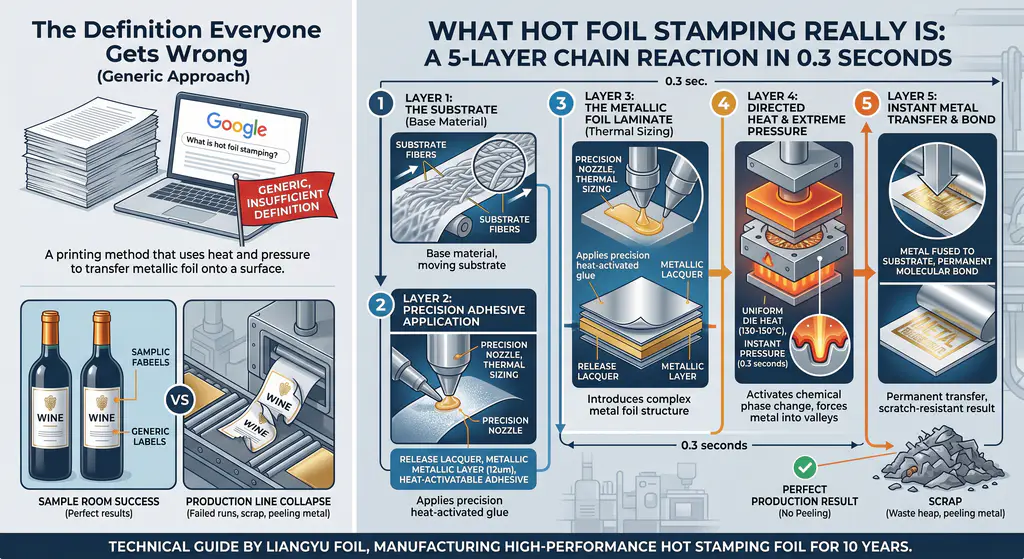
Ask Google “What is hot foil stamping?” and you’ll get a hundred versions of the same sentence: “A printing method that uses heat and pressure to transfer metallic foil onto a surface.”
That’s technically correct. It’s also completely useless if you’re a packaging buyer trying to understand why your foiled wine labels looked perfect in the sample room but fell apart on the production line.
At Liangyu Foil, we’ve been manufacturing hot stamping foil for a decade. We don’t describe the process as “heat and pressure.” We describe it as a 5-layer chain reaction that happens in 0.3 seconds — and if any single layer is wrong, your entire run is scrap.
The 5 Layers: What Hot Stamping Foil is Actually Made Of
Before you understand what hot foil stamping is, you need to understand what’s on that roll of foil. It’s not “gold paper.” It’s a precision-engineered film with five distinct functional layers:
The Layer Structure (This Is Where the Magic Happens):
| Layer | Material | Thickness | What It Does |
|---|---|---|---|
| 1. Carrier | PET (Polyester Film) | 12 – 16 μm | The “backbone” — carries all other layers through the machine |
| 2. Release Coat | Wax / Silicone Blend | 0.5 – 1 μm | Allows the decorative layers to separate from the carrier when heated |
| 3. Lacquer Layer | Nitrocellulose or Acrylic | 1 – 2 μm | Provides color, gloss, and scratch protection |
| 4. Metal Layer | Vacuum-deposited Aluminum | 0.04 μm | The “mirror” — this is what creates the metallic shine |
| 5. Adhesive Layer | Thermoplastic Hot-Melt Resin | 1 – 3 μm | Bonds the foil to your substrate when heat-activated |
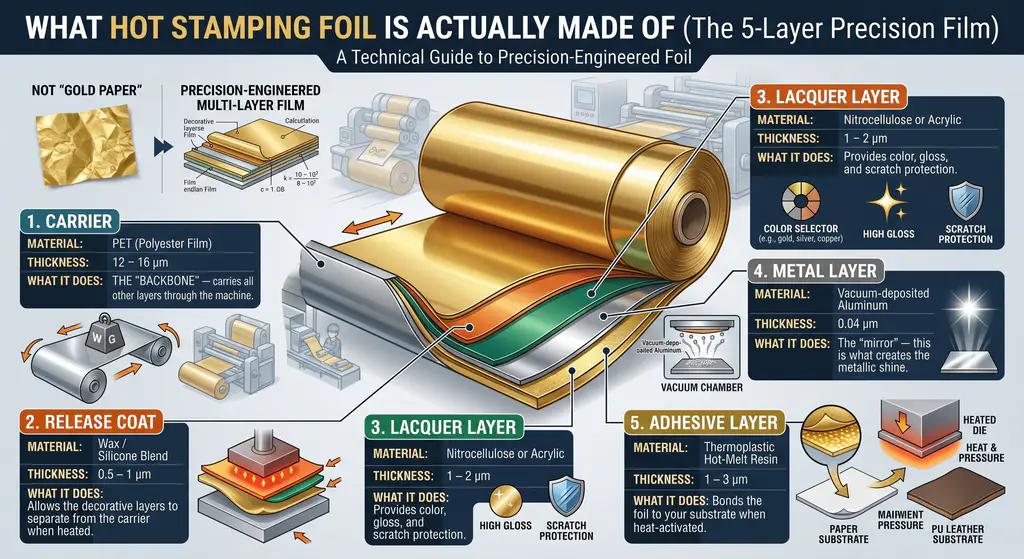
That’s what hot foil stamping is. Not “heat and pressure.” A controlled delamination of five chemically distinct layers.
Is Hot Foil Stamping Permanent?
One of the most searched sub-questions is: “Is hot foiling permanent?”
The short answer: yes, if done correctly. The thermoplastic adhesive (Layer 5) physically fuses with the substrate fibers. Unlike a sticker or a printed ink that sits on top, hot stamping foil becomes part of the surface.
But “permanent” has limits:
- On coated paper: Virtually indestructible. You’d tear the paper before the foil lifts.
- On uncoated / recycled board: Permanent under normal conditions, but aggressive rubbing or moisture can weaken the bond if your adhesive formulation isn’t tuned for low-surface energy substrates.
- On plastics (PP, PE): Requires a corona-treated surface. Without corona treatment, the adhesive has nothing to grip, and the foil will peel off within days.
At our 25,000m² facility, we run the 3M tape test on every foil formulation before shipping. If the foil comes off with the tape, we reformulate the adhesive. No exceptions.
What Materials Can Be Hot Foil Stamped?
The answer is: almost anything — but each material demands a different foil.
| Material | Foil Type Required | Key Challenge |
|---|---|---|
| Coated Paper / Board | Standard hot stamping foil | None — the easiest substrate |
| Uncoated / Textured Paper | “High-Grab” adhesive foil | Low surface energy, fiber absorption |
| Genuine Leather | Low-temp foil (85-95°C) | Natural oils block adhesion, burns easily |
| PVC / Acrylic Plastic | Plastics-grade foil | Requires corona treatment |
| Fabric / Ribbon | Textile-grade foil | Fibers trap air, causing pinholing |
| Wood / MDF | High-pressure foil | Porous, uneven surface |
What Equipment is Needed for Hot Foiling?
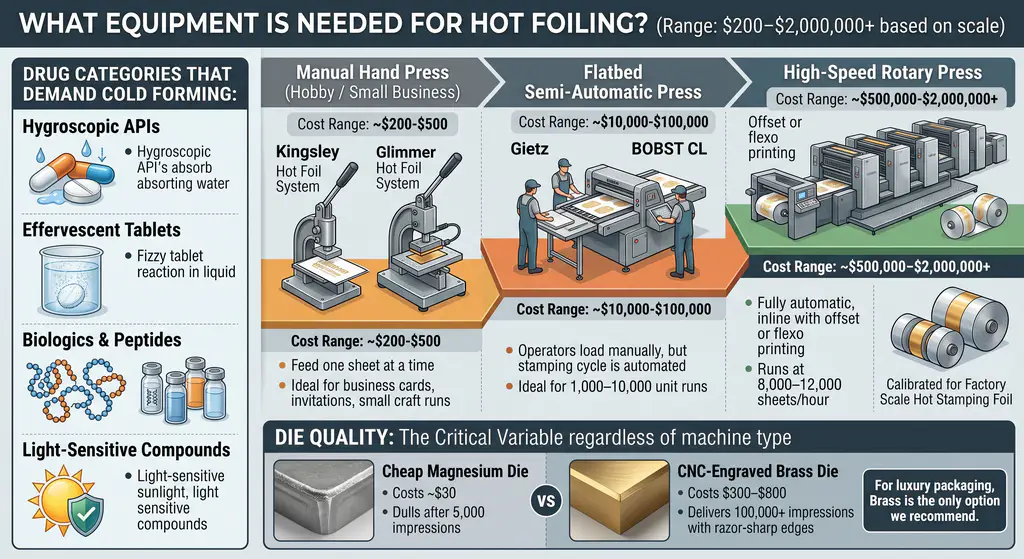
Another heavily searched question. The equipment ranges from $200 to $2,000,000 depending on your scale:
- Manual Hand Press (Hobby / Small Business): Machines like the Kingsley or Glimmer Hot Foil System. Feed one sheet at a time. Perfect for business cards, invitations, and small craft runs.
- Flatbed Semi-Automatic Press: Machines from Gietz or BOBST CL. Operators load sheets manually, but the stamping cycle is automated. Ideal for 1,000–10,000 unit runs.
- High-Speed Rotary Press: Fully automatic, inline with offset or flexo printing. Runs at 8,000–12,000 sheets/hour. This is what we calibrate our hot stamping foil for at factory scale.
Regardless of machine type, the critical variable is die quality. A cheap magnesium die costs $30 but dulls after 5,000 impressions. A CNC-engraved brass die costs $300–$800 but delivers 100,000+ impressions with razor-sharp edges. For luxury packaging, brass is the only option we recommend.
Hot Foil Stamping vs. Cold Foil Stamping: The Real Difference
- Hot foil uses heat + a physical die. It creates a tactile, embossed-like finish. It’s slower but produces luxury-grade results.
- Cold foil uses UV adhesive + no heat. It runs inline at high speed. It’s flat (no tactile depth) but cost-effective for large label runs.
The mistake most people make is treating them as competitors. They’re not. They solve different problems. A premium Champagne house will always use hot foil. A beverage company printing 500,000 water bottle labels will always use cold foil. The smart operators use both — cold foil for the background, hot foil for the logo.
Is Hot Foil Stamping Better Than Screen Print or Heat Transfer?
Another sub-question from the search data. The answer depends on what you value:
- Screen Print: Cheaper for flat, non-metallic designs. But it can’t produce a true mirror-finish metallic effect. If your design just needs gold color (not gold shine), screen print works. If you need the reflective, luxury look, only foil delivers.
- Heat Transfer: Uses a pre-printed decal applied with heat and pressure. Good for multi-color photographic designs on plastics, but the transferred film sits on top of the surface and can peel over time. Hot foil stamping physically fuses with the substrate — it’s more durable and feels more “built-in.”
FAQ: The Questions Behind the Question
What are the disadvantages of hot foiling?
Is hot foil stamping easy to learn?
The basics — yes. A manual press can be operated in 30 minutes. But mastering make-ready (die leveling, temperature calibration, pressure adjustment) takes years. The difference between a hobbyist and a professional is in the make-ready.
Can you hot stamp at home?
Yes, with a Glimmer or Kingsley machine and a desktop foil roll. But home-grade foils are thinner (10μm carrier) and have limited color options compared to industrial-grade hot stamping foils.
Does it matter if foil is shiny side up or down?
Absolutely. The adhesive layer (Layer 5) must face the substrate. If the roll is mounted backwards, no transfer will occur. Always check the winding direction label on the roll.
It's Not About "What." It's About "How Well."
Now you know what hot foil stamping is — a 5-layer delamination reaction driven by precisely calibrated heat, pressure, and dwell time. But knowing the definition doesn’t protect you from bad results. The foil’s internal chemistry, the die’s edge quality, and the substrate’s surface energy all need to align.