Knowledge Base • 8 Min Read
Digital Foil vs. Traditional Hot Foil: 180% Search Surge? Here’s the "Unfiltered" Factory Truth
Table of Contents
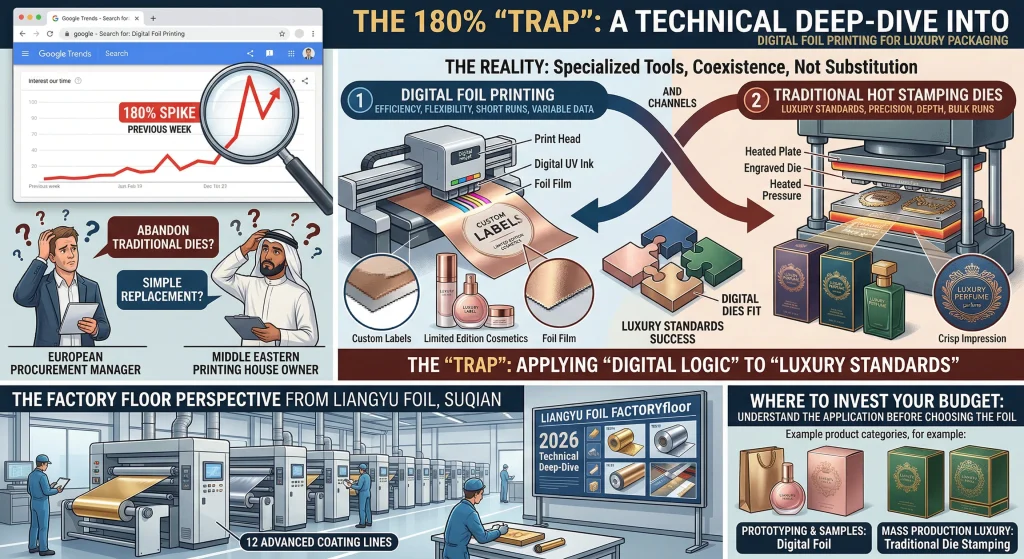
The 180% "Trap": Why Everyone is Searching, but Few are Succeeding
Last week, Google Trends reported a staggering 180% spike in searches for “Digital Foil Printing.” If you’re a procurement manager for a luxury cosmetic brand or a high-end printing house in Europe or the Middle East, this might look like a signal to abandon your traditional stamping dies.
In this 2026 technical deep-dive, we’re cutting through the marketing fluff to show you exactly where to invest your budget.
The "Mechanical Soul" of Traditional Hot Stamping
Traditional hot stamping isn’t just “old school”—it’s a matter of physics. It relies on a heated brass or magnesium die (often at 110°C – 130°C) to physically shear the foil from its PET carrier.
Why the “Big Brands” Still Demand It:
- The “Sharpness” Obsession: For a Chanel or Hennessy logo, the edge crispness must be absolute. Because a metal die has a physical edge, the hot stamping foil for luxury packaging is cut with razor-like precision.
- Tactile Depth (The “Heavy” Feel): Digital foil is flat. Traditional stamping creates a micro-debossing effect. When a consumer runs their finger over a premium wine label, that 0.1mm indentation is what signals “Expensive.”
- Substrate Versatility: If you are stamping on textured matte pigment paper or genuine leather, digital foil will almost always fail to “bite.” Traditional dies provide the brute force needed to drive the foil into the fibers.
Digital Foil: The King of "Agile" Branding
So, why the 180% search surge? Because the market has shifted to Limited Editions and Personalization.
Digital foil (also known as Sleeking or Toner Reactive Foil) skips the die entirely. It adheres to the carbon toner or UV varnish printed by machines like MGI, Scodix, or Konica Minolta.
The “Money-Maker” Scenarios:
- Zero Die Costs: If your project only requires 200 luxury gift boxes for a VIP event, spending $300 on a CNC-engraved brass die is suicide for your margins. Digital foil makes short-run customization profitable.
- Variable Data (VDP): You can foil a unique serial number or the customer’s name on every single unit. This is the “Holy Grail” of modern anti-counterfeiting and high-end gifting.
- Speed to Market: From PDF to foiled sample in 15 minutes. No waiting for a die-maker to ship a plate from another city.
The Expert Comparison: Technical Specs You Won't Find in Brochures
In this Digital Foil vs. Traditional Hot Foil technical comparison, we examine Choosing the right technique depends on your specific project. Here is a quick comparison to help you decide:
| Technical Variable | Traditional Hot Foil (Liangyu Series) | Digital Foil (Toner-Reactive) |
|---|---|---|
| Adhesive Chemistry | Heat-activated (Hot Melt) | Toner-affinity (Acrylic-based) |
| Standard Thickness | 12 - 16 Microns | 10 - 12 Microns (Thinner for bonding) |
| Release Force | Customizable (Easy to Tight) | Fixed (Must be "Ultra-Easy") |
| Max Speed | 8,000 - 12,000 sheets/hr | Limited by digital engine speed |
| Pinholing Risk | Low (Physical pressure fills gaps) | High (Toner density must be 100%) |
The "Catch": Why Digital Foil Often Disappoints Technical Managers
Manufacturing Infrastructure: Beyond the PET Film
When choosing a partner, don’t just look at the foil—look at the facility. Why does Liangyu Foil maintain a total investment of 100 million yuan?
- Consistency via RTO: We use Regenerative Thermal Oxidizing (RTO) furnaces. While this is great for the environment, its technical purpose is to maintain a perfect, stable environment for our 12 coating lines. Unstable temperatures lead to unstable foil release.
- The 20-Person Tech Team: We don’t just “sell” rolls; we solve application problems. If your foil is flaking on a specific UV varnish, our lab adjusts the foil formulation to match your chemistry.
Conclusion: The Decision Matrix
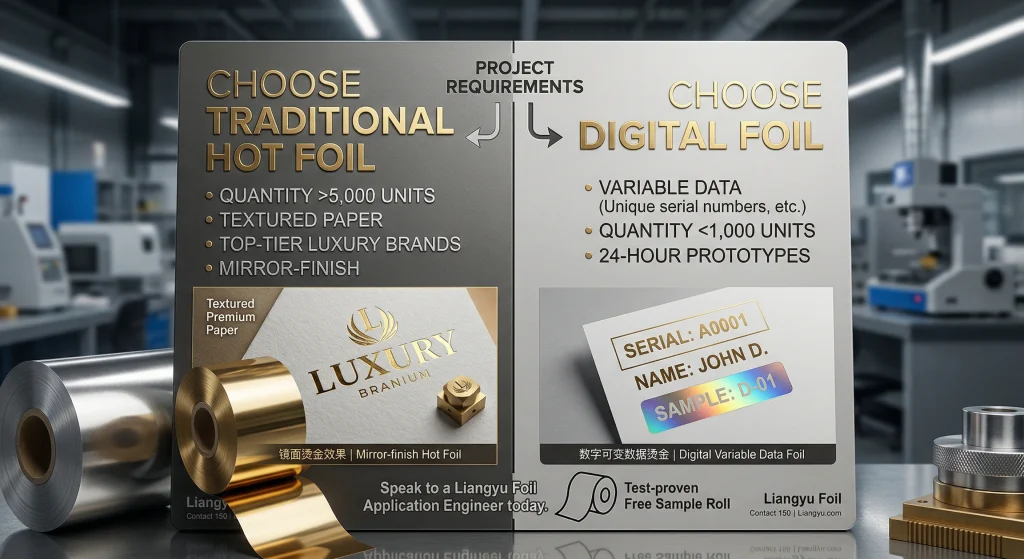
So, Digital or Traditional? Here is the Liangyu Foil “Rule of Thumb”:
- Choose Traditional Hot Foil if: Your run is >5,000 units, you’re using textured paper, or you’re working for a Top-Tier luxury brand where “Mirror-finish” is the only acceptable result. Check our Luxury Packaging Series.
- Choose Digital Foil if: You have variable data, your run is <1,000 units, or you need a 24-hour turnaround for prototypes. Explore our Digital Customization solutions.
Still undecided? Don’t guess. Speak to a Liangyu Foil Application Engineer today. We’ll send you a Free Sample Roll tested for your specific machine and substrate.
Ready to test it on your machines?
As a leading manufacturer, we provide free sample rolls engineered to your specific press and adhesive requirements.