Knowledge Base • 15 Min Read
Hot Stamping Foil Not Transferring? 5 Fixes That Actually Work
Table of Contents
Last week, a print shop owner in Chicago sent me photos of a luxury wine label job that was bleeding money. The gold foil kept leaving patchy, incomplete transfers on the textured paper stock. They had already wasted $800 in foil and three days of press time. The deadline was 48 hours away.
“We’ve tried everything,” he told me. “Higher temperature, more pressure, longer dwell time. Nothing works.”
I asked one question: “What temperature is your die actually reaching, and how are you measuring it?”
Silence. Then: “We’re going by the machine’s digital readout.”
This scenario plays out constantly. In 15 years of manufacturing hot stamping foil for print shops across 40 countries, I’ve learned that “foil not transferring” almost always traces back to one of five root causes. Here’s how to diagnose and fix each one.
The Temperature Lie: Why Your Machine Display Can't Be Trusted
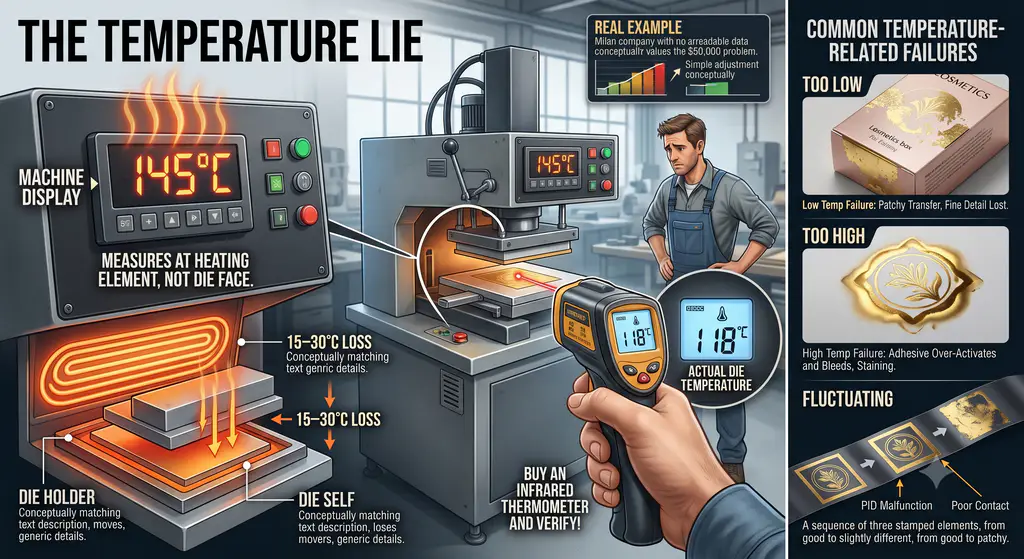
Most hot foil stamping machines measure temperature at the heating element, not at the die face. By the time heat travels through the die holder and the die itself, you can lose 15–30°C.
Here’s what I tell every customer: buy an infrared thermometer and verify your die surface temperature. They’re $30 on Amazon. Point it at the die face right before stamping. If the reading doesn’t match your foil’s recommended activation temperature (usually 110–160°C depending on the grade), you found your problem.
Common temperature-related failures:
- Too low: Foil release layer doesn’t activate. Result: patchy transfer, foil pulls away with the carrier.
- Too high: Adhesive over-activates and bleeds. Result: halo effect, background staining, fine detail lost.
- Fluctuating: PID controller malfunction or poor thermocouple contact. Result: inconsistent transfer across the run.
Pressure Distribution: The Hidden Variable
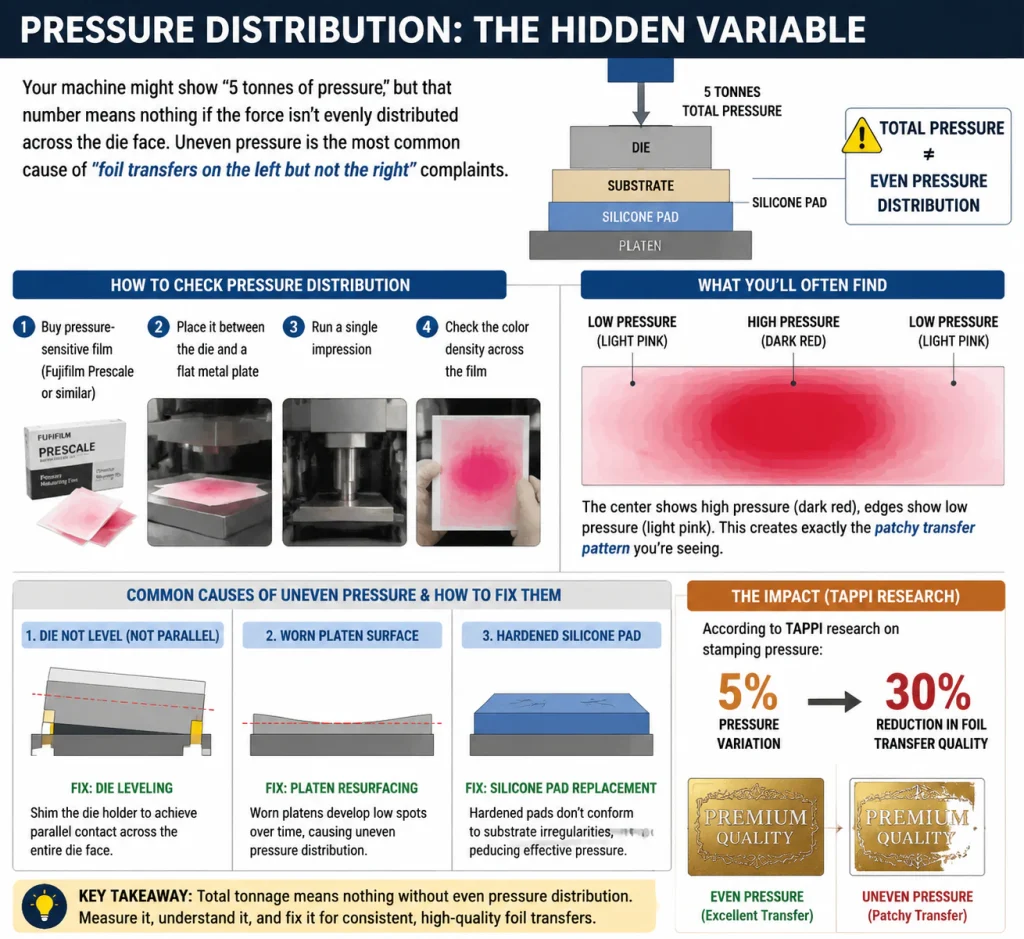
Your machine might show “5 tonnes of pressure,” but that number means nothing if the force isn’t evenly distributed across the die face. Uneven pressure is the most common cause of “foil transfers on the left but not the right” complaints.
How to check pressure distribution:
- Buy pressure-sensitive film (Fujifilm Prescale or similar)
- Place it between the die and a flat metal plate
- Run a single impression
- Check the color density across the film
What you’ll often find: the center shows high pressure (dark red), edges show low pressure (light pink). This creates exactly the patchy transfer pattern you’re seeing.
Fixes:
- Die leveling: Shim the die holder to achieve parallel contact
- Platen resurfacing: Worn platens develop low spots
- Silicone pad replacement: Hardened pads don’t conform to substrate irregularities
Dwell Time: The 0.3-Second Difference
Dwell time is how long the heated die maintains contact with the foil and substrate. Too short, and the adhesive doesn’t fully flow. Too long, and you scorch the substrate or cause over-adhesion.
The frustrating part: the “right” dwell time varies by substrate, foil grade, and even ambient humidity. But most operators never test it. They run whatever the machine was set to last week.
Here’s the testing method we use in our applications lab:
- Start with 1.0 second dwell time
- Run 10 impressions, inspect under 10x magnification
- Reduce dwell by 0.1 seconds, run 10 more
- Continue until you see incomplete transfer
- Back off 0.2 seconds from that failure point
What we typically find: the optimal dwell time is 0.3–0.5 seconds shorter than what operators assume. They’re wasting cycle time and increasing substrate damage risk.
| Holographic Type | Visual Effect | Best For | Cost Level |
|---|---|---|---|
| Rainbow / Diffraction | Full spectrum color shift | General premium packaging, seasonal products | $ |
| Silver/Gold Dot Pattern | Subtle shimmer, metallic base | Cosmetics, understated luxury | $ |
| 3D Depth Hologram | Apparent 3D depth, floating images | Security applications, high-value products | $$$ |
| Custom Registered Hologram | Logo or image appears at specific angle | Brand authentication, limited editions | $$$$ |
| Micron Text / Micro-pattern | Tiny text visible only under magnification | Anti-counterfeiting, government documents | $$$ |
| True Color Hologram | Full color image (not just metallic) | High-end collectibles, commemorative packaging | $$$$ |
Substrate Sabotage: When Your Paper Fights Back
Not all paper is created equal. The same foil that transfers perfectly on coated art paper might fail completely on uncoated kraft or recycled board. The culprit is surface energy and moisture content.
Here’s a quick substrate compatibility guide:
| Substrate Type | Recommended Temp | Pressure | Dwell Time | Common Issues |
|---|---|---|---|---|
| Coated art paper (250-350gsm) | 110-130°C | Medium | 0.8-1.2s | Easy, baseline standard |
| Uncoated kraft paper | 130-155°C | High | 1.2-2.0s | High heat needed, test first |
| Recycled cardboard | 125-150°C | High | 1.5-2.5s | Uneven surface, variable results |
| PVC/PET plastic film | 140-170°C | Medium | 0.5-1.0s | Heat-sensitive, risk of distortion |
| Textured/embossed paper | 135-160°C | Very High | 1.5-3.0s | Peaks and valleys, incomplete contact |
The Expired Foil Problem Nobody Checks
Hot stamping foil has a shelf life. The release layer and adhesive degrade over time, especially if stored in humid or high-temperature conditions. I’ve seen print shops struggle with foil that was manufactured 18 months ago and stored in a non-climate-controlled warehouse.
Signs your foil has expired:
- Foil releases from carrier inconsistently (some areas transfer, others don’t)
- Metallic appearance looks dull or oxidized
- Adhesive requires 20%+ higher temperature than spec sheet indicates
- Background staining increases even at normal settings
Storage guidelines:
- Temperature: 15-25°C (59-77°F)
- Humidity: 40-60% RH
- Keep away from direct sunlight
- Use FIFO (first in, first out) inventory rotation
- Shelf life: typically 12-18 months from manufacture date
Check the batch code on your foil rolls. If it’s older than 12 months and you’ve been having transfer problems, try a fresh roll before adjusting your machine.
Quick Troubleshooting Reference
When foil won’t transfer, run through this diagnostic sequence:
| Symptom | Most Likely Cause | Quick Test | Fix |
|---|---|---|---|
| Patchy transfer, random spots missing | Temperature too low or fluctuating | IR thermometer on die face | Increase temp 10°C, verify with thermometer |
| Left side transfers, right side doesn’t | Uneven pressure distribution | Pressure-sensitive film test | Level die, replace silicone pad |
| Fine detail lost, edges bleeding | Temperature too high or dwell too long | Reduce temp 5°C, test again | Lower temp or reduce dwell 0.2s |
| Halo effect around stamped area | Over-activation of adhesive | Check dwell time setting | Reduce dwell time, verify temp not too high |
| Foil pulls away with carrier | Temperature too low or pressure too low | Verify both temp and pressure | Increase temp 15°C or pressure 20% |
| Works on some sheets, fails on others | Substrate variation or expired foil | Test fresh foil roll | Replace foil, check substrate batch consistency |
When You've Tried Everything
FAQ: Foil Transfer Problems
Can humidity affect foil transfer?
Yes. High humidity (>70% RH) can cause the foil carrier to absorb moisture, changing release characteristics. It can also affect paper substrates. If you’re in a humid climate, consider climate-controlled storage and production areas.
Why does foil transfer perfectly on flat areas but fail on raised embossing?
Can I use the same foil on plastic and paper?
Sometimes, but rarely optimally. Plastic and paper have different surface energies and thermal properties. Foil formulated for paper often fails on plastic, and vice versa. If you must use one foil for both, test extensively and accept compromises in quality.
How do I know if my problem is the foil or the machine?
The fastest test: try a different foil roll (different brand or batch) on the same substrate with the same settings. If the problem persists, it’s machine/settings. If it fixes, it was the foil.
What's the most commonly overlooked cause of foil transfer failure?
Die temperature verification. Everyone trusts the machine display. Almost nobody verifies with an IR thermometer. That $30 tool solves 40% of “mysterious” foil problems.
Related guides:
📞 Contact our technical team → — Quote turnaround in 24 hours.
Still Struggling with Foil Transfer Issues?
Hot stamping foil problems can cost you thousands in wasted materials and missed deadlines. The good news: 90% of transfer issues are solved with the right foil grade and proper machine settings.