By Liangyu Laser Technical Team | 18-min read
Holographic Cold Foil: Process, Specs, Cost, and Buyer Guide
Table of Contents
- 1. How Does Holographic Cold Foil Work?
- 2. How Should Designers Prepare Artwork for Holographic Cold Foil?
- 3. How Should Designers Prepare Artwork for Holographic Cold Foil?
- 4. Cost, MOQ, Lead Time, and Cold vs Hot Foil
- 5. Supplier Selection Checklist
- 6. Is Holographic Cold Foil Recyclable or Sustainable?
- 7. Security Features and Practical Applications
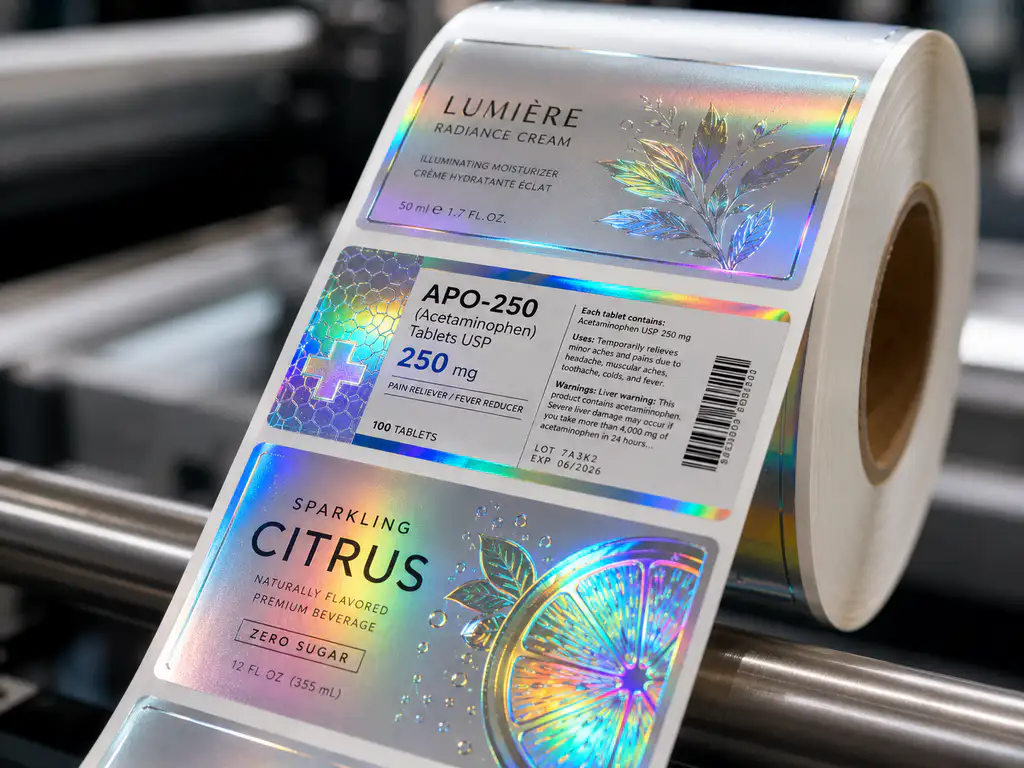
Holographic cold foil is a cold foil transfer material with a micro-embossed holographic pattern. It is applied with UV-curable adhesive, pressure, and UV curing instead of heated metal dies. It is useful for premium labels, retail cartons, pharmaceutical packaging, security seals, promotional cards, and high-speed narrow-web packaging lines that need metallic motion effects.
For buyers, the key question is not only “does it shine?” The right holographic cold foil must match the press, adhesive, substrate, curing system, artwork detail, overprint plan, durability requirement, and compliance expectations. A beautiful sample can still fail if the adhesive does not cure through dense ink, if the pattern reduces barcode readability, or if the foil layer interferes with downstream lamination.
How Does Holographic Cold Foil Work?
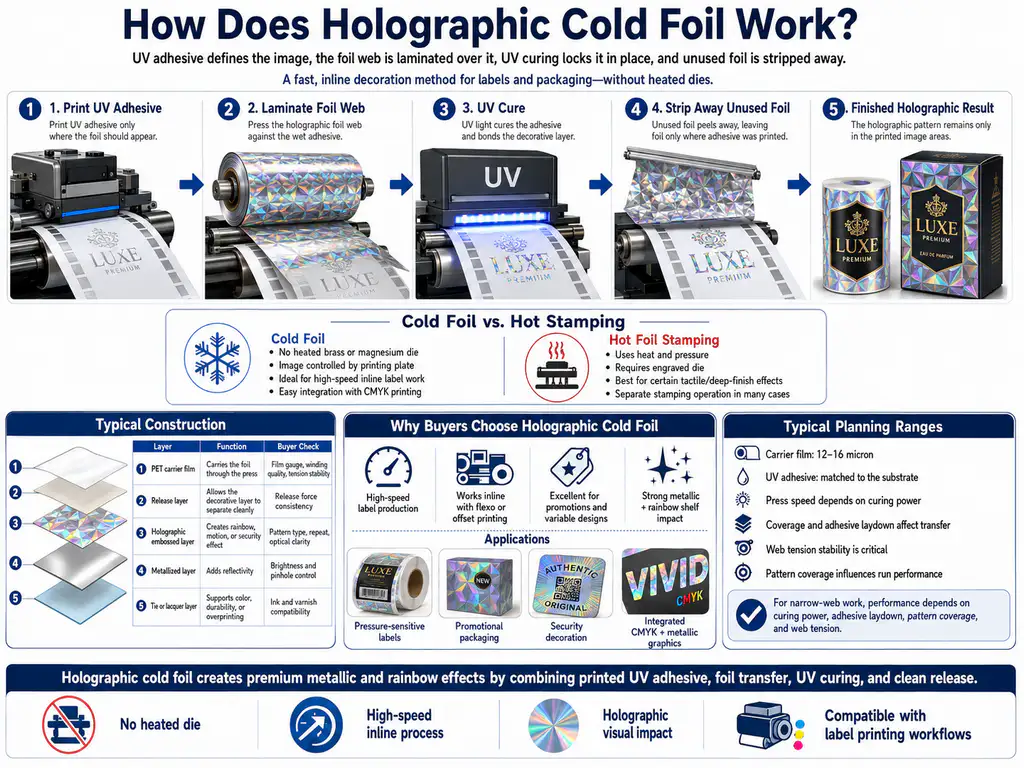
Holographic cold foil works by printing a UV adhesive in the areas where the foil should appear, laminating the foil web against the wet adhesive, curing the adhesive with UV light, and stripping away unused foil. The holographic pattern stays only where the adhesive was printed.
Unlike hot foil stamping, cold foil does not use a heated brass or magnesium die. The image is controlled by a printing plate, usually on a flexographic or offset press. This makes it attractive for high-speed label work, variable promotional packaging, and designs that need metallic areas integrated with CMYK printing.
Typical construction includes:
| Layer | Function | Buyer Check |
|---|---|---|
| PET carrier film | Carries the foil through the press | Film gauge, winding quality, tension stability |
| Release layer | Allows the decorative layer to separate cleanly | Release force consistency |
| Holographic embossed layer | Creates rainbow, motion, or security effect | Pattern type, repeat, optical clarity |
| Metallized layer | Adds reflectivity | Brightness and pinhole control |
| Tie or lacquer layer | Supports color, durability, or overprinting | Ink and varnish compatibility |
How Does Foil Printing Work on Labels and Packaging?
Ask the supplier for a datasheet that includes:
| Datasheet Item | Why It Matters |
|---|---|
| Foil grade and pattern code | Avoids substituting a similar but different holographic effect |
| Carrier thickness | Affects web handling and tension |
| Release value | Helps predict clean transfer and edge definition |
| Recommended adhesive type | Prevents weak bonding or curing problems |
| Compatible substrates | Paper, PP, PET, PE, laminated board, or synthetic label stock |
| Overprint compatibility | Needed for CMYK, spot color, varnish, or coating |
| Rub and tape test results | Confirms durability after finishing |
| Food or child-product use notes | Helps U.S. buyers screen compliance risk |
How Should Designers Prepare Artwork for Holographic Cold Foil?
Artwork for holographic cold foil should be built as a separate foil layer with clear vector shapes, realistic minimum line widths, controlled knockouts, and registration tolerance for foil, ink, varnish, die cutting, and finishing.
Designers should not treat holographic foil as a normal ink channel. It reflects light, changes color by viewing angle, and can reduce readability when used behind small text or dense graphics.
| Artwork Detail | Recommended Practice |
|---|---|
| Foil layer | Supply as a separate named spot color or vector layer |
| Fine lines | Test below 0.15-0.20 mm before production |
| Reverse type | Avoid tiny knockout text inside holographic areas |
| Barcodes and QR codes | Keep clear of strong holographic interference |
| White ink or spot color | Use when foil needs controlled color under or over print |
| Die cutting | Allow registration margin between foil edge and cut line |
| Varnish | Test matte, gloss, UV, and water-based varnish over the foil |
Press compatibility is equally important. Holographic cold foil usually performs best on presses with stable web tension, controlled UV output, correct nip pressure, and adhesive units that can lay down a clean, even film. Poor adhesive leveling often shows up as broken edges, dull shine, or weak transfer in large solid areas.
How Should Designers Prepare Artwork for Holographic Cold Foil?
The best holographic cold foil pattern depends on the product category, viewing distance, retail lighting, and whether the foil is decorative, security-focused, or both. Small labels need controlled movement. Large cartons can handle stronger patterns.
| Pattern Type | Visual Effect | Best Use |
|---|---|---|
| Rainbow diffraction | Strong color shift and shelf impact | Promotions, cosmetics, beverage labels |
| Radial burst | Light moves from a center point | Seals, logos, limited editions |
| Star or sparkle | Small points of reflected light | Beauty, gift packaging, novelty labels |
| Grid or lens pattern | Technical, controlled, structured | Electronics, supplements, security labels |
| Motion stripe | Directional movement as the pack turns | Retail cartons, event tickets |
| Custom security pattern | Hidden text, microtext, logo repeats | Authentication and anti-counterfeit packaging |
For pharma labels, food packaging, and high-end retail boxes, test the final stacking order: substrate, adhesive, holographic cold foil, ink, varnish, lamination, and die cutting. A pattern that looks perfect before coating may become too muted or too busy after finishing.
Cost, MOQ, Lead Time, and Cold vs Hot Foil
Holographic cold foil cost depends on foil grade, holographic pattern, adhesive system, substrate, roll width, order quantity, press setup, waste allowance, shipping, and any custom security work. Custom patterns cost more than standard rainbow or sparkle patterns because they require pattern development and tighter quality control.
| Cost Driver | Lower-Cost Scenario | Higher-Cost Scenario |
|---|---|---|
| Pattern | Standard rainbow or generic pattern | Custom logo, microtext, registered security image |
| Coverage | Small logo or stripe | Large solid area or full background |
| Substrate | Coated paper label stock | Difficult film, soft-touch, or low-energy plastic |
| Press setup | Existing cold foil line | Trial setup, adhesive changes, extra curing tests |
| Finishing | No overprint or simple varnish | Lamination, spot UV, die cut, scratch testing |
| Order size | Standard stock roll | Narrow custom slit width or low-volume special order |
Typical lead time is shortest for stock patterns and standard widths. Custom holographic or security projects may need artwork review, optical pattern approval, lab sampling, press trial, and final production. U.S. buyers should ask whether the supplier can provide retained samples, lot traceability, and repeatable pattern codes for future reorders.
Supplier Selection Checklist
Before ordering holographic cold foil, ask:
- Can the supplier provide the exact pattern code and retained master sample?
- Has the foil been tested with your adhesive, substrate, ink, and varnish?
- Are rub, tape, scratch, and curing tests available?
- Can the supplier slit to your roll width and winding direction?
- Is batch traceability available?
- Can they support U.S. food, child-product, or retail compliance questions when relevant?
- Are MOQ, lead time, freight terms, and replacement policy clearly stated?
Is Holographic Cold Foil Recyclable or Sustainable?
Holographic cold foil can be used in more sustainable packaging programs, but recyclability depends on the whole package: substrate, adhesive, ink, coating, foil coverage, label construction, and the recycling stream. A foil effect alone does not make a package recyclable or unrecyclable.
Practical ways to reduce recycling risk:
| Design Choice | Why It Helps |
|---|---|
| Use foil as an accent, not full coverage | Reduces decorative load |
| Test label adhesive compatibility | Helps avoid residue in recycling |
| Avoid unsupported recyclable claims | Reduces greenwashing risk |
| Keep material records | Helps brands answer retailer audits |
| Request third-party or lab test data when needed | Supports procurement and compliance review |
Security Features and Practical Applications
Holographic cold foil is useful when packaging needs both decoration and authentication. It can create visible motion, hidden text, custom logo repeats, serialized seals, and optical effects that are harder to copy than ordinary metallic ink.
Common applications include:
| Application | Why It Fits |
|---|---|
| Pharmaceutical labels | Tamper evidence, authentication, high shelf trust |
| Food and beverage labels | Premium shelf impact and promotional editions |
| Cosmetic cartons | Rainbow movement, luxury perception, social media appeal |
| Gift boxes | High visual value without a separate hot stamping pass |
| Promotional cards | Eye-catching motion and limited-edition feel |
| Retail security seals | Custom patterns, microtext, difficult-to-scan effects |
For labels that need durability, pair the foil trial with real-use testing: rub under dry and damp conditions, cold-chain exposure, alcohol wipe, carton abrasion, and barcode scanning after varnish. If removability matters, remember that peel behavior depends more on adhesive, substrate, and finishing construction than on the word “cold” or “hot.” A well-bonded cold foil decoration is not meant to peel off cleanly unless the label system is designed that way.
Premium work is about consistency: the same color, shine, release, and edge quality across every label, carton, and shipment.
FAQ
How does holographic cold foil printing work compared with hot foil stamping?
Cold foil uses UV adhesive, pressure, and UV curing to transfer foil inline. Hot foil uses heat, pressure, and a metal die. Cold foil is usually faster for label production, while hot foil is often better for deep tactile luxury effects.
What are the typical technical specs for cold foil?
Buyers should request film thickness, release value, adhesive compatibility, substrate compatibility, winding direction, roll width, overprint guidance, rub resistance, and storage conditions. For holographic cold foil, the pattern code and optical effect should also be documented.
Which substrates and inks are compatible with cold foil?
Coated paper, synthetic label stock, film labels, and some laminated boards can work, but each construction needs testing. UV inks, spot colors, varnishes, and laminations should be checked for adhesion, curing, readability, and visual distortion.
How common is cold foil usage in packaging, and are holographic cold foils rare?
Cold foil is common in narrow-web label and packaging production. Holographic cold foil is more specialized than standard silver or gold cold foil, but stock patterns are available. Custom security patterns require more development time and supplier coordination.
Can holographic foil or vinyl be peeled off?
A properly transferred foil layer is designed to stay bonded. Peel behavior depends on adhesive, substrate, coating, and label construction. If removability is required, it should be specified as part of the full label system, not assumed from the foil type.
What factors most affect cost, MOQ, and lead time?
Pattern complexity, foil coverage, custom slitting, substrate difficulty, adhesive testing, order quantity, security requirements, freight, and finishing steps all affect cost and lead time. Custom holographic security patterns usually need longer approval cycles.
Related Technical Resources:
📞 Contact our technical team → — Quote turnaround in 24 hours.