Knowledge Base • 15 Min Read
Hot Foil Stamping Problems & Solutions: A Hardcore Troubleshooting Guide for Printers
Table of Contents
When the machine stops, the profit stops. Ask any packaging print shop owner, and they will tell you this is the ultimate truth.
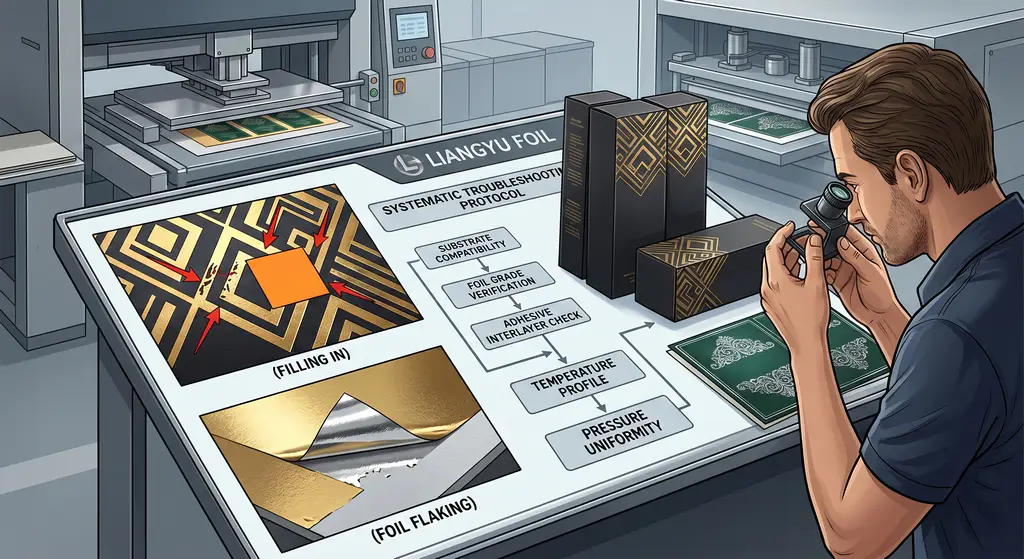
When a batch of high-end cosmetic boxes or premium wine labels experiences “filling in” or “foil flaking” on the platen press, it doesn’t just waste expensive specialty substrates—it severely delays delivery times. Many operators treat hot foil stamping like some kind of dark magic. But as a material supplier deeply rooted in the foil industry for years, we at Liangyu Foil have seen almost every “incurable” defect on the shop floor.
The truth is, 80% of hot foil stamping problems can be resolved through systematic troubleshooting. Today, we are breaking down the most common hot foil stamping defects and providing actionable, floor-ready solutions.
The Core Premise: What Temperature for Hot Foil Stamping?
Before diving into specific defects, we must answer the most frequently asked foundational question. The stability of your stamping quality is built on the “Golden Triangle of Foiling”: Temperature, Pressure, and Dwell Time.
Many beginners ask: “What exact temperature should I set my machine to?” The answer is: There is no absolute standard temperature, only the optimal temperature for your specific setup.
Generally speaking, for conventional flatbed stamping machines, the temperature ranges between 110°C to 150°C (230°F – 300°F). For high-speed rotary stamping machines where the dwell time (contact time) is incredibly short, the temperature needs to be boosted to 150°C to 210°C (300°F – 410°F).
Three key variables dictate your temperature setting:
- Foil Sizing Characteristics: Different adhesive layers (sizing) have varying melting points. Discover the optimal temperature ranges for different Liangyu Foil series here.
- Substrate Surface Tension: Laminated paper (BOPP) or surfaces coated with UV varnish typically require higher temperatures than uncoated, raw paper.
- Die Material: Brass dies conduct and retain heat excellently, magnesium dies are a step below, and silicone dies require an entirely different parameter setup.
Top 4 Hot Foil Stamping Problems & Actionable Solutions
If you are standing next to your machine tearing your hair out, find your specific symptom below and apply the fix.
1. Poor Adhesion / Flaking
Symptom: The foil doesn’t stick to the paper completely, flakes off with a light scratch, or the stamped image looks patchy and incomplete.
Diagnosis & Fixes:
- Temperature too low or Dwell time too short: The sizing (adhesive) layer hasn’t fully melted. Action: Increase the temperature incrementally by 5°C at a time, or slightly reduce the machine speed to increase dwell time.
- Insufficient Pressure: The die isn’t pushing the foil deep enough into the paper fibers. Action: Check your make-ready. Apply patch-up tape on the counter board specifically under the areas where the foil isn’t adhering.
- Material Mismatch (The Silent Killer): If you are stamping over BOPP lamination or UV inks, you must use a hot stamping foil specifically formulated for low surface energy. If you chose the wrong foil grade, no amount of machine tweaking will save you. Read our internal guide: How to Choose the Right Stamping Foil for Different Packaging Substrates.
2. Filling In / Bridging
Symptom: Fine text (like 6pt fonts) or intricate line work merges together, looking blurry or like a solid blob of gold. Diagnosis & Fixes:
Temperature too high: The heat is melting not only the adhesive under the image area but also the surrounding foil. Action: Turn the heat down! This is the most direct fix.
Pressure too high: Excessive tonnage is squishing the melted adhesive outward beyond the die’s edges. Action: Back off the overall pressure. For fine details, ensure you are using a hard make-ready material (like epoxy glass or hard pressboard); strictly avoid soft packing.
Improper Stripping Tension: The rewind tension of the waste foil web is too loose, failing to pull the carrier film away cleanly. Action: Tighten the rewind clutch.
3. Bubbling or Loss of Gloss
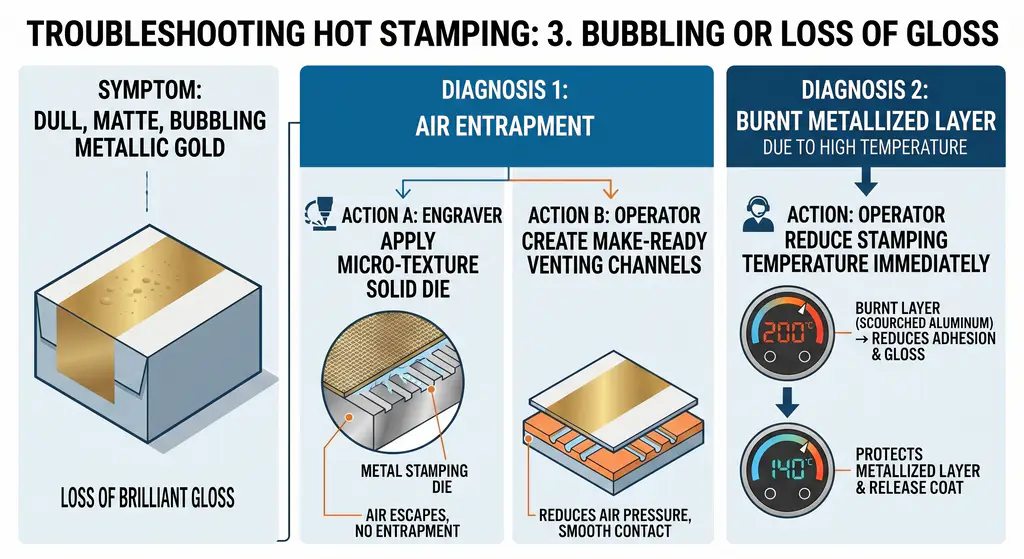
Symptom: Your brilliant metallic gold turns dull, matte, or exhibits tiny bubbles on the surface. Diagnosis & Fixes:
Air Entrapment: When stamping large solid areas, air gets trapped between the foil and the paper. Action: Ask your engraver to apply a microscopic texture/venting pattern on the solid die, or intentionally create slight venting channels in your make-ready.
Burnt Metallized Layer: The temperature is so high that it literally scorched the aluminum metallized layer and the release coat inside the foil structure. Action: Reduce the temperature immediately.
4. Web Snapping / Foil Breaking
Symptom: The foil web snaps repeatedly during the run, forcing you to stop the press constantly. Diagnosis & Fixes:
Tension Issues: Unwind tension is set way too high.
Nicked Edges from Slitting: If the foil roll was slit with a dull blade, micro-tears on the edges will snap under high-speed pulling tension. This heavily tests your supplier’s slitting capabilities.
Dirty Web Path: Thoroughly clean all the idler rollers on your machine. Sticky rollers create drag.
The Ultimate Question: Why is Hot Stamping Better Than Cold Stamping?
In standard industry searches, many packaging designers ask: “Since hot stamping requires so much troubleshooting, why not just use Cold Stamping?” Some even search for the specific disadvantages of hot foiling.
To be objective, the main disadvantages of hot foiling are the high costs associated with engraving metal dies and the fact that production speeds generally lag behind inline printing speeds.
So why do top-tier luxury brands—like Chanel cosmetics or high-end spirits—refuse to give up hot foil stamping? Because hot stamping possesses 3 unmatched advantages that cold foil simply cannot replicate:
- Unrivaled Metallic Brilliance: Hot stamping uses heat and pressure to literally brand a true metallic layer onto the paper. Its mirror-like reflectivity and premium density far exceed the capabilities of UV-glue-transferred cold foil.
- Rich Tactile Experience (3D Embossing): Hot foil stamping can be combined with embossing (often in a single pass using a fluted die) to create stunning 3D raised effects. Cold foil is strictly a flat, 2D process. (See Wikipedia’s definition of Hot Stamping for more details on tactile finishes).
- Superior Opacity on Difficult Substrates: For dark, uncoated, or heavily textured specialty papers, hot foil offers incredible hiding power and razor-sharp edge definition.
Of course, if your project involves high-volume, cost-sensitive FMCG labels, cold foil is an excellent alternative. Want a deep dive into the cost structures of both? Check out our breakdown: Hot Stamping vs. Cold Foil Stamping: A Comprehensive Comparison.
Dispelling Myths: Household Aluminum Foil vs. Industrial Stamping Foil
While analyzing search intent, we noticed a bizarre trend. People frequently ask the internet: “Why put aluminum foil in a toilet tank?” or “Why should you wrap your doorknob in aluminum foil at night?” and even “Why should you stop using aluminum foil immediately?”
This confusion stems from mixing up household aluminum foil (used for baking or blocking RFID signals) with industrial hot stamping foil.
The “foil” we use in the printing industry isn’t a sheet of metal. It is a highly engineered, ultra-thin polyester (PET) carrier film coated with multiple microscopic layers: a release layer, a color lacquer, a vacuum-metalized aluminum layer, and a heat-activated sizing layer. So, for the printing and packaging industry, absolutely do not stop using foil! It remains the most irreplaceable tool for elevating brand value and shelf appeal.
Next Steps
If you’re calibrating a new line or troubleshooting a defect issue, here’s what we offer:
📩 Free Application Engineering Support — Send us your substrate spec + machine model, and our applications team will provide a custom temperature/pressure/dwell recommendation within 24 hours.
📦 Free Sample Book — Get 12 different foil grades to test on your actual substrate before committing to a roll.
Related guides:
📞 Contact our technical team → — Quote turnaround in 24 hours.
Stop Guessing, Start Troubleshooting
Hot foil stamping is not magic; it’s a science of physics involving temperature, pressure, chemistry, and mechanical setup. When you hit a roadblock, don’t just blindly turn the pressure dials. Revert to the “Golden Triangle” and evaluate your material properties.
A highly stable, premium hot stamping foil can literally cut your make-ready time in half. If you are struggling with difficult UV coatings, rough textured papers, or if your current supplier can’t solve your flaking issues, don’t let your machines sit idle.