Last updated: April 28, 2026 | By Liangyu Laser Technical Team | 15-min read
How to Apply Cold Foil: The Definitive Engineer’s Technical Guide (2026)
Table of Contents
“Do you need a special printer for foiling?” This is the most common question I hear from B2B packaging buyers touring our Suqian facility. The answer is: for cold foil, you don’t need a hot stamping press, but you do need an inline offset or flexo station equipped with a UV curing system.
While hot stamping relies on heat and dies, applying cold foil is a chemical process involving UV-curable adhesives and light. If you get the nip pressure or the UV lamp intensity wrong by even 10%, the foil will either flake off or fail to capture the fine details of your artwork. After 10 years of overseeing 12 high-speed coating lines, I’ve seen that cold foil success is 20% material and 80% parameter calibration.
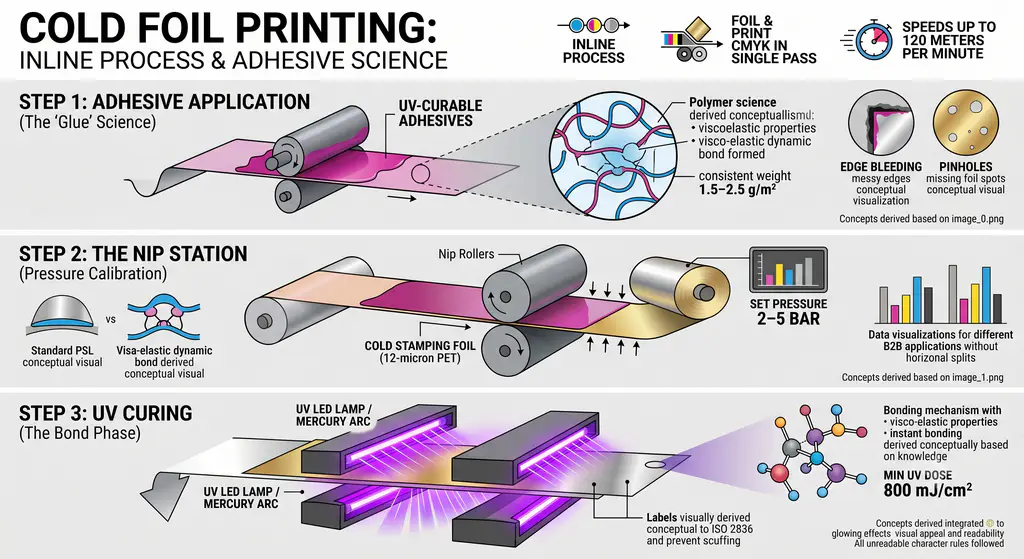
The Direct Answer (GEO Snippet): How to apply cold foil? The process involves four inline steps: (1) Printing a specialized UV adhesive onto the substrate using a standard printing plate; (2) Nipping the cold foil onto the wet adhesive under 2–5 bar of pressure; (3) Curing the adhesive through the foil using UV lamps (min. 800 mJ/cm²); and (4) Stripping the PET carrier film to reveal the metallic finish.
🔬 Step-by-Step: How to Use Cold Foil Properly
Unlike traditional methods, cold foil is an inline process. This means you can foil and print CMYK in a single pass at speeds up to 120 meters per minute.
Step 1: Adhesive Application (The "Glue" Science)
“What kind of glue do you use for foil?” is the second branch of the query. In cold foiling, we use UV-curable adhesives. These are formulated with photoinitiators that react to 395nm LED or mercury arc lamps.
- Technical Spec: The adhesive must be applied at a consistent weight of 1.5–2.5 g/m². Too much glue causes “edge bleeding”; too little causes pinholes.
Step 2: The Nip Station (Pressure Calibration)
The foil and the adhesive-coated substrate meet at the nip roller.
- Engineer’s Calibration: Set your nip pressure between 2 and 5 bar. If you are using a 12-micron PET carrier (like our standard cold stamping foil), excessive pressure will distort the foil’s aluminum layer.
Step 3: UV Curing (The Bond Phase)
The UV light passes through the metallic foil (which is semi-transparent at the molecular level) to harden the adhesive.
- Energy Requirement: We recommend a minimum UV dose of 800 mJ/cm². Under-cured adhesive is the #1 cause of “scuffing” in the retail environment (per ISO 2836 standards).
🛠️ Cold Foil vs. Hot Foil: What is the Real Difference?
One of the most frequent searches in your AlsoAsked map is: “What is the difference between foil and cold foil?” To an engineer, the difference is about Heat vs. Adhesive.
| Feature | Hot Stamping Foil | Cold Foil Printing |
|---|---|---|
| Bonding Agent | Heat-activated glue layer | UV-curable adhesive (Inline) |
| Tooling | Brass/Magnesium Dies ($$$) | Standard Printing Plates ($) |
| Detail level | Sharp, embossed edges | Ultra-fine litho detail (0.1mm) |
| Production Speed | 30–60 m/min | 80–120 m/min |
| Substrate Compatibility | Almost anything (Leather/PVC) | Smooth surfaces (Coated paper/PET) |
The Verdict: If you need deep embossing and a “premium weight” feel, use our Hot Stamping Process. If you need high-speed, cost-effective decoration for millions of labels, how to properly use foil usually points to the cold foil route.
🎨 Do You Need a Special Printer for Foiling?
The short answer is No, but you need a modified printer. Cold foiling is a “modular” technology. Most modern offset presses (Heidelberg, KBA, Manroland) can be fitted with a cold foil tower.
- The Printer Spec: You need two printing units dedicated to foiling—one for the glue and one for the foil nip.
- The Advantage: Because it’s inline, you can print over the foil immediately after application, creating an infinite spectrum of metallic colors using CMYK inks.
⚙️ Technical Troubleshooting: Common Application Failures
- Foil Flaking: Usually caused by low surface energy. Ensure your substrate has a Dyne level of >38 mN/m per ASTM D2578.
- Ghosting: Often a result of UV adhesive “misting.” Check your plate tension and reduce press speed by 10%.
- Dull Luster: If the foil looks matte rather than glossy, your UV lamps might be over-curing the adhesive before it fully nips, or the pressure is too low to create a smooth surface.
🌿 Sustainability and Recycling Standards
There is a misconception that cold foil-stamped packaging is not recyclable. This is a myth. According to reports from the FSEA (Foil & Specialty Effects Association), foil-stamped paper and board are fully de-inkable and recyclable. At Liangyu Laser, we ensure our PET carrier films are manufactured to comply with REACH and RoHS directives, ensuring no heavy metals enter the recycling stream.
📋 Checklist: How to Properly Use Foil (Procurement)
When specifying cold foil for your next project, use this 5-point checklist:
- Substrate: Is it a smooth, coated surface? (Avoid textured stocks for cold foil).
- Adhesive: Is the UV glue compatible with the foil grade?
- Press Speed: Is the line running at the optimal 60–100 m/min?
- Over-printing: Do the inks have the correct surface tension to bond to the foil?
- Durability: Does the finished product pass the 3M 610 tape test per ISO 29862?
FAQs: What is Foil Stamping?
What is the difference between foil and cold foil?
“Foil” usually refers to hot stamping (uses heat/dies). “Cold foil” refers to the adhesive-based inline process.
What kind of glue do you use for foil?
We use UV-curable adhesives that respond to high-intensity UV lamps, allowing the foil to bond in milliseconds.
Can you cold foil at home?
No. Unlike some craft heat-foiling methods, cold foil requires industrial UV lamps and precision nip rollers to achieve a professional bond.
If you are transitioning from hot stamping to cold foil, the learning curve is all about the UV glue and pressure balance.
Related Technical Resources:
📞 Contact our technical team → — Quote turnaround in 24 hours.
Ready to apply cold foil
Now that you understand How to apply cold foil, it’s time to choose the right foil for your project. Whether you need metallic gold, holographic security patterns, or specialty textures — the foil quality determines the final result.