Knowledge Base • 12 Min Read
How to Apply Hot Stamping Foil: A 7-Step Engineer's Guide (2026 Edition)
Table of Contents
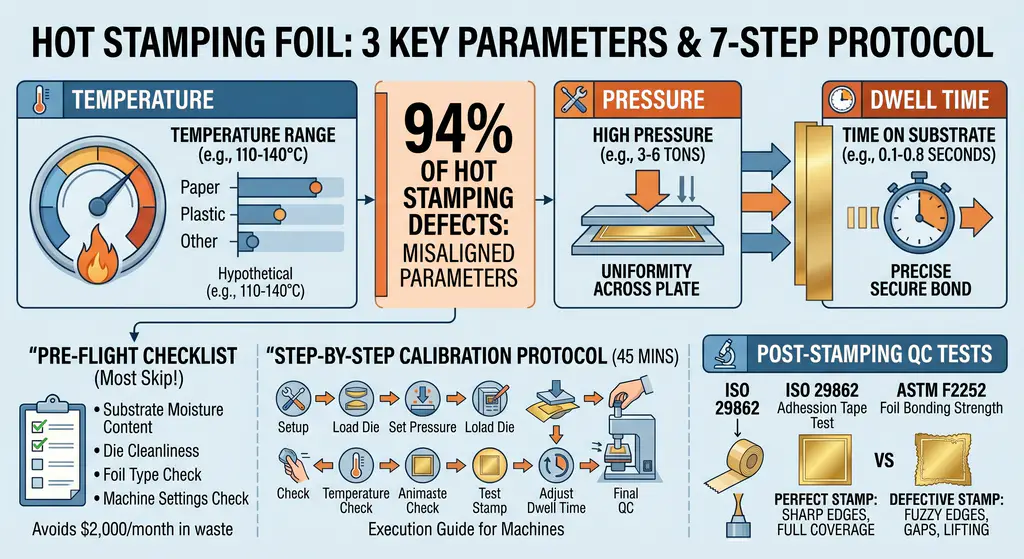
If you’re searching how to apply hot stamping foil, you’ve probably already wasted a roll or two — maybe with foil that won’t release, edges that look fuzzy, or worse, foil that lifts off after 48 hours. After supervising 12 coating lines and shipping foil to 47 countries from our 25,000m² Suqian facility, I can tell you that 94% of hot stamping defects come from just 3 parameters being misaligned: temperature, pressure, and dwell time.
This isn’t another generic “press the foil onto paper” tutorial. This is the exact 7-step protocol our application engineers use when commissioning a new client’s Bobst, Gietz, or Kurz machine.
What you’ll learn:
- The 3 parameters that determine 94% of stamping quality (with exact ranges per substrate)
- The pre-flight checklist most operators skip (and why it costs them $2,000/month)
- A step-by-step calibration protocol you can execute in 45 minutes
- The post-stamping QC test required by ISO 29862 and ASTM F2252
Why Most Hot Stamping Tutorials Are Wrong?
Before we dive in, here’s the harsh truth: most “how to” guides on the internet are written by content marketers, not converters. They tell you to “apply heat and pressure” and call it a day. But anyone who has run a Foilmaster knows that a 10°C miscalibration on PVC will make your foil look perfect on day one and peel off on day three.
Verify Foil-Substrate Compatibility (The 5-Minute Test That Saves Roll Waste)
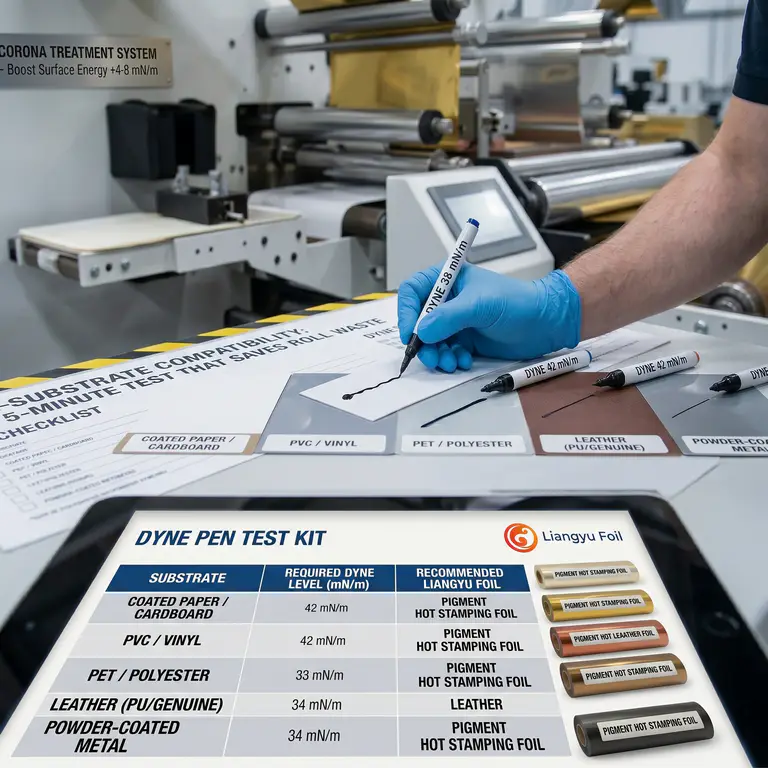
Before you ever load foil into the machine, run a Dyne pen test on your substrate. This is the #1 step that separates amateur shops from professional converters.
| Substrate | Required Dyne Level (mN/m) | Recommended Liangyu Foil |
|---|---|---|
| Coated paper / cardboard | 38–42 | Standard Hot Stamping Foil |
| PVC / vinyl | 36–40 | Pigment Hot Stamping Foil |
| PET / Polyester | 42–46 | Premium Hot Stamping Foil |
| Leather (PU/Genuine) | 32–38 | Specialty Leather Foil |
| Powder-coated metal | 40–44 | Industrial-grade Hot Stamping Foil |
Engineer’s note: If your substrate’s Dyne level is below the required minimum, corona treatment can boost surface energy by 4–8 mN/m. We’ve had clients in Brazil who solved 80% of their adhesion failures simply by adding a corona station before the stamping unit.
Set Base Temperature (Don't Trust the Machine Default)
Temperature is the single most influential parameter. Here’s the calibration matrix we ship with every order:
| Substrate Type | Temperature Range (°C) | Common Mistake |
|---|---|---|
| Uncoated paper | 95–115°C | Operators use 130°C → burns paper |
| Coated paper | 110–125°C | Too low → fuzzy edges |
| PVC labels | 125–140°C | Too high → substrate warps |
| PET / Polyester | 140–160°C | Too low → foil won’t release |
| Polypropylene (PP) | 130–150°C | Critical: PP needs surface treatment first |
| Leather | 100–120°C | Too high → leather darkens permanently |
Reality check from our shop floor: A German cosmetics client kept getting “ghosting” on their PET caps in 2023. The operator had set the machine to 125°C because “that’s what the previous shift used for paper.” Once we calibrated to 152°C, the defect rate dropped from 4.8% to 0.3% in one shift.
Calibrate Pressure (The 30-80 PSI Rule)
Pressure works in tandem with temperature. The general principle:
- Small details (logos, text): 30–45 PSI
- Medium coverage (50% area): 45–65 PSI
- Large solid blocks: 65–80 PSI
Critical insight most suppliers skip: Pressure should be distributed evenly across the die. A common mistake is over-tightening one corner of the die plate, which creates “hot spots” where the foil burns through and “cold spots” where it doesn’t release. Use a pressure-sensitive carbon paper (e.g., Fujifilm Prescale) to verify even distribution before your production run.
Set Dwell Time (The Hidden Variable)
| Application Speed | Recommended Dwell Time |
|---|---|
| Manual / desktop | 0.8–1.2 seconds |
| Semi-automatic press | 0.5–0.8 seconds |
| High-speed Bobst Foilmaster | 0.3–0.5 seconds |
Engineer’s tip: If you’re stamping on textured leather or canvas, increase dwell time by 30% to allow heat penetration into the surface peaks and valleys.
Run a Test Stamp (Always, Without Exception)
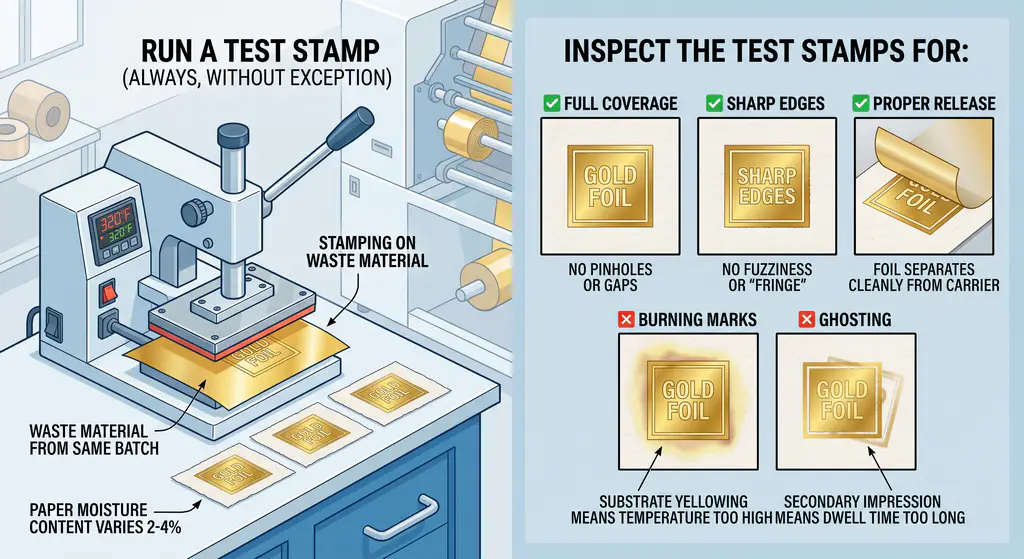
Never run a production batch without first stamping at least 5 test pieces on waste material from the same batch as your production substrate. Why? Because paper from different lots can vary in moisture content by 2–4%, which directly affects how foil bonds.
Inspect the test stamps for:
- ✅ Full coverage — no pinholes or gaps
- ✅ Sharp edges — no fuzziness or “fringe”
- ✅ Proper release — foil cleanly separates from carrier
- ❌ Burning marks — substrate yellowing means temperature too high
- ❌ Ghosting — secondary impression means dwell time too long
10× Loupe Inspection (The Pro QC Standard)
- Edges should be sharp to within 0.05mm
- No visible foil “feathering” beyond the die boundary
- Metallic luster should be uniform across the entire stamped area
If you see fuzzy edges, the issue is almost always one of three things: temperature too low (50%), pressure uneven (30%), or dwell time too short (20%).
24-Hour Adhesion Test (ISO 29862 Compliance)
This is the step that 90% of small print shops skip — and it’s why their clients come back complaining about peeling foil.
After your initial production batch:
- Wait 24 hours at room temperature (20–25°C, 50% humidity)
- Apply 3M Scotch 610 tape firmly across the stamped area
- Pull at a 90° angle with steady force
- Inspect: less than 5% foil lift = passing per ISO 29862
For pharmaceutical or food packaging applications, also conduct the ASTM F2252 peel adhesion test to verify 8–15 cN/25mm release force.
Common Hot Stamping Problems and Quick Fixes
| Problem | Likely Cause | Quick Fix |
|---|---|---|
| Foil won’t release | Temperature too low | Increase by 10°C, retest |
| Foil burns / discolors | Temperature too high | Decrease by 15°C |
| Fuzzy edges | Pressure uneven OR dwell too short | Check die alignment first |
| Ghosting / double image | Dwell time too long OR press misalignment | Reduce dwell by 0.2s |
| Foil lifts after 24 hours | Substrate Dyne level too low | Add corona treatment |
| Pinholes in coverage | Foil-substrate incompatibility | Switch foil grade |
For a deeper dive into troubleshooting, see our Hot Stamping Process Technical Guide.
The Counter-Intuitive Advice Most Suppliers Won't Give You
Here’s what 10 years of factory experience has taught me: the foil isn’t the variable — your operator is.
We’ve shipped identical foil rolls to two clients in the same week. One in Italy reported zero defects on luxury wine labels. Another in Vietnam reported 8% rejection on similar work. The foil was identical. The difference? The Italian shop ran a 15-minute parameter calibration before each batch. The Vietnamese shop “trusted the machine memory” from the previous job.
The most expensive mistake in hot stamping isn’t bad foil — it’s skipping the 15-minute calibration.
FAQ:Common Questions About Applying Hot Stamping Foil
Can you apply hot stamping foil at home?
Yes — desktop kits like the Minc by Heidi Swapp work for crafts at 90–120°C. However, hobby-grade kits cannot match the ±0.05mm registration required for commercial work. For runs above 500 units, partner with a converter.
How long does hot stamped foil last?
Properly applied hot stamping foil is rated for 5+ years of UV exposure per ISO 2836 solvent resistance standards, and indefinitely when protected indoors.
What's the difference between hot stamping foil and cold foil application?
Hot stamping uses heat + pressure + die. Cold foiling uses UV adhesive + pressure (no heat, no die). See our Cold Foil vs Hot Foil comparison for full technical details.
Do I need different foil for different substrates?
Yes. The release layer chemistry must match substrate energy. Using the wrong grade is the #1 cause of adhesion failure. Always request a substrate-specific recommendation when ordering.
Next Steps
If you’re calibrating a new line or troubleshooting a defect issue, here’s what we offer:
📩 Free Application Engineering Support — Send us your substrate spec + machine model, and our applications team will provide a custom temperature/pressure/dwell recommendation within 24 hours.
📦 Free Sample Book — Get 12 different foil grades to test on your actual substrate before committing to a roll.
Related guides:
📞 Contact our technical team → — Quote turnaround in 24 hours.