Knowledge Base • 12 Min Read
Foil Stamping vs Hot Stamping: Are They the Same Process?
Table of Contents
- 1. The Fundamental Physics: Heat vs. Adhesive
- 2. When Would You Use Cold Foil? (The Speed Argument)
- 3. When Is Hot Foil Still King?
- 4. The "Primer" Question Nobody Asks
- 5. What Happens When You Mix Vinegar and Aluminum Foil?
- 6. The Hybrid Approach: Why "Both" Is Often the Answer
- 7. The Decision Framework: A Checklist
Why This Comparison Matters More Than You Think
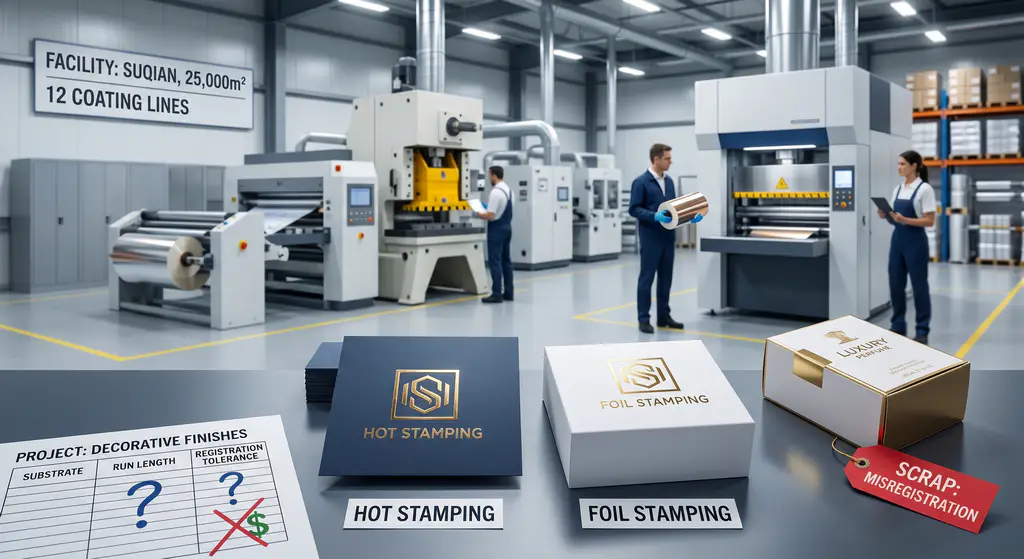
If you’ve spent more than five minutes Googling decorative finishing, you’ve seen the terms “foil stamping” and “hot stamping” used interchangeably — sometimes in the same paragraph, sometimes by the same supplier. After 10 years of running 12 coating lines at our 25,000m² Suqian facility and shipping foil to converters in 47 countries, I’m going to give you the answer most blogs won’t: they’re related, but they are NOT the same thing — and confusing them costs the average packaging buyer $30,000–$80,000 per year in scrapped jobs.
Here’s what you’ll learn in this guide:
- The actual industry definition (per FSEA — Foil & Specialty Effects Association)
- Why the terms diverged after 1995 (and why your supplier still confuses them)
- The 3 hidden process differences that affect your unit cost
- A decision matrix based on substrate, run length, and registration tolerance
The Short Answer: Foil Stamping vs Hot Stamping Is a Category vs. Method Problem
Think of it this way: “foil stamping” is the umbrella category. “Hot stamping” is one method inside that umbrella.
This is the same logic as “vehicle” vs. “sedan” — every sedan is a vehicle, but not every vehicle is a sedan. Under the foil stamping umbrella, you actually have three distinct industrial processes:
| Process | Heat? | Die Required? | Year Commercialized | Speed (m/min) |
|---|---|---|---|---|
| Hot Foil Stamping | Yes (110–160°C) | Yes (brass/magnesium) | ~1892 (Ernst Oeser patent) | 30–80 |
| Cold Foil Stamping | No (UV adhesive) | No (printing plate) | 2003 (commercialized) | 120–300 |
| Digital Foil (Sleeking) | Low (90–110°C) | No | 2015 (mainstream) | 5–15 |
So when someone asks “Is foil stamping the same as hot stamping?” — the technically correct answer is: “Hot stamping is a TYPE of foil stamping, but foil stamping is not always hot stamping.” If your supplier blurs this distinction, ask them which of the three processes they’re actually quoting.
Why the Terminology Got Messy: A Brief History
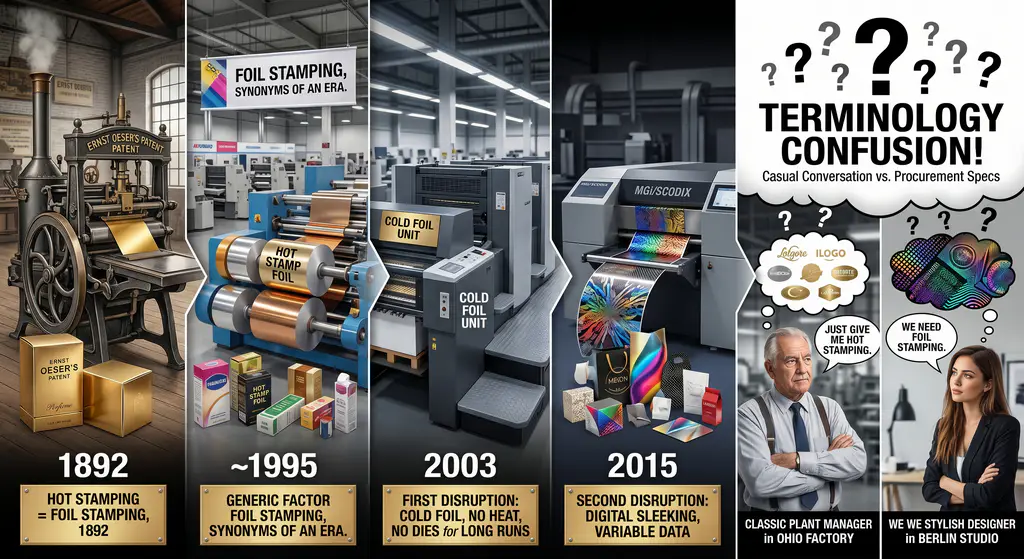
Until roughly 1995, almost all decorative metallic finishing on packaging used heat — the classic hot stamping process patented by Ernst Oeser in 1892. So “foil stamping” and “hot stamping” genuinely WERE the same thing for about a century. The terms became synonyms in trade shows, supplier catalogs, and printer slang.
Then two disruptions happened:
- 2003 — KBA & API launched commercial cold foil units for offset presses, eliminating the need for heat or dies on long-run jobs.
- 2015 — Digital sleeking devices (MGI, Scodix, Konica Minolta) entered short-run packaging, allowing variable-data foiling.
The trade press (Printing Impressions, Package Design Magazine) updated their terminology, but the printer’s shop floor never caught up. This is why a 55-year-old plant manager in Ohio still says “hot stamping” when he means “any foiling process,” and a 28-year-old designer in Berlin says “foil stamping” assuming everyone knows she means digital sleeking. Both are technically correct in casual conversation. Both are technically wrong in a procurement spec.
The 3 Real Differences That Affect Your Unit Cost
1. Tooling Cost — The Hidden Deal-Breaker
Hot stamping requires a custom brass or magnesium die, typically $180–$1,200 per design depending on intricacy. For a one-time job under 5,000 units, this die cost alone can add $0.04–$0.24 per piece.
Cold foiling uses your existing offset printing plates — no die required. Digital foil uses a clear toner pattern — also no die. Reality check from our shop floor: we had a US cosmetics startup in 2024 that quoted hot stamping for 2,500 sample boxes and ate a $980 die cost on a $4,200 job. Had they specified cold foil, the die cost would’ve been zero. Always check process before signing the PO.
2. Substrate Compatibility — Where Hot Stamping Wins
Hot stamping works on almost any substrate: paper, leather, PVC, polypropylene, PET, ABS, polycarbonate, even powder-coated metal. The release layer in our hot stamping foil is engineered for Dyne levels of 32–46 mN/m, which covers 95% of industrial substrates per ASTM D2578 wettability standards.
Cold foiling has a critical limitation: it requires a UV-curable adhesive compatible with offset/flexo inks. This rules out heat-sensitive specialty papers and most rigid plastics. Digital foil sleeking only works on toner-based digital prints — you cannot apply it to offset-printed sheets without compatibility testing.
3. Registration Tolerance — The Defect Rate Reality
This is the difference nobody tells you in marketing brochures: defect rates vary by 4–6× across the three processes.
| Process | Registration Tolerance | Typical Defect Rate | Min. Detail Size |
|---|---|---|---|
| Hot Stamping | ±0.05mm | 0.3–0.8% | 0.15mm line |
| Cold Foiling | ±0.15mm | 1.5–3.2% | 0.25mm line |
| Digital Foil | ±0.10mm | 1.0–2.5% | 0.20mm line |
For luxury cosmetics packaging where a 1.5% reject rate on a $3.50 unit means $52,500 lost per million units — hot stamping’s tighter tolerance is non-negotiable. For mass-market beverage labels at $0.08 per unit, cold foiling’s higher defect rate is acceptable in exchange for 3–4× faster production.
The Counter-Intuitive Advice Most Suppliers Won't Give You
Here’s something I tell every new buyer who tours our Jiangsu facility: if your annual run volume is between 50,000 and 250,000 pieces, hot stamping is almost always cheaper than cold foiling — even though everyone “knows” cold foil is faster and cheaper.
Why? Because cold foil’s setup time on an offset press (plate prep + UV adhesive calibration + waste during makeready) typically runs 90–150 minutes. Hot stamping setup on a Bobst Foilmaster runs 25–40 minutes. At sub-250K volumes, the setup amortization kills cold foil’s per-piece advantage.
This is why our European clients in luxury wine labeling, niche cosmetics, and limited-edition packaging still order 80% hot stamping foil from us, despite the press operators “knowing” cold foil is the modern choice. Math wins over fashion.
How to Choose: Decision Matrix by Use Case
| Your Application | Best Process | Foil to Order |
|---|---|---|
| Luxury cosmetics caps (≤500K/yr) | Hot Stamping | Hot Stamping Foil |
| Wine & spirits labels (high-end) | Hot Stamping | Hot Stamping Foil (Pigment grade) |
| Mass-market beverage labels (>2M/yr) | Cold Foiling | Cold Stamping Foil |
| Personalized gifts, short-run boxes | Digital Foil | Digital Foil |
| Holographic security packaging | Hot Stamping | Holographic Foil |
| Textile decoration (T-shirts, bags) | Heat Transfer | Textile Foil |
Frequently Asked Questions
Can you foil stamp at home?
Yes — desktop hot stamping kits like the Minc by Heidi Swapp or the WeR Memory Keepers Foil Quill work for crafts at temperatures around 90–120°C. However, these produce hobby-grade results and cannot match the 0.05mm registration tolerance required for commercial packaging. For any commercial run above 500 units, partner with a foil converter.
Is foil stamping permanent?
When properly applied with the correct release force (typically 8–15 cN/25mm per ISO 29862), hot foil stamping is rated for 5+ years of UV exposure and is solvent-resistant per ISO 2836. Cold foil bonds depend on UV cure quality and are typically rated for 2–3 years. See our complete guide on cold foil heat resistance for benchmark data.
Why is hot stamping considered higher quality?
Hot stamping produces sharper edge definition (down to 0.15mm) and richer metallic luster because the heat fully activates the foil’s release layer at molecular level. Cold foiling, while faster, has a slightly diffused edge due to UV adhesive flow during cure. For luxury packaging where shelf appeal drives 23% of purchase decisions (PIA 2024 packaging study), this quality gap matters.
Next Steps
If you’re still uncertain which process fits your project, here’s the engineer’s shortcut: send us your artwork file (AI/PDF) and a description of your substrate and annual volume. Our applications team will quote both hot stamping foil and cold foil options side-by-side, with realistic defect rate estimates based on similar jobs we’ve run for converters in your region.
For deeper reading on adjacent topics, see our guides on: