
Knowledge Base • 15 Min Read
Hot Foil Stamping Machine: The Complete Buying Guide for Print Shops & Packaging Manufacturers (2026)
Table of Contents
- 1. 5 Types of Hot Foil Stamping Machines (And Who They're Built For)
- 2. 7 Specifications That Actually Affect Your Output Quality
- 3. Substrate Compatibility: The Hidden Dealbreaker
- 4. How Machine Choice Affects Your Foil Selection
- 5. True Cost of Ownership: Beyond the Price Tag
- 6. How to Vet a Machine Supplier (Without Getting Burned)
- 7. FAQ
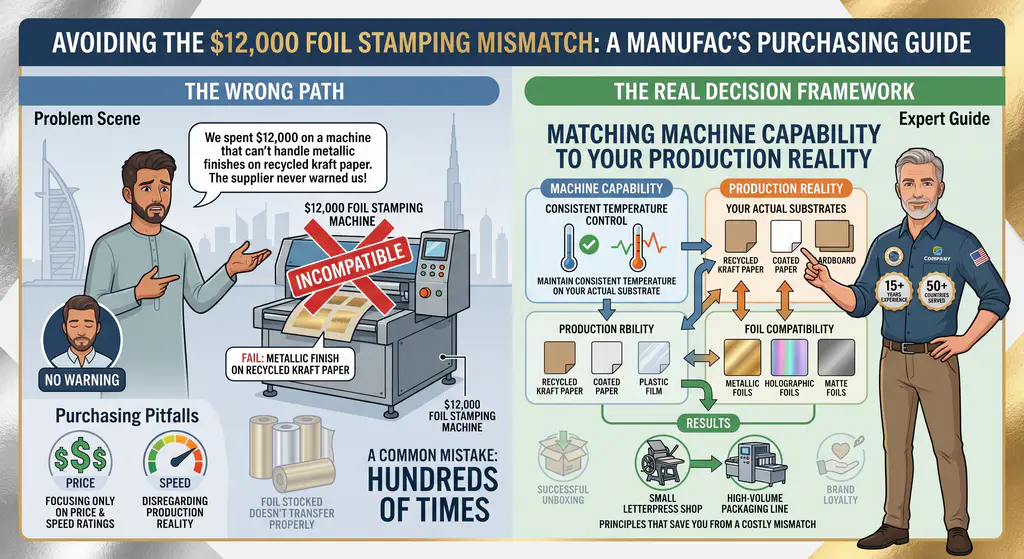
That conversation wasn’t unusual. In 15 years of supplying hot stamping foil to print shops across 50+ countries, I’ve seen the same purchasing mistake repeated hundreds of times. Buyers focus on price and speed ratings, then discover the machine can’t maintain consistent temperature on their actual substrate — or worse, the foil they already stocked doesn’t transfer properly on that specific equipment.
This guide is different. Instead of listing machine specs from brochures, I’ll walk you through the decision framework that actually matters: matching machine capability to your production reality. Whether you run a small letterpress shop or a high-volume packaging line, the principles here will save you from a costly mismatch.
5 Types of Hot Foil Stamping Machines (And Who They're Built For)
Not all foil stamping machines are created equal. The type you need depends entirely on what you’re stamping, how fast you need to produce, and whether your operator has engineering-level skills or basic training. Here’s the breakdown based on what we see from our foil customers’ actual production setups.
1. Manual Platen Press (Clamshell Type)
The simplest and most affordable option. You load the substrate, pull a lever, and the heated platen presses the die against the foil and substrate. Cycle times range from 8–15 seconds per impression.
Best for: Small studios, wedding invitation printers, leather craft workshops, and prototyping. If you’re producing fewer than 500 impressions per day, this gets the job done.
Limitation: Temperature consistency depends heavily on the operator. Long production runs will show visible variation in foil transfer quality.
2. Pneumatic / Automatic Platen Press
Same principle as the manual press, but air pressure drives the platen instead of human force. This delivers more consistent pressure across the entire die surface — critical for large-area stamping where uneven pressure causes patchy foil transfer.
Best for: Mid-size print shops doing cosmetic boxes, wine labels, and book covers. Production rates typically hit 1,500–3,000 sheets per hour.
3. Rotary Hot Foil Stamping Machine
Instead of a flat platen, a heated cylinder rolls the foil onto a moving substrate web. This is where speed enters a different league — rotary systems can reach 6,000–12,000 impressions per hour, making them the standard for packaging converters running long orders.
Best for: Flexible packaging, label converters, and folding carton manufacturers. If your orders regularly exceed 10,000 units, rotary is the only economically viable option.
Critical detail: Rotary machines require foil specifically engineered for rotary application — standard platen foils will break or transfer inconsistently at high speeds. We’ve seen customers waste entire foil rolls because they tried to run platen-grade material on a rotary press.
4. Vertical Slide-Type Stamping Machine
The heated head moves vertically downward onto a flat bed. This design offers precise control over dwell time and pressure, making it popular for thick substrates like rigid boxes, leather goods, and multi-layer packaging.
Best for: Luxury packaging manufacturers, leather goods producers, and anyone stamping on substrates thicker than 500gsm.
5. Inline Foil Stamping Unit (Integrated with Printing Press)
These modules bolt directly onto offset presses, flexo presses, or digital printing systems. Foil stamping happens in the same pass as printing — no secondary operation needed.
Best for: High-volume label and packaging printers who need to eliminate handling steps. Setup is complex, but once dialed in, per-unit cost drops dramatically.
| Machine Type | Speed (impressions/hr) | Typical Price Range | Best Substrate | Skill Level Required |
|---|---|---|---|---|
| Manual Platen | 200–400 | $800–$3,000 | Paper, cardstock, leather | Basic |
| Pneumatic Platen | 1,500–3,000 | $5,000–$25,000 | Paper, board, thin plastic | Intermediate |
| Rotary | 6,000–12,000 | $30,000–$150,000 | Film, labels, carton stock | Advanced |
| Vertical Slide | 800–2,000 | $8,000–$40,000 | Rigid board, leather, thick stock | Intermediate |
| Inline Unit | 8,000–15,000 | $50,000–$200,000+ | Labels, flexible packaging | Expert |
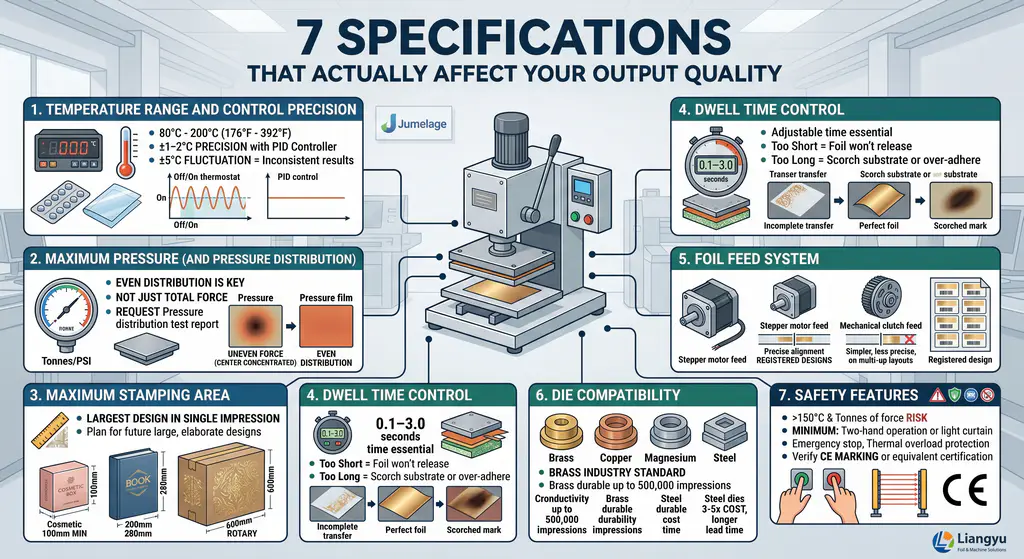
7 Specifications That Actually Affect Your Output Quality
Machine spec sheets are packed with numbers. Most of them don’t matter for your daily production. Here are the seven that do — and what to look for in each.
1. Temperature Range and Control Precision
Most hot foil stamping machines operate between 80°C and 200°C (176°F–392°F). But the range isn’t what matters — precision is. A machine that fluctuates ±5°C will produce inconsistent results, especially on heat-sensitive substrates like pharmaceutical blister packs or thin plastic films.
Look for machines with PID temperature controllers (Proportional-Integral-Derivative). These maintain temperature within ±1–2°C of your setpoint. Cheaper machines use basic on/off thermostats that overshoot and undershoot constantly.
2. Maximum Pressure (and Pressure Distribution)
Pressure is measured in tonnes or PSI. But total pressure means nothing without even distribution. A machine rated for 5 tonnes of pressure means little if that force concentrates in the center of the platen.
Ask the supplier for a pressure distribution test report — some manufacturers provide these using pressure-sensitive film. If they can’t or won’t, that’s a red flag.
3. Maximum Stamping Area
This determines the largest design you can stamp in a single impression. For cosmetic boxes, you typically need 100mm × 100mm minimum. For book covers, 200mm × 280mm. For large-format packaging, some rotary machines handle widths up to 600mm.
Don’t buy a machine with barely enough area for your current work. Plan for your next two years of design trends — metallic finishes are getting larger and more elaborate.
4. Dwell Time Control
Dwell time is how long the heated die maintains contact with the foil and substrate. Too short, and the foil won’t fully release. Too long, and you’ll scorch the substrate or cause the foil to over-adhere.
Adjustable dwell time (typically 0.1–3.0 seconds) is essential. Some entry-level machines have fixed dwell times — avoid these unless you only ever work with one substrate type.
5. Foil Feed System
How the machine advances the foil between impressions matters more than most buyers realize. There are two main systems:
- Stepper motor feed: Precise, programmable foil advancement. Essential for registered designs where foil placement must align perfectly with printed elements.
- Mechanical clutch feed: Simpler, less precise. Works fine for general decorative stamping but causes foil waste on multi-up layouts.
6. Die Compatibility
Check what type of dies the machine accepts: brass, copper, magnesium, or steel. Brass dies are the industry standard for most applications — they offer good heat conductivity and durability for runs up to 500,000 impressions. Steel dies last longer but cost 3–5x more and require longer lead times for engraving.
7. Safety Features
Operating temperatures above 150°C with several tonnes of closing force creates genuine safety risks. At minimum, the machine should have:
- Two-hand operation or light curtain safety sensors
- Emergency stop button within arm’s reach
- Thermal overload protection
- Guarded pinch points
If you’re buying from a Chinese manufacturer (as many do for cost reasons), verify the machine carries CE marking or equivalent certification. Unbranded machines from trade portals often cut corners on safety components.
Substrate Compatibility: The Hidden Dealbreaker
Here’s what most machine suppliers won’t tell you: the same machine that produces flawless gold stamping on coated art paper might fail completely on uncoated kraft or recycled board. Substrate compatibility is where most purchasing decisions go wrong.
The core issue is surface energy. According to research published by the Technical Association of the Pulp and Paper Industry (TAPPI), different paper and plastic substrates have vastly different surface energies, which directly affect how well the foil’s adhesive layer bonds during the stamping process.
| Substrate | Recommended Temp (°C) | Pressure | Dwell Time | Difficulty |
|---|---|---|---|---|
| Coated art paper (250–350gsm) | 110–130 | Medium | 0.8–1.5s | Easy |
| Uncoated kraft paper | 130–155 | High | 1.2–2.0s | Challenging |
| Recycled cardboard | 125–150 | High | 1.5–2.5s | Challenging |
| PVC / PET plastic film | 140–170 | Medium | 0.5–1.0s | Moderate |
| Leather (genuine) | 100–125 | Medium-Low | 1.5–3.0s | Moderate |
| Textile fabric | 120–150 | Low-Medium | 2.0–4.0s | Challenging |
| Rigid box board (1000gsm+) | 130–160 | High | 1.0–2.0s | Moderate |
Notice that uncoated and recycled substrates require significantly more heat and pressure. If your machine can’t deliver consistent pressure above 8 MPa or maintain temperature above 150°C without fluctuations, you’ll struggle with these materials — which are increasingly common as brands shift toward sustainable packaging.
Before purchasing any machine, request a sample run on your actual substrate. Send the supplier 50–100 sheets of the material you work with most. If they refuse, find another supplier. This single step would have saved that Dubai brand owner $12,000.
How Machine Choice Affects Your Foil Selection
Here’s something most equipment buyers don’t realize: your machine choice directly determines which foils you can use — and how much foil you’ll waste.
At Liangyu Foil, we manufacture hot stamping foil in over 200 specifications. But not every foil works on every machine. The key variables are:
Carrier Film Thickness
Standard hot stamping foil uses a 12-micron polyester carrier. Rotary machines typically require thinner carriers (10–11 microns) for better conformability at high speeds. Using standard 12-micron foil on a rotary press can cause tracking issues and uneven transfer.
We specify carrier thickness on every product data sheet — check this against your machine manufacturer’s recommendations before ordering.
Release Layer Activation Temperature
Every foil has a specific temperature window where the release layer activates and the metallic coating transfers to the substrate. This window is typically 15–25°C wide. If your machine can’t maintain temperature within that window, you’ll get either incomplete transfer (temperature too low) or background staining (temperature too high).
For example, our rose gold luxury foil activates at 120–140°C. A machine with ±5°C fluctuation might dip to 115°C on some cycles — causing patchy results on a premium cosmetic box where perfection is non-negotiable.
Adhesive Layer Compatibility
The foil’s adhesive layer must bond to your substrate. Some adhesives are formulated for porous surfaces (paper, board), others for non-porous surfaces (plastic, coated stock). Your machine’s pressure capability determines how well the adhesive flows into the substrate surface.
Low-pressure machines (< 5 MPa) limit you to foils with aggressive adhesive formulations. High-pressure machines open up the full range of specialty foils, including alcohol-resistant and abrasion-resistant variants used in cosmetics packaging.
True Cost of Ownership: Beyond the Price Tag
The machine’s purchase price is typically only 30–40% of your five-year cost. Here’s what most budgets fail to account for:
| Cost Category | Manual Platen (5-Year) | Pneumatic Platen (5-Year) | Rotary (5-Year) |
|---|---|---|---|
| Machine purchase | $1,500 | $15,000 | $80,000 |
| Dies (brass, average 20 designs/year) | $4,000 | $6,000 | $12,000 |
| Foil consumption | $8,000 | $25,000 | $120,000 |
| Maintenance & parts | $500 | $3,000 | $15,000 |
| Electricity | $800 | $2,500 | $18,000 |
| Labor (operator cost) | $50,000 | $35,000 | $15,000 |
| Total 5-Year Cost | $64,800 | $86,500 | $260,000 |
| Cost per 1,000 impressions | $8.60 | $2.31 | $0.87 |
The data tells a clear story: for low-volume work, manual machines win on total cost. But once you cross roughly 500,000 impressions over five years, the rotary machine’s per-unit economics become impossible to ignore. The digital vs. traditional foil comparison follows a similar logic — volume is the decisive factor.
How to Vet a Machine Supplier (Without Getting Burned)
The hot foil stamping machine market is fragmented. You’ll find everything from established European manufacturers (Kurz, BOBST, Masterwork) to Chinese trade portal listings with no verifiable track record. Here’s a practical vetting framework:
Step 1: Request a Video of Your Specific Substrate Being Stamped
Not a brochure video. Not a generic demo. A live video showing the machine stamping on the exact substrate you use, with the foil grade you plan to run. Any serious supplier will do this.
Step 2: Ask for 3 Reference Customers in Your Region
Call them. Ask about after-sales support response time, spare parts availability, and whether the machine delivered the promised performance. A supplier who can’t provide references likely has a reason.
Step 3: Verify Spare Parts Availability
Heating elements, silicone rubber pads, and control boards are wear items. Ask: “If a heating element fails on a Friday, can you ship a replacement that arrives before Monday?” If the answer is anything other than “yes,” factor downtime into your cost calculation.
Step 4: Check Safety Certifications
CE marking (Europe), UL listing (USA), or EAC certification (Eurasia) aren’t just bureaucratic checkboxes. They indicate the machine has been tested for electrical safety, emergency stop functionality, and thermal protection. Machines without these certifications are a liability risk — and some insurance companies won’t cover workplace accidents involving uncertified equipment.
Step 5: Negotiate a Trial Period or Money-Back Clause
The best suppliers offer a 30-day performance guarantee. If the machine doesn’t meet agreed-upon quality standards on your substrate, you return it. Suppliers confident in their product will agree to this. Those who won’t are telling you something about their confidence in their own equipment.
FAQ: Hot Foil Stamping Machine Questions Printers Ask Most
What's the difference between hot foil stamping and cold foil printing?
Hot foil stamping uses heat and pressure to transfer a metallic layer from a carrier film. Cold foil printing uses UV adhesive applied by a printing plate, then the foil is pressed onto the wet adhesive and cured under UV light. Hot stamping produces sharper detail and more durable finishes. Cold foil is faster for large-area coverage but can’t match hot stamping’s brilliance on fine text and line work. Read our detailed cold foil vs hot foil comparison for the full breakdown.
Can I use any hot stamping foil on any machine?
No. Foil selection depends on machine type (platen vs. rotary), operating temperature range, and pressure capability. Using the wrong foil-machine combination leads to poor transfer, foil breakage, or substrate damage. Always verify foil specifications against your machine’s parameters.
How long do brass dies last?
Brass dies typically last 300,000–500,000 impressions on paper substrates. On abrasive substrates like recycled board or textile, die life drops to 100,000–200,000 impressions. Magnesium dies are cheaper ($50–$150 vs. $200–$800 for brass) but only last 10,000–30,000 impressions.
What's causing patchy or incomplete foil transfer?
The most common causes, in order of frequency: (1) insufficient pressure, (2) temperature below the foil’s activation window, (3) uneven die surface, (4) contaminated substrate, (5) expired or improperly stored foil. For a complete troubleshooting guide, see our hot foil stamping problems & solutions article.
Next Steps
If you’re calibrating a new line or troubleshooting a defect issue, here’s what we offer:
📩 Free Application Engineering Support — Send us your substrate spec + machine model, and our applications team will provide a custom temperature/pressure/dwell recommendation within 24 hours.
📦 Free Sample Book — Get 12 different foil grades to test on your actual substrate before committing to a roll.
Related guides:
📞 Contact our technical team → — Quote turnaround in 24 hours.
Ready to Match the Right Foil to Your Machine?
Choosing the right hot foil stamping machine is only half the equation. The other half is sourcing foil that’s engineered to perform on your specific equipment and substrate combination.
At Liangyu Foil, we’ve been helping print shops and packaging manufacturers optimize their foil-machine pairing since 2016. We offer free sample testing — send us your substrate, tell us your machine specs, and we’ll recommend the right foil grade with sample rolls for you to test.