Knowledge Base • 15 Min Read
Luxury Packaging Foil: Mastering the Chemistry of Premium Luster for Elite Brands
Table of Contents
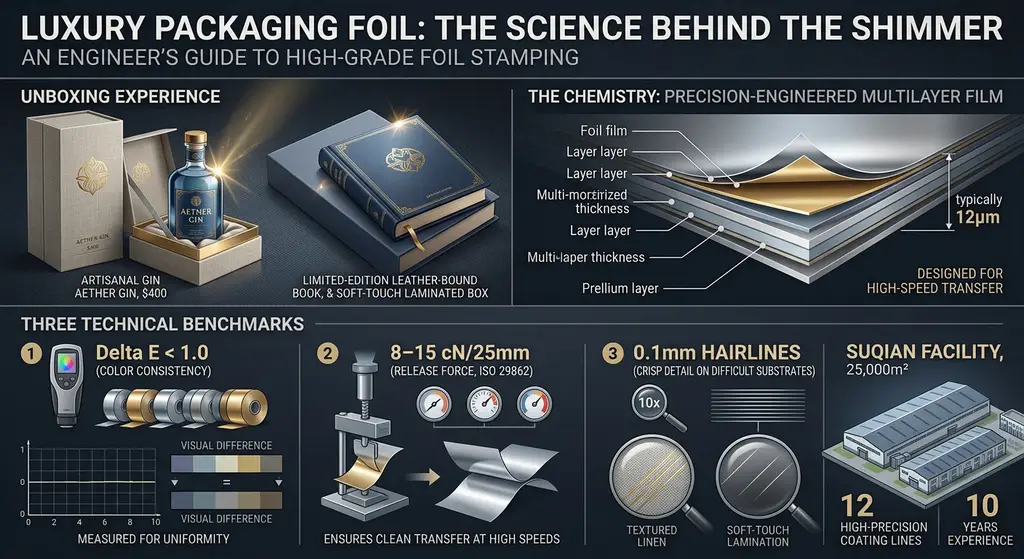
In the ultra-competitive landscape of premium retail, the “unboxing experience” has become a critical touchpoint for brand loyalty. Whether it is a $400 bottle of artisanal gin or a limited-edition leather-bound luxury book, the first thing a consumer notices is the play of light on the luxury packaging foil. It is a visual shorthand for quality, heritage, and exclusivity.
However, behind that shimmering logo lies a complex world of material science. After 10 years of overseeing 12 high-precision coating lines at our 25,000m² facility in Suqian, we have learned that the difference between “commercial” and “luxury” foil is not just the color—it is the chemistry.
The Direct Answer: What defines high-grade luxury packaging foil? It is a precision-engineered multilayer film (typically 12μm) designed for high-speed transfer. Its performance is measured by three technical benchmarks: Delta E < 1.0 for color consistency, 8–15 cN/25mm release force (ISO 29862), and the ability to maintain crisp 0.1mm hairlines on difficult substrates like textured linen or soft-touch lamination.
The Anatomy of Luxury: Why 12 Microns Matter
When a designer specifies luxury packaging foil, they are interacting with a five-layer sandwich of technology. Understanding these layers is the key to preventing $100,000 production errors.
The 5-Layer Engineering
- PET Carrier (12μm): The high-tensile base that must withstand 9,500 impressions per hour on a Bobst Foilmaster.
- Release Layer: A heat-activated wax or resin that determines the “sharpness” of the stamp.
- Color Lacquer: Where we manage the Delta E color consistency.
- Aluminum Layer (0.04μm): Vacuum-deposited via physical vapor deposition (PVD) to create the mirror effect.
- Adhesive Layer: The “bridge” that bonds the foil to the packaging material.
| Technical Feature | Standard Foil | Luxury Packaging Foil (Liangyu) |
|---|---|---|
| Carrier Film Thickness | 10–12μm (Variance ±10%) | 12μm (Precision ±2%) |
| Release Force | High variance (Patchy results) | 8–15 cN/25mm (ISO 29862) |
| Minimum Detail size | 0.25mm lines | 0.10mm (Ultra-Fine Text) |
| Dyne Compatibility | 38–40 mN/m only | 32–46 mN/m (Wide Substrate Range) |
| Chemical Resistance | Water resistant only | Alcohol, Perfume, & UV Resistant |
Design Aesthetics: Matte vs. Gloss vs. Silk
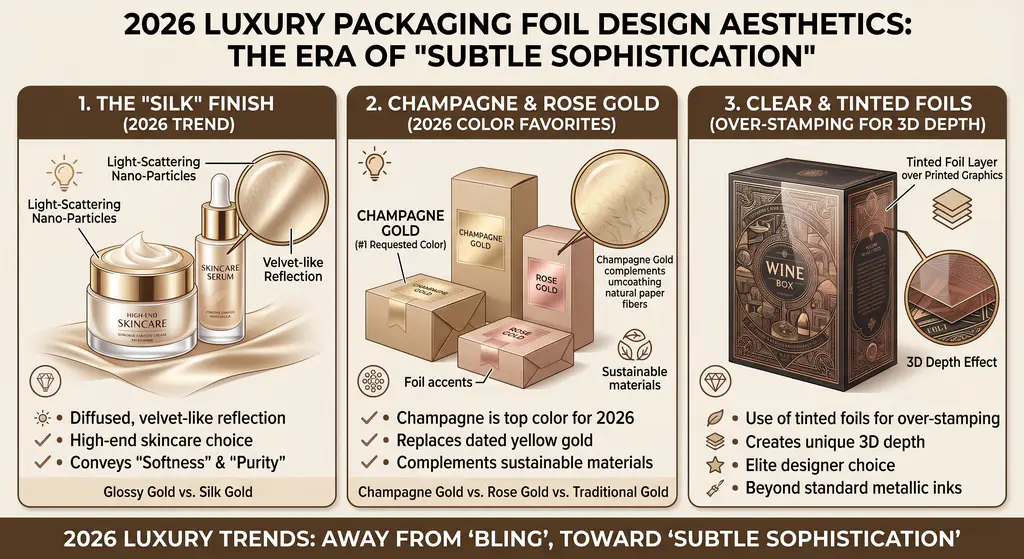
The 2026 luxury market is moving away from “bling” and toward “Subtle Sophistication.” Choosing the right finish of luxury packaging foil can change the entire personality of a brand.
1. The "Silk" Finish (2026 Trend)
Unlike traditional high-gloss gold, Silk Foil provides a diffused, velvet-like reflection. This is achieved by incorporating light-scattering nano-particles in the color lacquer. It is the preferred choice for high-end skincare brands that want to convey “softness” and “purity.”
2. Champagne and Rose Gold
Traditional yellow gold can sometimes feel dated. Champagne Gold has become our #1 requested color for 2026. It complements the natural, uncoated papers and recycled boards that are currently dominating sustainable luxury packaging.
3. Clear & Tinted Foils (Over-stamping)
Elite designers are now using tinted luxury packaging foil to over-stamp printed graphics. This creates a “3D depth” effect that is impossible to replicate with standard metallic inks.
Technical Mastery: Substrate Interaction
The biggest challenge in luxury packaging is the substrate. Brands are increasingly using uncoated, textured, or heavily recycled boards (like those from Fedrigoni or Arjowiggins) to meet ESG goals.
The Problem: These papers have high “peaks and valleys.” Standard foil will “bridge” these gaps, leading to flaking or “pinholing.”
For detailed calibration, see our How to Apply Hot Stamping Foil: 7-Step Guide.
Sustainability: The Circular Luxury Myth-Busting
There is a common misconception that luxury packaging foil makes paper non-recyclable. This is incorrect.
At Liangyu, we have pushed sustainability further:
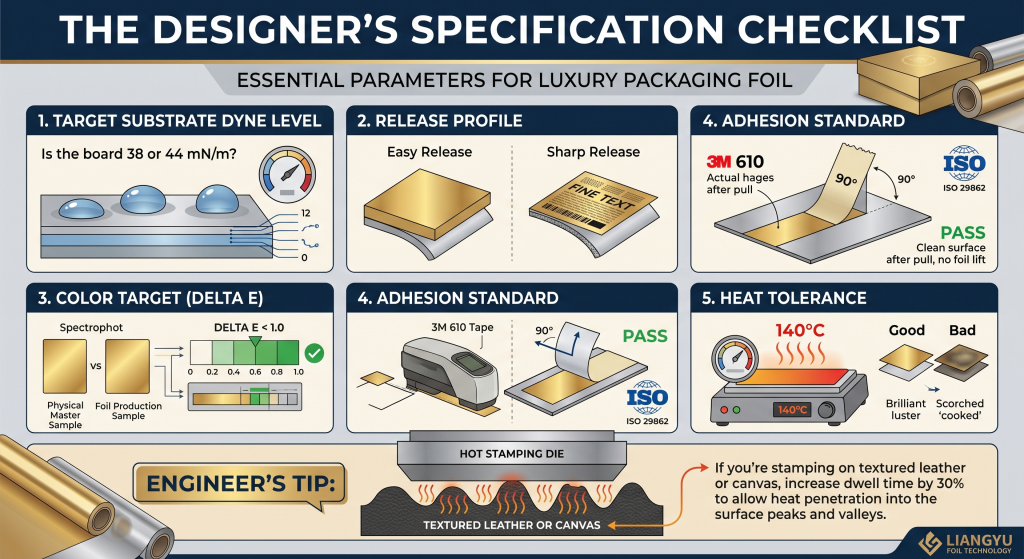
The Designer’s Specification Checklist
When preparing a technical spec for luxury packaging foil, ensure you include these five parameters:
- Target Substrate Dyne Level: Is the board 38 or 44 mN/m?
- Release Profile: Do you need “Easy Release” (for large solids) or “Sharp Release” (for fine text)?
- Color Target (Delta E): Specify a Delta E < 1.0 against a physical master sample.
- Adhesion Standard: Must pass 3M 610 Tape Test per ISO 29862.
- Heat Tolerance: Must withstand 140°C without dulling or “cooking” the luster.
Engineer’s tip: If you’re stamping on textured leather or canvas, increase dwell time by 30% to allow heat penetration into the surface peaks and valleys.
FAQ: Deep Dive into Luxury Foiling
Why does my foil look dull after stamping?
Can I foil stamp on 100% recycled board?
Yes, but you need a “High-Build” adhesive to compensate for the uneven surface. We recommend a 15-minute parameter calibration before running the full batch.
Is digital foil a viable alternative for luxury packaging?
For short runs, yes. For high-speed production (above 5,000 units), traditional luxury packaging foil is more cost-effective and provides a superior “scuff resistance” (ISO 2836).
Next Steps
If you’re calibrating a new line or troubleshooting a defect issue, here’s what we offer:
📩 Free Application Engineering Support — Send us your substrate spec + machine model, and our applications team will provide a custom temperature/pressure/dwell recommendation within 24 hours.
📦 Free Sample Book — Get 12 different foil grades to test on your actual substrate before committing to a roll.
Related guides:
📞 Contact our technical team → — Quote turnaround in 24 hours.
The Engineer’s Conclusion
Luxury is not a commodity; it is a standard. When you choose luxury packaging foil, you are choosing the “insurance policy” for your brand’s visual identity.