Knowledge Base • 15 Min Read
Holographic Foil Printing: 2026 Applications & Trends Guide
Table of Contents
- 1. What is Holographic Foil Printing?
- 2. 5 High-Impact Applications Driving Holographic Foil Adoption
- 3. Holographic Foil Types: Which Pattern Fits Your Brand?
- 4. 2026 Trends: Where Holographic Foil is Heading
- 5. Cost vs. Impact: Is Holographic Foil Worth the Investment?
- 6. How to Specify Holographic Foil for Your Next Project
- 7. FAQ
A skincare brand launched a limited edition serum last quarter. Same formula as their standard line, same 30ml volume — but the holographic foil-printed box sold out in 72 hours at 40% premium pricing. The only difference? The packaging caught light differently on Instagram.
That’s the power of holographic foil printing in 2026. It’s no longer just a security feature for banknotes and high-value documents. Brands across cosmetics, pharmaceuticals, food, and electronics are using holographic effects to command attention, communicate authenticity, and justify premium positioning.
But here’s what most guides won’t tell you: not all holographic foil is the same. The difference between a rainbow diffraction pattern and a custom-registered holographic logo isn’t just aesthetic — it’s technical, logistical, and significantly impacts cost. This guide breaks down exactly where holographic foil printing delivers ROI in 2026, which applications make sense for your product category, and how to specify the right effect without overpaying.
What is Holographic Foil Printing?
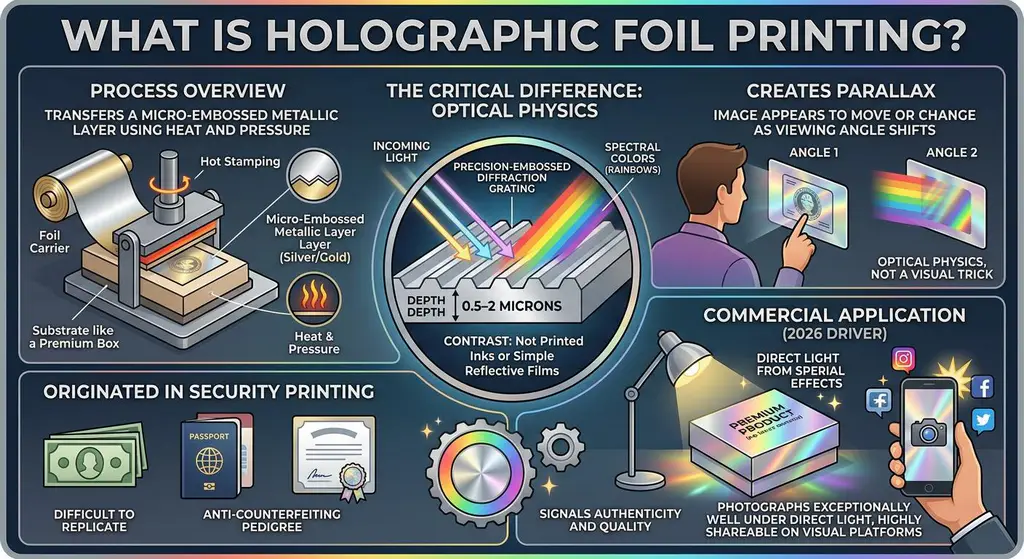
Holographic foil printing transfers a micro-embossed metallic layer onto a substrate using heat and pressure — similar to standard hot stamping foil, but with a critical difference. The foil carrier contains a precision-embossed diffraction grating that splits light into spectral colors, creating the characteristic shifting, three-dimensional appearance.
Unlike printed metallic inks or simple reflective films, true holographic foil creates parallax — the image appears to move or change as the viewing angle shifts. This isn’t a visual trick; it’s optical physics. The embossing pattern on the foil (typically 0.5–2 microns in depth) interferes with light wavelengths to produce the holographic effect.
The technology originated in security printing (banknotes, passports, certificates) where holograms are difficult to replicate. In commercial packaging, that same anti-counterfeiting pedigree signals authenticity and quality to consumers. But the real driver in 2026 is simpler: holographic packaging photographs exceptionally well under direct light, making it highly shareable on visual platforms.
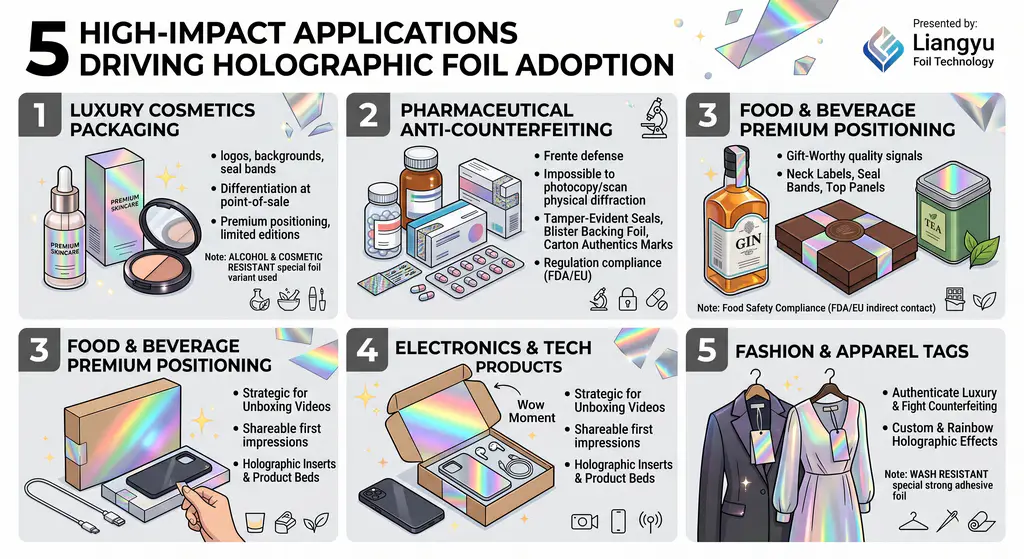
5 High-Impact Applications Driving Holographic Foil Adoption
1. Luxury Cosmetics Packaging
Cosmetics brands were early adopters of holographic foil, and the trend has accelerated. In 2026, premium skincare and makeup lines use holographic effects not just for logos, but for full-panel backgrounds, seal bands, and interior box linings.
The key application is differentiation at point-of-sale. When 12 serums on a Sephora shelf all claim “premium” positioning, the holographic package captures attention first. Brands like Estée Lauder and Charlotte Tilbury have moved from accent holographic logos to full holographic cartons for limited editions.
Technical note: Cosmetics packaging requires holographic foil with alcohol and cosmetic resistance. Standard holographic foils degrade when exposed to fragrance oils or alcohol-based formulations. Our holographic special foil for security includes chemical-resistant variants specifically for this application.
2. Pharmaceutical Anti-Counterfeiting
Counterfeit pharmaceuticals cost the industry an estimated $200 billion annually. Holographic foil is a frontline defense. Unlike printed security features, embossed holograms cannot be photocopied or scanned — the physical diffraction pattern is impossible to replicate without specialized embossing equipment.
In 2026, pharmaceutical holographic applications include:
- Tamper-evident seals with custom holographic patterns
- Blister pack backing foil with embedded holographic strips
- Carton authentication marks visible to distributors and pharmacists
The regulatory push helps adoption. The FDA’s Drug Supply Chain Security Act (DSCSA) and EU’s Falsified Medicines Directive both encourage physical authentication features. Holographic foil satisfies these requirements while adding visual appeal.
3. Food & Beverage Premium Positioning
Craft spirits, premium chocolates, and specialty teas are adopting holographic foil to signal “gift-worthy” quality. The application differs from cosmetics — food packaging typically uses holographic foil for:
- Neck labels on spirits bottles
- Seal bands on premium chocolate boxes
- Top panels on specialty tea tins
The constraint is food safety. Holographic foil used in direct food contact applications must meet FDA 21 CFR 175.105 (indirect food contact) or EU 10/2011 standards. Not all holographic formulations qualify — verify compliance documentation before specifying.
4. Electronics & Tech Products
Unboxing videos have created a new packaging category: “shareable first impressions.” Tech accessory brands (phone cases, earbuds, charging cables) use holographic foil for interior packaging elements that appear in unboxing content.
The application is strategic: the exterior box may be simple black cardboard, but opening reveals a holographic insert or product bed. This creates the “wow moment” that drives social sharing without the cost of full holographic exterior packaging.
5. Fashion & Apparel Tags
Hang tags and woven labels increasingly incorporate holographic elements to combat counterfeiting and signal authenticity. Luxury fashion houses use custom holographic patterns that are difficult for counterfeiters to source, while fast fashion brands use standard rainbow holographic effects for seasonal collections.
The technical challenge is wash resistance. Apparel tags must survive garment handling, storage, and sometimes accidental washing. Holographic foil for textile applications requires stronger adhesive formulations than paper packaging.
Holographic Foil Types: Which Pattern Fits Your Brand?
Not all holographic effects are created equal. The embossing pattern determines the visual result, and different patterns serve different purposes.
| Holographic Type | Visual Effect | Best For | Cost Level |
|---|---|---|---|
| Rainbow / Diffraction | Full spectrum color shift | General premium packaging, seasonal products | $ |
| Silver/Gold Dot Pattern | Subtle shimmer, metallic base | Cosmetics, understated luxury | $ |
| 3D Depth Hologram | Apparent 3D depth, floating images | Security applications, high-value products | $$$ |
| Custom Registered Hologram | Logo or image appears at specific angle | Brand authentication, limited editions | $$$$ |
| Micron Text / Micro-pattern | Tiny text visible only under magnification | Anti-counterfeiting, government documents | $$$ |
| True Color Hologram | Full color image (not just metallic) | High-end collectibles, commemorative packaging | $$$$ |
Key decision factor: Custom holographic patterns require origination — creating the master embossing shim. This costs 2,000–5,000 and takes 4–6 weeks. Standard “stock” holographic patterns are available immediately and cost only the foil itself. For first-time holographic packaging, start with stock patterns to validate market response before investing in custom origination.
2026 Trends: Where Holographic Foil is Heading
Trend 1: Sustainable Holographic Formulations
Traditional holographic foil uses a polyester carrier and metallic aluminum layer — neither recyclable. In 2026, manufacturers are introducing:
- Compostable carriers (cellulose-based)
- Reduced-metal formulations (50% less aluminum)
- Mono-material structures compatible with plastic recycling streams
The performance trade-off is minimal for most applications. We expect sustainable holographic foil to become standard (not premium-priced) within 24 months.
Trend 2: Digital Holographic Integration
Digital printing + holographic foil = short-run customization with premium effects. New systems allow variable data printing over holographic foil backgrounds, enabling:
- Personalized packaging with holographic elements
- Serialized authentication codes on holographic strips
- Regional customization with consistent holographic branding
Trend 3: Micro-Authentication Features
As counterfeiters improve, holographic security features shrink. 2026 sees increased use of micro-text holograms (text smaller than 0.2mm) and nano-scale patterns invisible to the naked eye but detectable with smartphone apps.
Trend 4: Holographic + Tactile Combination
Embossed holographic foil adds texture. The combination of visual holographic effect with tactile embossing (braille patterns, texture gradients) creates multi-sensory packaging that stands out both visually and physically.
Cost vs. Impact: Is Holographic Foil Worth the Investment?
| Cost Component | Standard Foil | Stock Holographic | Custom Holographic |
|---|---|---|---|
| Foil material (per 1,000 impressions) | $15–$25 | $35–$55 | $40–$70 |
| Origination / Setup | $0 | $0 | $2,000–$5,000 |
| Die cost (brass) | $200–$400 | $200–$400 | $300–$600 |
| Production speed | Standard | 10–15% slower | 15–20% slower |
| Impact on shelf | Moderate | High | Very High |
| Break-even run size | N/A | Any volume | 50,000+ units |
ROI calculation: For a cosmetic product selling at 80retailwith600.40 more per unit needs to drive only 0.8% sales increase to break even. Most brands see 5–15% uplift in perceived value from holographic effects — making the investment clearly positive.
How to Specify Holographic Foil for Your Next Project
Step 1: Define the Objective
Step 2: Choose the Pattern Type
Refer to the table above. Start with stock rainbow or dot patterns for market testing. Move to custom holographic only after validating demand.
Step 3: Specify Substrate Compatibility
Holographic foil adhesion varies by substrate. Provide your packaging supplier with:
- Exact substrate material (paper weight, plastic type, coating)
- Expected storage conditions (temperature, humidity)
- Any chemical exposure (cosmetics, cleaning agents)
Step 4: Request Samples
Step 5: Plan for Production
Holographic foil stamping requires precise registration. Allow 10–15% additional setup time compared to standard foil. For custom holographic, add 4–6 weeks lead time for origination.
FAQ: Holographic Foil Printing Questions
Can holographic foil be recycled?
Traditional holographic foil is not recyclable due to the metallic layer and polyester carrier. However, 2026 introduces recyclable and compostable holographic alternatives. Specify “sustainable holographic foil” if environmental credentials matter for your brand.
How long does custom holographic origination take?
4–6 weeks from artwork approval to production-ready master shim. Rush services (2–3 weeks) are available at 30–50% premium. Plan your packaging timeline accordingly.
Does holographic foil work with digital printing?
What's the minimum order quantity for holographic foil?
Next Steps
If you’re calibrating a new line or troubleshooting a defect issue, here’s what we offer:
📩 Free Application Engineering Support — Send us your substrate spec + machine model, and our applications team will provide a custom temperature/pressure/dwell recommendation within 24 hours.
📦 Free Sample Book — Get 12 different foil grades to test on your actual substrate before committing to a roll.
Related guides:
📞 Contact our technical team → — Quote turnaround in 24 hours.
Ready to Add Holographic Impact to Your Packaging?
Holographic foil printing transforms ordinary packaging into shareable, memorable brand experiences. The key is matching the right holographic effect to your application, budget, and production constraints.
At Liangyu Foil, we manufacture holographic foil in stock patterns and custom origination, with formulations for cosmetics, pharmaceuticals, food, and specialty applications. We offer free sample kits showing different holographic effects on various substrates — request yours to see how holographic foil performs on your actual packaging materials.