Knowledge Base • 15 Min Read
Hot Foil Stamping vs Sleeking vs Digital Foil: What You're Actually Buying
Table of Contents
A restaurant owner in Texas ordered 500 gold foil business cards online. When they arrived, he posted on a printing forum: “Gold foil was metallic beige.”
A cosmetics brand manager in London spent £2,000 on “hot stamped” packaging, only to discover the gold effect was flat — no depth, no emboss, no tactile premium feel. Her boss asked: “Why does this look the same as our regular printed boxes?”
These stories are not rare. They happen every day. The reason? The printing industry uses the term “gold foil” to describe at least four completely different processes. Only one of them is true hot foil stamping. The others — sleeking, digital foil, and toner foil — produce visually similar but fundamentally different results.
The Four Metallic Finish Processes
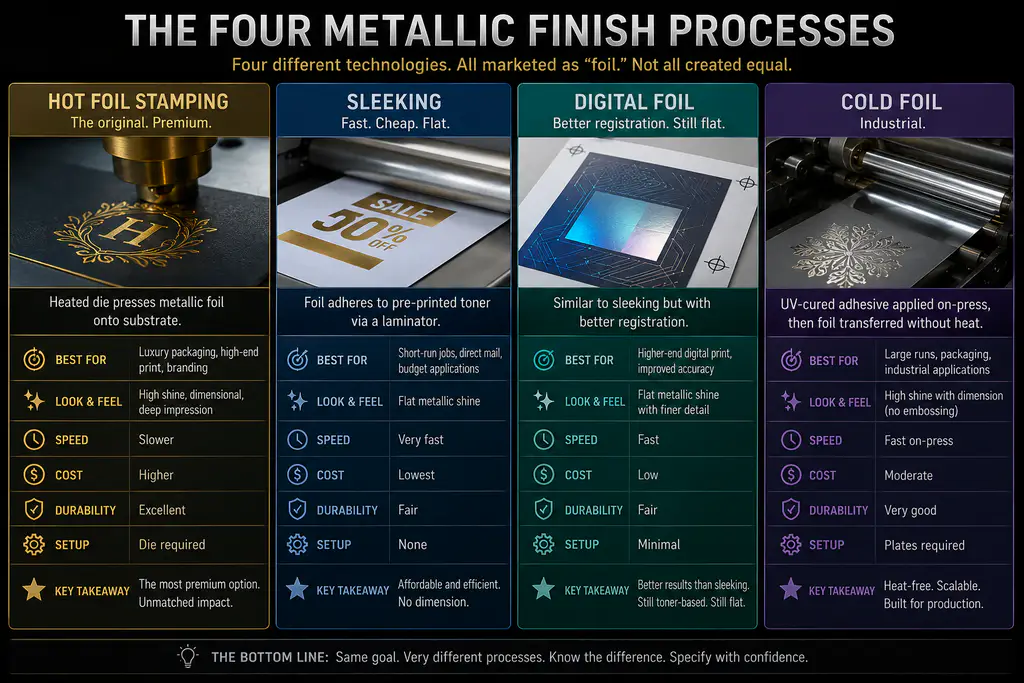
Here’s the landscape. Four distinct technologies, all marketed as “foil” or “metallic finish” to buyers who don’t know the difference:
- Hot Foil Stamping — heated die presses metallic foil onto substrate. The original. Premium.
- Sleeking — foil adheres to pre-printed toner via a laminator. Fast. Cheap. Flat.
- Digital Foil — similar to sleeking but with better registration. Still toner-based. Still flat.
- Cold Foil — UV-cured adhesive applied on-press, then foil transferred without heat. Industrial.
Hot Foil Stamping: The Original Standard
Hot foil stamping has been around since 1892, when Ernst Oeser patented the first hot stamping process in Germany. The technology is straightforward but requires precision:
How it works: A heated metal die (typically brass or copper) presses down through a thin carrier film coated with metallic pigment. Heat and pressure cause the pigment layer to release from the carrier and bond permanently with the substrate surface.
What makes it premium:
- Tactile depth: The die creates a physical impression in the substrate. You can feel the foil is part of the surface, not sitting on top of it.
- True metallic brilliance: The vacuum-metallized aluminum layer in hot stamping foil reflects light like actual metal — because it essentially is.
- Durability: The bond is permanent. Hot-stamped foil on packaging survives rubbing, handling, and environmental exposure.
- Emboss capability: Hot foil can be combined with embossing in a single step (“foil embossing”) to create raised metallic elements — the gold standard for luxury packaging.
The catch: Hot foil stamping requires a custom metal die for each design. Die costs range from $50–$500 depending on size and complexity. This makes it economical for runs of 200+ pieces but expensive for short runs where you’re changing names or details on every card.
Sleeking: The 99% Secret
Sleeking is the process that confused buyer was almost certainly sold. Here’s how it works:
How it works: A design is printed on a digital press using regular CMYK toner. The printed sheet is then run through a laminator-like machine with a metallic foil roll. The foil adheres only to the toner areas — everything else gets rejected.
Why it dominates online:
- No dies needed: Zero tooling cost. Any design can be produced from a digital file.
- Variable data: Every piece can have a different name, number, or design — perfect for business cards with individual employee names.
- Fast turnaround: No die manufacturing time. Print and sleek in the same day.
- Low cost: Suppliers like VistaPrint, Moo, and GotPrint use sleeking because it’s cheap at scale.
Why buyers are disappointed:
- Completely flat: No emboss, no tactile depth. The foil sits on the toner surface.
- Reduced brilliance: Toner-based adhesion doesn’t produce the same mirror-like reflectivity as hot stamping. The result often looks “metallic beige” rather than true gold.
- Durability issues: The foil-toner bond can degrade with rubbing, especially on uncoated stocks.
- Edge quality: Sleeking often produces slightly fuzzy edges compared to the crisp definition of a metal die.
One buyer on a printing forum described the difference perfectly: “I want it to have a premium feel… my boss just wants a slightly sunken in, debossed, effect rather than the logo be raised.” Sleeking can’t deliver either. Only hot foil stamping with a custom die can.
| Holographic Type | Visual Effect | Best For | Cost Level |
|---|---|---|---|
| Rainbow / Diffraction | Full spectrum color shift | General premium packaging, seasonal products | $ |
| Silver/Gold Dot Pattern | Subtle shimmer, metallic base | Cosmetics, understated luxury | $ |
| 3D Depth Hologram | Apparent 3D depth, floating images | Security applications, high-value products | $$$ |
| Custom Registered Hologram | Logo or image appears at specific angle | Brand authentication, limited editions | $$$$ |
| Micron Text / Micro-pattern | Tiny text visible only under magnification | Anti-counterfeiting, government documents | $$$ |
| True Color Hologram | Full color image (not just metallic) | High-end collectibles, commemorative packaging | $$$$ |
Digital Foil: The Newcomer
Digital foil is sleeking’s more sophisticated cousin. The core technology is similar — foil adheres to toner — but the equipment is more advanced.
How it works: A specialized digital press (like the MGI Meteor series) prints a black toner image, then immediately applies foil in a single pass through the machine. The registration is more precise than manual sleeking.
Advantages over sleeking:
- Better registration (foil aligns more precisely with the toner image)
- Wider range of foil finishes (holographic, matte, gloss, patterned)
- Higher consistency across the run
Same limitations as sleeking:
- Still flat — no emboss capability
- Still toner-based adhesion — less durable than hot stamping
- Still doesn’t match the brilliance of true hot foil
Cold Foil: The Industrial Option
Cold foil is primarily used in commercial packaging and label printing — you won’t find it offered on business card websites.
How it works: A UV-curable adhesive is printed onto the substrate using a flexo or offset press. Before the adhesive cures, metallic foil is pressed onto it. UV light then cures the adhesive, bonding the foil permanently. No heat required.
Best for: Wine labels, cosmetic packaging, pharmaceutical packaging, and any high-volume application where metallic effects need to be integrated into the printing process without slowing down the press.
Limitations: Cold foil doesn’t emboss, and the metallic effect is slightly less brilliant than hot foil. But for high-speed packaging lines (10,000+ units), it’s the most cost-effective option.
Side-by-Side Comparison
| Feature | Hot Foil Stamping | Sleeking | Digital Foil | Cold Foil |
|---|---|---|---|---|
| Tactile depth / emboss | Yes — die creates impression | No — completely flat | No — completely flat | No — completely flat |
| Metallic brilliance | ★★★★★ True mirror-like | ★★☆☆☆ “Metallic beige” | ★★★☆☆ Better than sleeking | ★★★★☆ Close to hot foil |
| Custom die required | Yes ($50–$500) | No | No | No (plate required) |
| Variable data | No — fixed die | Yes — every piece different | Yes — every piece different | Limited |
| Durability | Excellent — permanent bond | Poor — rubs off over time | Moderate — better than sleeking | Good — UV-cured bond |
| Minimum run | 200+ (die cost amortization) | 1 piece | 50+ pieces | 5,000+ pieces |
| Setup time | 3–7 days (die manufacturing) | Same day | 1–2 days | 5–10 days (plate + press setup) |
| Typical cost per unit | $0.50–$3.00 | $0.10–$0.50 | $0.30–$1.50 | $0.05–$0.30 |
| Best use case | Luxury packaging, premium cards | Cheap business cards, short runs | Event tickets, certificates | Labels, high-volume packaging |
Which Process Do You Actually Need?
Here’s a decision framework based on what buyers actually ask for:
| Your Situation | Best Process | Why |
|---|---|---|
| “I want premium business cards with a gold logo that feels expensive” | Hot Foil Stamping | Tactile depth + true metallic brilliance = premium feel |
| “I need 500 business cards, each with a different employee name” | Digital Foil | Variable data + better quality than sleeking |
| “I’m on a tight budget and just want something shiny” | Sleeking | Lowest cost, fastest turnaround |
| “We need 50,000 cosmetic boxes with gold accents on the logo” | Cold Foil | High volume + integrated into print line |
| “I want gold foil on leather notebooks” | Hot Foil Stamping | Only hot foil bonds properly to leather |
| “We need holographic security features on event wristbands” | Digital Foil | Holographic patterns + variable data (serial numbers) |
| “I want raised gold text on our wine label” | Hot Foil Stamping | Only hot foil can emboss and foil simultaneously |
5 Red Flags When Ordering Foil Online
Based on the complaints we see from buyers who were sold the wrong process, here are five warning signs:
1. No mention of “die” or “tooling” in the ordering process.
If a supplier offers “gold foil business cards” but never asks about die specifications or charges a tooling fee, you’re almost certainly getting sleeking — not hot foil stamping.
2. Price seems too good to be true.
Real hot foil stamping with a custom brass die costs more. If you’re quoted $30 for 500 gold foil business cards, that’s sleeking. Real hot foil business cards typically start at $150–$300 for 500 pieces including die cost.
3. “Raised” or “embossed” is not offered as an option.
Hot foil stamping can produce flat or embossed results. If embossing isn’t even mentioned, the supplier probably can’t do it — because they’re using sleeking or digital foil.
4. Every card can have different content at no extra charge.
This is a dead giveaway for toner-based processes (sleeking/digital foil). Hot foil stamping uses a fixed physical die — every piece is identical.
5. The word “sleeking” appears anywhere — or “digital enhancement.”
Some honest suppliers will mention sleeking in their fine print. Others use vague terms like “digital metallic enhancement” or “foil fusing.” These are all sleeking variants.
None of these processes are inherently “bad.” Sleeking is excellent for what it does — cheap, fast, variable-data metallic printing. The problem is buyers paying for premium hot foil stamping and receiving sleeking instead.
The Bottom Line
FAQ: Metallic Finish Processes
Can you combine hot foil stamping with sleeking on the same piece?
Yes, but it requires two separate production steps. Some print shops use hot foil for the fixed logo element and sleeking for variable data (names, numbers). It’s uncommon but technically possible.
Is sleeking the same as "foil fusing"?
Yes. “Foil fusing” is another trade name for the sleeking process. Other names include “toner foil,” “digital foil application,” and “foil enhancement.” They all describe the same fundamental process: foil adhering to toner.
Why does my sleeked business card look dull after a few weeks?
The foil-toner bond degrades with abrasion and exposure to oils from handling. This is a fundamental limitation of toner-based processes. Hot foil stamping doesn’t have this problem because the metallic layer bonds directly with the substrate.
Can hot foil stamping work on plastic packaging?
How do I verify my supplier is actually using hot foil stamping?
Ask three questions: (1) “What is the die material?” (brass, copper, or magnesium = hot foil), (2) “Is there a tooling/die charge?” (yes = hot foil), (3) “Can you produce an embossed foil effect?” (yes = hot foil). If the answer to any of these is wrong, you’re not getting hot foil stamping.
Related guides:
📞 Contact our technical team → — Quote turnaround in 24 hours.
Not Sure Which Foil You Need?
With so many metallic finish options — hot foil, sleeking, digital foil, cold foil — choosing the right process and foil grade can be overwhelming. The wrong choice means wasted materials, unhappy clients, and lost margins.