By Liangyu Laser Technical Team | 15-min read
Cold Foil Overprint Adhesion: Why Ink Rubs Off and How to Test It
Table of Contents
Cold foil overprint adhesion is the bond between the printed ink and the transferred decorative surface. If ink rubs off while the metallic layer remains, check the foil grade, ink compatibility, drying or cure, contamination and finishing sequence. Compare unprinted foil, ink on unfoiled stock and ink over foil, then evaluate adhesion and abrasion separately before approving production.
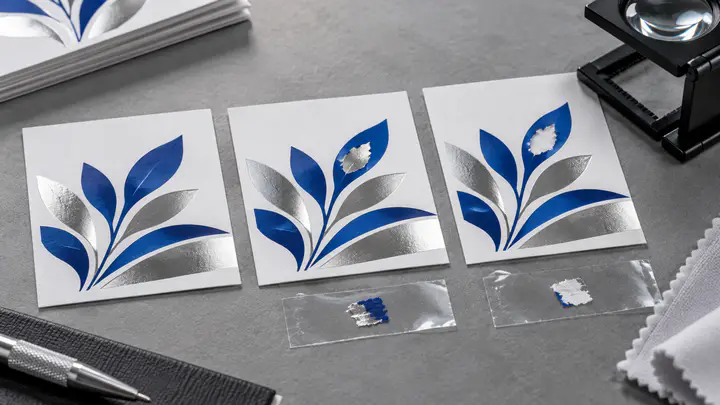
Blue ink on a tape strip tells you little without the matching label. If the silver stays in place, the investigation differs from one where ink and foil lift together. Keep both pieces. A label that looks good at the rewind is not necessarily ready for bottle application, packing or transport.
Key Takeaways
- Ink loss, foil loss and surface scuffing are different observations.
- An overprintable foil still needs validation with the actual ink and finish.
- A tape pass does not establish rub resistance or complete cure.
- Compare matched panels and retain failed samples, not only successful ones.
Evidence and Scope
This guide reviews supplier information and the public scope descriptions of two ASTM practices, checked on October 14, 2026. It focuses on ink printed over cold transfer, especially label production. The diagnostic tables and trial design are editorial guidance, not LiangyuFoil experimental results. Sheet-fed offset drying and UV flexo curing require different material instructions.
Find the Failure Layer Before Changing Materials
Begin cold foil overprint adhesion checks by inspecting the tested panel, removed tape or rubbing receptor, and an untouched reference under suitable magnification. Appearance suggests where to investigate; it does not prove the mechanism.
| Observation | First Investigation | Useful Comparison |
|---|---|---|
| Ink lifts; metallic surface remains. | Ink-to-foil interface or weakness within the ink film. | Same ink on unfoiled stock versus overprinted foil. |
| Ink and metallic layer lift together. | Underlying transfer bond or another weak interface. | Unprinted transferred foil versus overprinted foil. |
| Color smears or transfers during rubbing. | Drying/cure and abrasion performance. | Same finish and test timing on matched panels. |
| Paper fibers tear or stock deforms. | Substrate damage confounding the test. | Untouched stock and a suitable alternative evaluation. |
Why Ink Rubs Off a Cold-Foiled Label
A sound underlying transfer does not confirm that the overprint ink has dried or cured sufficiently. Record ink film application, press speed and the relevant drying or lamp conditions. Dense colors and different laydowns need their own verification. Do not transfer cure settings from the cold foil adhesive to the ink, or assume a dry-feeling surface proves complete cure.
Record ink additions, cleaning residues, storage and handling. Investigate contamination when defects follow fingerprints, contact points or a change in production history. Do not wipe or treat the decorative surface as a routine fix without supplier approval. For cold foil overprint adhesion, an apparent improvement after changing several variables does not identify which change mattered.
Slitting, winding, bottle application and carton contact can expose weaknesses absent from a stationary proof. Include the actual varnish or laminate. A protective coating changes the tested structure; it does not prove that the ink-to-foil bond underneath is sound. Wet handling or product contact requires additional agreed tests.
Testing Cold Foil Overprint Adhesion: Tape Versus Rub
Separate adhesion from resistance to repeated contact. The following chart compares public method scopes; it contains no measured performance scores.
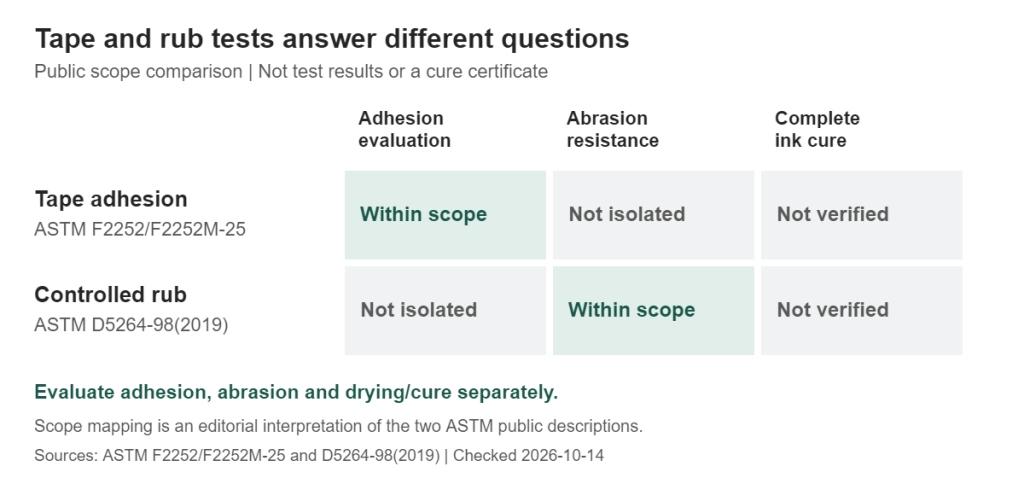
Figure 1. Scope-based comparison using ASTM F2252/F2252M-25 and D5264-98(2019). The scope mapping is editorial interpretation, not a result chart or proof of cure. Source links and readable details follow.
| Evaluation | What It Addresses | Important Limit |
|---|---|---|
| Tape adhesion | Removal of ink or coating under defined tape conditions. | Substrate damage can invalidate interpretation; not an abrasion test. |
| Controlled rub | Wear under specified contact conditions. | Does not isolate the ink-to-foil bond or confirm complete cure. |
| Supplier cure/drying verification | Suitability of the actual ink’s process conditions. | Separate from appearance, tape and rub screening. |
7 Essential Checks for Cold Foil Overprint Adhesion
This is a proposed screening protocol, not a completed experiment. Agree on methods, conditioning, test timing and acceptance before running.
Log facestock, topcoat, transfer adhesive, foil, ink and finishing codes and lots. Include any white underprint. Retain technical sheets and production settings. Do not replace a precise construction with “BOPP plus silver foil.”
2. Record the Complete Material Stack
Panel A is transferred foil without overprint. Panel B is the same ink on unfoiled stock. Panel C is that ink over transferred foil. Include a known passing reference if available. Keep each panel clearly identified and retain an untouched counterpart.
Use the ink supplier’s approved checks at recorded test times. UV and LED compatibility is formulation-specific; conventional offset has its own drying requirements. Do not handle potentially uncured samples without the applicable safety instructions.
Apply the agreed tape evaluation consistently, where appropriate for the stock. Identify which layers moved and whether the stock was damaged. Use separate specimens for later rub evaluation; prior tape damage would confound that comparison.
Record instrument, load, receptor, motion, repetitions and conditioning for the agreed rub evaluation. Examine both panels and receptor. Then check the finished varnished or laminated structure and intended handling. Do not apply one universal rub count to every label.
As an exploratory plan, consider three independent press setups with matched panels collected at predefined positions. This is not a statistical sampling standard. Adjacent labels are not independ
Turn Observations Into Comparable Records
For cold foil overprint adhesion, retain panel IDs, test conditions, layer-loss notes and before/after images. If measuring area loss, define the inspected region, lighting and segmentation method. Report lost ink area separately from lost metallic area. A visual grade is not a measured percentage.
A later results chart should show actual per-run observations and sample counts. No LiangyuFoil dataset is available for this guide, so no failure rates, improvement percentages or cure thresholds are presented.
Frequently Asked Questions
Can I overprint every cold foil?
No universal approval applies. Confirm the grade’s intended ink process, then test the actual ink, drying or curing system and finish. A manufacturer’s overprintability statement is not a guarantee for every combination.
Does ink loss mean the cold foil adhesive is wrong?
Not necessarily. If the metallic layer remains, investigate the ink and decorative surface first. If foil also lifts, assess the underlying transfer and other interfaces. Inspect both the panel and removed material.
Will more UV power fix cold foil overprint adhesion?
Only a controlled, supplier-approved trial can establish whether cure is contributing. More power is not a universal solution to incompatible materials or contamination, and can change thermal exposure.
Is a tape pass enough for shipment?
No. Evaluate rub, finishing and relevant handling separately. A tape result does not establish resistance to transport scuffing, wet exposure or contact with the packaged product.
What should I send for a sample review?
Send substrate, adhesive, foil, ink and varnish codes, press and speed, drying/curing details, test conditions and paired photos showing what stayed and what lifted. Include roll width, quantity and destination.
Request an Overprint-Compatible Foil Sample Review
Investigating cold foil overprint adhesion? Send LiangyuFoil your material stack, ink and foil codes, press conditions and paired failure photos. Ask for a foil recommendation to validate with your ink supplier on the actual finished label.