Knowledge Base • 15 Min Read
3 Proven Ways to Foil Stamp Textured Leather Without Cracking
Table of Contents
Learning how to foil stamp textured leather without cracking is one of the most frustrating challenges in leatherworking. You buy the machine, order the foil, pick a beautiful piece of textured calf leather — and the result looks like a cracked mosaic instead of a clean, golden stamp.
You’re not alone. Even professional leatherworkers struggle with this. “I prefer the blind deboss as well. Once in a while I get a client that requests foil, and it bugs me that I cannot do a good job at it.” That’s from a seasoned artisan with years of experience.
But foil stamp on textured leather isn’t impossible — you just need the right techniques. After 15 years of supplying foil to print shops and leatherworkers, we’ve seen what works and what doesn’t. Here are 3 proven methods that actually deliver clean results.
Why Foil Cracks on Textured Leather
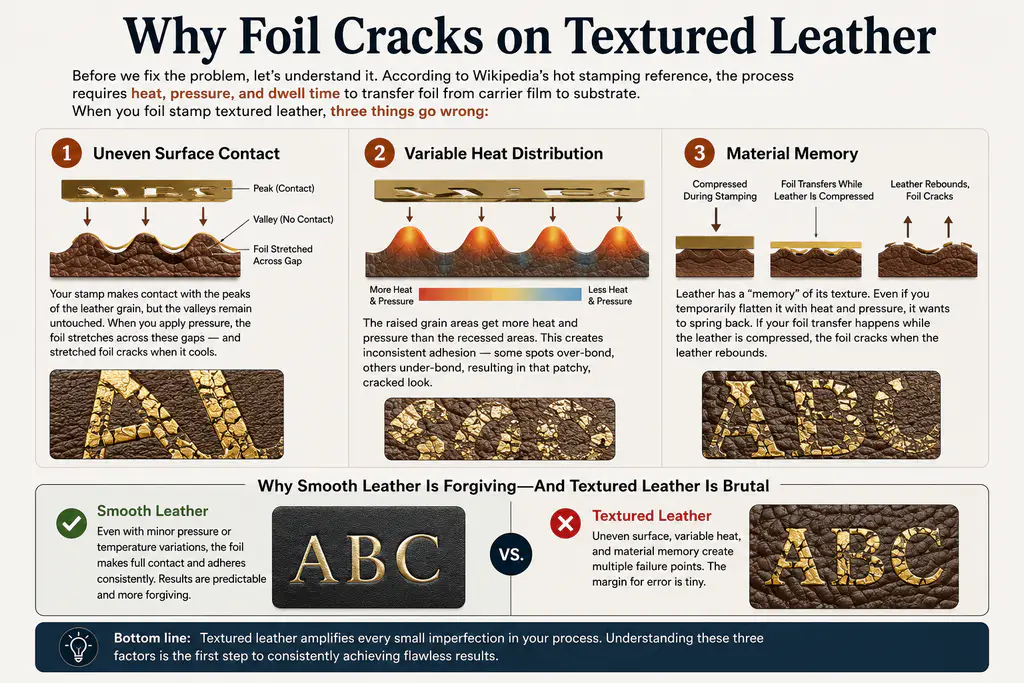
Before we fix the problem, let’s understand it. According to Wikipedia’s hot stamping reference, the process requires heat, pressure, and dwell time to transfer foil from carrier film to substrate. When you foil stamp textured leather, three things go wrong:
1. Uneven Surface Contact
Your stamp makes contact with the peaks of the leather grain, but the valleys remain untouched. When you apply pressure, the foil stretches across these gaps — and stretched foil cracks when it cools.
2. Variable Heat Distribution
The raised grain areas get more heat and pressure than the recessed areas. This creates inconsistent adhesion — some spots over-bond, others under-bond, resulting in that patchy, cracked look.
3. Material Memory
Leather has a “memory” of its texture. Even if you temporarily flatten it with heat and pressure, it wants to spring back. If your foil transfer happens while the leather is compressed, the foil cracks when the leather rebounds.
This is why smooth leather is forgiving and textured leather is brutal. On smooth leather, minor pressure or temperature variations still produce acceptable results. When you foil stamp textured leather, the margin for error is tiny.
Technique 1: The Pre-Flattening Method
This is the simplest approach — and it works surprisingly well when you foil stamp textured leather with medium grain patterns.
What you need:
- A smooth, flat metal plate (or an old brass stamp with no design)
- Your textured leather piece
- Your hot foil stamping machine
The process:
- Heat your machine to 275°F (135°C) — no foil, just heat
- Place the textured leather on the machine bed
- Press the flat plate against the leather for 3-5 seconds with medium pressure
- Remove the plate — the leather is now temporarily flattened
- Immediately (without moving the leather), stamp your design with foil
Why it works: The pre-flattening step compresses the grain structure, creating a smoother surface for foil transfer. The key is doing both steps without moving the leather — if you reposition it, you’re back to trying to foil stamp textured leather with all its uneven surface problems.
Limitations: This works best on lightly to moderately textured leathers. Deep, aggressive textures (like heavy pebble grain) may spring back too quickly or resist flattening altogether.
Technique 2: Kiss Stamping (The Pro Secret)
This is the technique professionals use for fine details when they foil stamp textured leather. One experienced leatherworker described it perfectly: “You’re going to want to just ‘kiss the leather’ with the stamp, anything more when it comes to ‘dwell’ and you’ll get bleed because of the heat. Radiant heat will cause foil adjacent to the die to adhere to the leather.”
“Kiss stamping” means using the minimum pressure and dwell time necessary to transfer the foil — just enough contact to “kiss” the surface, not enough to fully compress it.
How to execute:
- Start with lower pressure than you think you need
- Use shorter dwell time (1-2 seconds instead of 3-4)
- Test on scrap first — you’re looking for clean transfer without squashing the texture
- Increase pressure or dwell time in tiny increments until you get clean results
The risk: Too little pressure and the foil won’t transfer. Too much and you get bleed (foil spreading beyond your design) or the foil cracks when the leather rebounds. The sweet spot is narrow — expect to ruin some scrap leather finding it.
Pro tip: If your design has fine lines or small text, kiss stamping is essential. Heavy pressure on fine details causes the foil to bridge across texture peaks and crack in the valleys.
Technique 3: Foil Selection for Texture
Not all foils behave the same when you foil stamp textured leather. The foil’s “release” characteristics — how easily it separates from the carrier film — make a huge difference.
| Foil Type | Release Characteristic | Best For | Texture Performance |
|---|---|---|---|
| Standard Release | Moderate adhesion | Smooth to lightly textured leather | ⚠️ May crack on medium+ texture |
| Tight Release | Clean, crisp separation | Fine details, all textures | ✅ Recommended for textured leather |
| Leather-Specific | Formulated for leather substrates | All leather types | ✅✅ Best choice for textured leather |
| Pigment Foil | Thicker, opaque layer | Heavy coverage needs | ⚠️ Can crack if over-pressed |
| Metallic Foil | Thin, reflective layer | Gold/silver effects | ⚠️ Shows texture imperfections |
The key insight: One leatherworker specifically searched for “tight release” foil for crisp edges on fine detail — and couldn’t find it. This is a real gap in the market. If you’re struggling to foil stamp textured leather, sourcing leather-specific or tight-release formulations can solve problems that technique alone cannot.
5 Mistakes That Guarantee Cracking
Learn from the failures others have already experienced:
1. Using too much pressure
More pressure doesn’t fix texture — it makes it worse by over-compressing the leather and causing rebound cracking. Start light and increase gradually.
2. Overheating the die
“Hot foil requires a very specific temperature to work properly… Even a degree or 2 can make a large difference.” When you foil stamp textured leather, excess heat causes the foil to activate before full contact, leading to partial transfers and cracking.
3. Moving the leather between steps
If you’re pre-flattening, any repositioning ruins the effect. Mark your leather position with tape or use registration guides.
4. Wrong foil for the job
Standard foils are designed for smooth substrates. Using them on aggressive texture is fighting the material. Match your foil to your substrate.
5. Impatience with testing
“I have so far tried varying the temperature, pressure and dwell time” — but did you test systematically? Random adjustments waste time and material. Change one variable at a time and document results.
Quick Troubleshooting Guide
| Problem | Likely Cause | Solution |
|---|---|---|
| Foil cracks in lines | Over-pressure causing stretch | Reduce pressure, try kiss stamping |
| Patchy transfer | Uneven texture contact | Pre-flatten or increase dwell time slightly |
| Foil bleeds beyond design | Excess heat/pressure | Reduce both, work faster |
| Foil won’t stick at all | Temperature too low or wrong foil type | Verify die face temp with IR thermometer, test different foil |
| Good transfer but cracks later | Leather rebound after compression | Reduce pressure, use leather-specific foil |
When to Skip Foil Altogether
Here’s an honest truth that could save you hours of frustration: sometimes foil is the wrong choice.
One bookbinder put it perfectly: “Blind-stamping is so much more chill than through foil…” That post got 1.1K upvotes for a reason. Blind debossing (stamping without foil) works beautifully on textured leather because:
- No foil to crack or patch
- Texture becomes part of the design aesthetic
- Much wider margin for error on pressure and temperature
- Timeless, premium look that many clients actually prefer
If your client insists on metallic effects but texture is fighting you, consider sleeking as an alternative to traditional hot foil. Sleeking uses toner-reactive foil and doesn’t require the same pressure levels, making it more forgiving on textured substrates.
Bottom line: Master the techniques above for when you need to foil stamp textured leather, but don’t force it when another process would serve your client better.
FAQs: Foil Stamping on Textured Leather
Can you foil stamp on any leather texture?
Does a more expensive machine solve the texture problem?
Not automatically. A Kwikprint or Maxita gives you better temperature stability and pressure consistency — which helps — but the fundamental physics of foil on uneven surfaces remains. Technique and foil selection matter more than machine price.
What's the best temperature to foil stamp textured leather?
Start at 275°F (135°C) and adjust from there. Textured leather often needs slightly higher temperatures than smooth leather to ensure foil activation in the valleys, but this increases bleed risk. It’s a balance.
Can I use a handheld tool to foil stamp textured leather?
Handheld tools (branding irons, foil pens) are especially difficult on texture. “I have never managed to get this to work… the margins for error are tiny.” One experienced user eventually gave up and switched to HTV (heat transfer vinyl). If you must use handheld tools, stick to very light textures and simple designs.
Where can I get leather-specific foil?
Yes, for most users. The Maxita offers better temperature stability, more consistent pressure, and wider availability of compatible supplies. If you’re serious about foil stamping beyond occasional hobby use, the price difference pays for itself in reduced frustration and better results.
Related guides:
📞 Contact our technical team → — Quote turnaround in 24 hours.