Hot Stamping on PP and PE: Adhesion Treatment Guide
Updated September 2026 · Technical Guide
PP and PE can be hot stamped, but reliable adhesion depends on the exact resin, surface condition, pretreatment and foil adhesive system. Do not select foil from the polymer name alone. Identify the molded grade and additives, remove contamination, confirm any surface treatment, then compare foil candidates in a controlled trial.
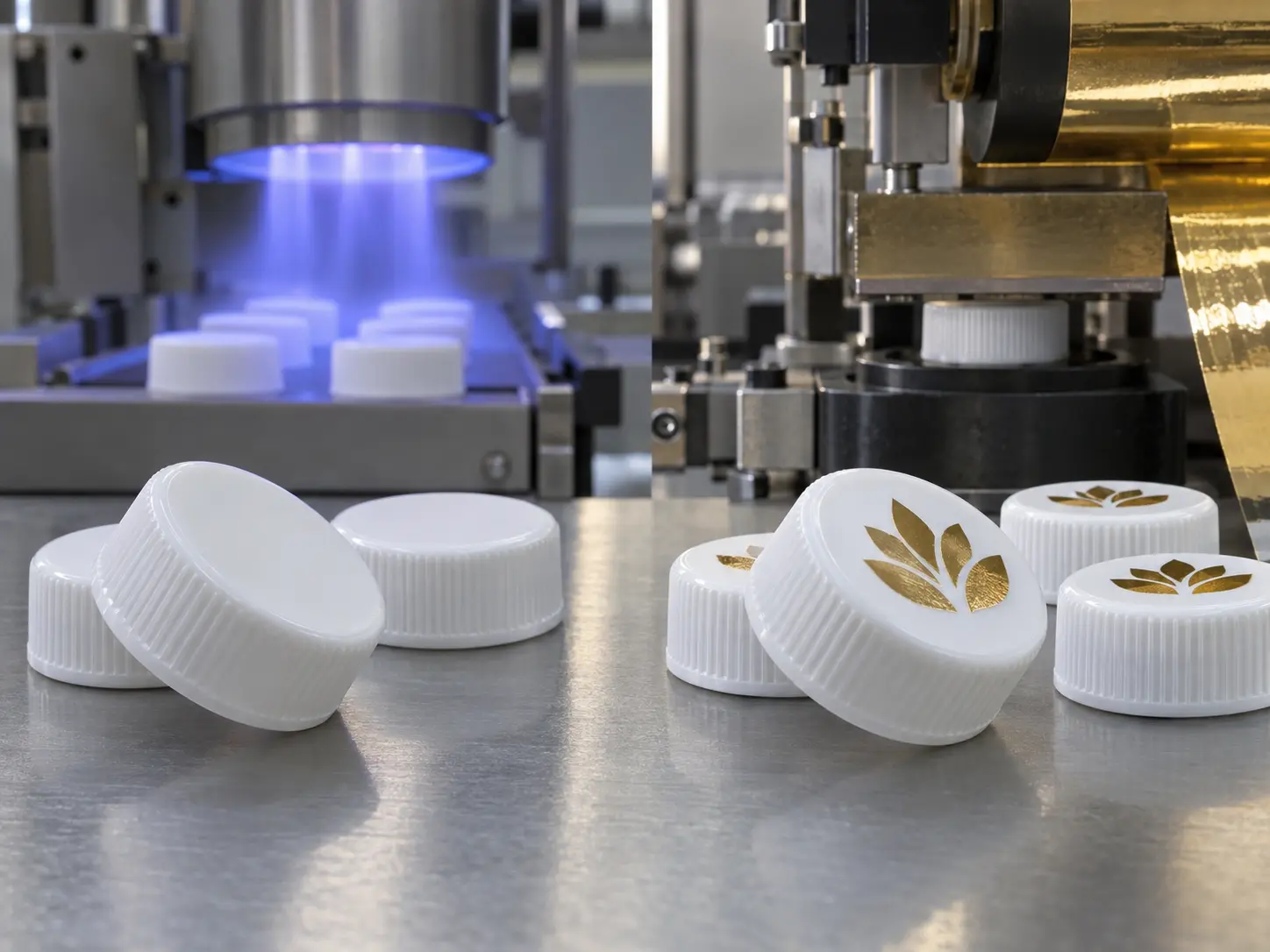
Polypropylene and polyethylene are widely used for caps, closures, household packaging and molded components. Their non-polar surfaces can make decoration less forgiving than on many coated plastics. Mold-release residue, slip additives and recycled-content variation can change the result even when two parts are both labeled “PP.”
Why is hot stamping PP and PE difficult?
The foil’s adhesive layer must wet and bond to the surface while the heated die transfers the decorative layers. A low-energy or contaminated surface can prevent intimate contact. The visible symptom may be incomplete coverage, weak tape-test performance or decoration that releases after handling.
| Variable | Why it matters | What to record |
|---|---|---|
| Resin and grade | PP, HDPE and LDPE are not interchangeable; additives also vary. | Polymer, supplier, grade and recycled content |
| Surface condition | Oil, dust, mold release and blooming additives can block adhesion. | Cleaning method and time since molding |
| Pretreatment | Corona, plasma, flame or a compatible primer may improve wetting. | Method, equipment setting and time to stamping |
| Part geometry | Ribs, curvature and sink marks change contact pressure. | Photos plus decoration area dimensions |
| Foil construction | The adhesive must match the substrate and process window. | Foil code, color and lot |
Do PP and PE always need surface treatment?
Not always, but treatment should be treated as a test variable rather than an assumption. Some parts are supplied pretreated or coated; others may accept a foil designed for the surface. Treatment effectiveness can also decay during storage, so “treated at molding” is incomplete information without timing and handling history.
How should you prepare PP or PE parts?
1. Identify the real substrate
Ask the molder for the exact resin grade, color concentrate, recycled content and known slip or release additives. If that information is unavailable, send representative production parts rather than relying on a generic material label.
2. Remove contamination without damaging the part
Use a cleaning method approved for the resin and end use. Allow the surface to dry fully and avoid touching the decoration area. A cleaning change should be logged as a separate trial condition.
3. Verify treatment close to stamping
Record how the part was treated and the elapsed time before stamping. Do not turn a surface-energy test into the only acceptance criterion: it is a useful process check, while the final decorated part still needs adhesion and end-use evaluation.
How do you select a hot stamping foil for PP or PE?
Send the foil supplier the substrate, part, machine, die type, decoration area, required color, finish and end-use test. A plastic-compatible foil is a starting family, not a universal specification. Metallic shade, pigment layer, release behavior and adhesive system must work together.
LiangyuFoil supplies foil material and sample matching; it does not provide contract stamping services. For a first recommendation, review the hot stamping foil for plastic range and submit actual parts when possible.
What trial matrix should you run?
| Trial | Surface | Foil | Process change | Decision |
|---|---|---|---|---|
| A | Current production surface | Candidate 1 | Baseline | Establish present result |
| B | Freshly treated | Candidate 1 | None | Measure treatment effect |
| C | Best surface | Candidate 2 | None | Compare adhesive systems |
| D | Best surface | Best foil | Small heat/dwell/pressure steps | Find a stable window |
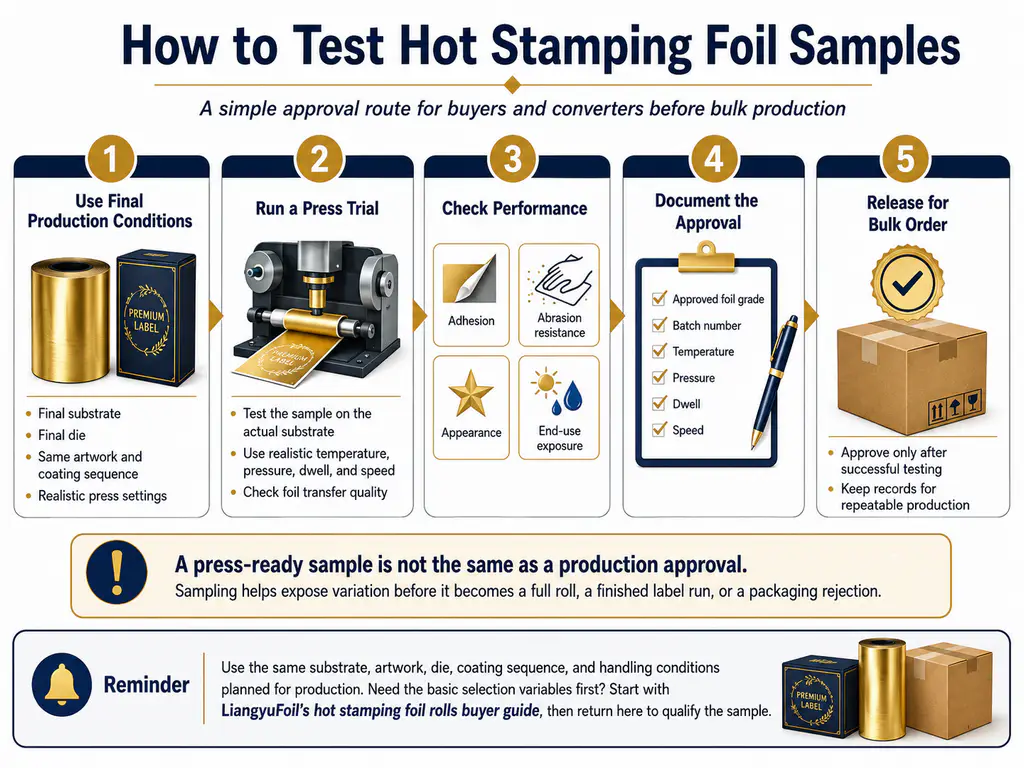
Change one factor at a time and mark every part. Evaluate coverage after cooling, then use the customer’s relevant adhesion, abrasion, chemical or environmental test. Record failures by location; an edge-only defect often points to contact or geometry rather than the entire foil.
Common PP and PE stamping failures
| Symptom | Likely checks | First action |
|---|---|---|
| Foil releases cleanly | Surface treatment, contamination, adhesive compatibility | Compare treated parts and another foil family |
| Patchy transfer | Part flatness, die contact, uneven treatment | Map the defect and inspect support fixture |
| Fine detail bridges | Excess heat, dwell or pressure; die relief | Reduce one variable and inspect die |
| Good initially, poor later | Additive bloom, delayed test, storage condition | Repeat after defined conditioning time |
Get a PP or PE foil recommendation
Send the resin grade, production-part photos, machine/model, die type, required color, roll width and annual demand. A physical sample gives the most reliable matching path.
FAQ
Can hot stamping foil stick directly to untreated PP?
Sometimes, depending on the resin, additives, surface condition and foil adhesive. It should be proven on production parts; treatment or primer may still be required for a stable manufacturing window.
Is corona treatment the same as flame or plasma treatment?
No. They modify surfaces through different equipment and mechanisms. Compare methods using the same parts, foil and test protocol instead of assuming equivalent results.
Why does foil pass immediately but fail later?
Additive migration, incomplete cooling, environmental exposure or a marginal adhesive match may be involved. Define a conditioning period and repeat the end-use test.
What samples should I send?
Send representative molded parts from the intended production material, including color and additives, plus a target color reference and details of the stamping machine and die.