Knowledge Base • 12 Min Read
The Ultimate 2026 Guide to Premium Packaging: Why Advanced Hot Stamping Foils Are Transforming Brand Aesthetics
Table of Contents
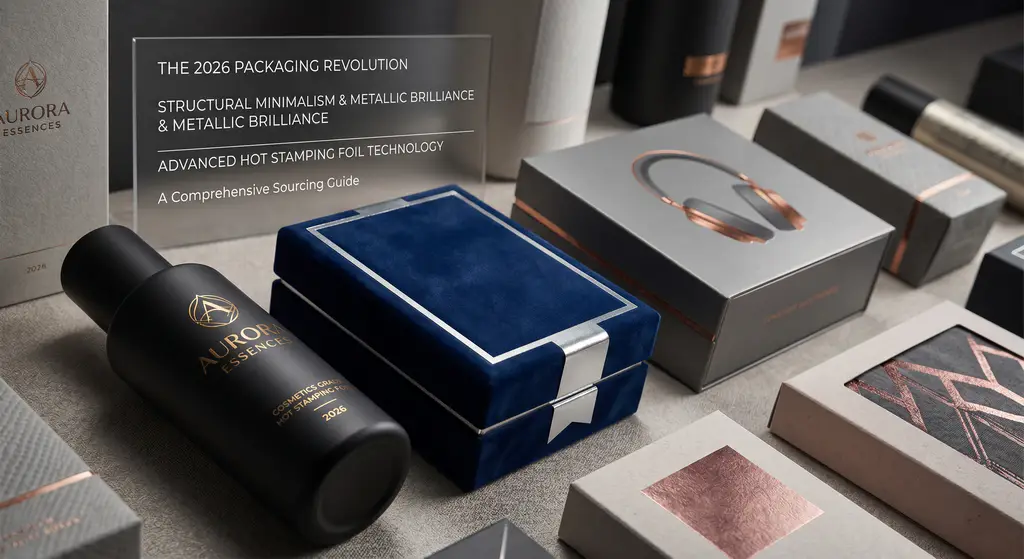
If you walk down the aisle of any high-end retail store in 2026, you will immediately notice a fundamental shift in how brands present themselves. The loud, hyper-colorful designs of the early 2020s are fading. In their place, a new aesthetic has taken over: one defined by structural minimalism, undeniable tactile quality, and the strategic use of metallic brilliance.
For brands competing in cosmetics, luxury goods, consumer electronics, and high-end textiles, packaging is no longer just a protective shell. It is the critical first physical touchpoint with the consumer. And at the center of this packaging revolution is a technology that has been quietly evolving behind the scenes: advanced hot stamping foil.
Whether you are a procurement manager looking to secure reliable supply chains for the upcoming fiscal year, or a packaging engineer trying to balance aesthetic demands with strict environmental compliance, understanding the trajectory of the hot stamping foil market is essential. In this comprehensive guide, we will break down the driving forces behind the 2026 packaging trends, the technical specifications you must demand from your suppliers, and how to source premium materials without compromising your bottom line.
The Data Behind the Shine: Market Realities in 2026
The shift towards metallic and holographic packaging isn’t just an anecdotal design trend; it is backed by staggering financial data. The global hot stamping foil market was valued at USD 2.50 billion in 2025, and it has already surged to an estimated USD 2.69 billion in 2026. Forecasts indicate this trajectory will only accelerate, expanding to a massive USD 5.54 billion by 2036 at a steady 7.5% Compound Annual Growth Rate (CAGR).
What is driving this billions-of-dollars expansion? The answer lies in the escalating demand for premium packaging solutions across various high-margin sectors. Premium packaging effectively communicates brand value and product quality before the consumer even tests the product inside. Hot stamping foils provide a high-end finish with their metallic sheen and intricate designs, making them the undisputed choice for brands aiming to command attention on crowded retail shelves.
Furthermore, the geography of manufacturing is shifting. China currently leads the country-level growth in this sector with a remarkable 10.1% CAGR, underpinned by highly efficient production networks and advanced manufacturing policies. For global buyers, this means partnering with established Chinese manufacturers is no longer just a cost-saving measure—it is a requirement for accessing the latest material innovations.
2026 Design Trends: The Era of "Pure Steel" and Ultra-Clean Industrial
To understand why specific types of foils are in such high demand, we have to look at what creative directors and packaging designers are demanding this year. According to the latest April 2026 design analyses, several core aesthetic movements are dictating material choices.
The most prominent trend currently dominating the landscape is the “Ultra-Clean Industrial” look. This style relies heavily on blocky minimalism, muted base palettes, and extreme ergonomic clarity. However, minimalism without contrast is just boring. To disrupt this minimalism, designers are turning to the “Pure Steel” trend.
We are seeing a massive influx of chrome and brushed metal finishes that provide a futuristic, high-end edge. These finishes catch the light dynamically and provide an instant premium feel that standard CMYK printing simply cannot replicate. Sharp, defined edges paired with strategic foil accents add a layer of sophistication and perceived high-quality engineering.

Technical Nuances: Moving Beyond "Just Shiny Paper"
A common mistake made by junior buyers is treating hot stamping foil as a generic commodity. In the B2B manufacturing world, the nuances matter enormously. When you are dealing with automated printing presses running at high speeds, a slight variance in the foil’s release layer can cause thousands of dollars in wasted substrate and downtime.
Modern hot stamping foils are complex, multi-layered engineered films. They typically consist of a PET (polyethylene terephthalate) base film, coated with a release agent, a color or metallization layer, and finally, a heat-activated adhesive sizing.
The Importance of PET Base Film Thickness
The thickness of the base film is a critical parameter that dictates both the durability of the roll and the precision of the stamp. Industry standards typically offer materials in various micron metrics. For instance, reputable manufacturers engineer their films in precise thicknesses: 12-micron, 15-micron, 19-micron, and 25-micron PET base films.
12 to 15 Micron: This is the industry sweet spot for high-speed, fine-detail stamping on smooth surfaces like coated paper and certain plastics. It allows for sharp edge definition on intricate typography.
19 to 25 Micron: Thicker base films are highly recommended for deep embossing applications, textured substrates (like leather or heavy-grain textiles), or large solid-area stamping where heat dispersion needs to be carefully managed.
If your production team is experiencing flaking, poor adhesion, or webbing issues, the root cause is often a mismatch between the base film thickness and the substrate. We highly recommend reading our deep-dive technical guide on(https://liangyufoil.com/blog/how-to-choose-foil-thickness/) to eliminate these costly production errors.
| Substrate Type | Temperature Range (°C) | Common Mistake |
|---|---|---|
| Uncoated paper | 95–115°C | Operators use 130°C → burns paper |
| Coated paper | 110–125°C | Too low → fuzzy edges |
| PVC labels | 125–140°C | Too high → substrate warps |
| PET / Polyester | 140–160°C | Too low → foil won’t release |
| Polypropylene (PP) | 130–150°C | Critical: PP needs surface treatment first |
| Leather | 100–120°C | Too high → leather darkens permanently |
The Sustainability Question: Reconciling Luxury with Ecology
You cannot discuss packaging in 2026 without addressing sustainability. However, the conversation has matured. Ecology and sustainability in packaging are no longer a passing trend, but a strictly enforced long-term direction.
In the past, metallic packaging was heavily criticized for making paper and plastic substrates difficult to recycle. This year, the regulatory focus for pharmaceutical and cosmetic packaging is firmly on limiting multi-material packaging that is difficult to process.
Does this mean the end of metallic finishes? Absolutely not. In fact, hot stamping is proving to be a highly sustainable alternative to fully metallized laminated boards. Because the hot stamping process only transfers a microscopic layer of aluminum and lacquer (often less than 0.1 microns thick) onto the product, the overall recyclability of the paper or carton is usually unaffected. The PET carrier film—which makes up the bulk of the foil roll—never actually stays on the final product and can often be collected for industrial recycling by the printing facility.
Does this mean the end of metallic finishes? Absolutely not. In fact, hot stamping is proving to be a highly sustainable alternative to fully metallized laminated boards. Because the hot stamping process only transfers a microscopic layer of aluminum and lacquer (often less than 0.1 microns thick) onto the product, the overall recyclability of the paper or carton is usually unaffected. The PET carrier film—which makes up the bulk of the foil roll—never actually stays on the final product and can often be collected for industrial recycling by the printing facility.
When sourcing materials, brands must make informed choices regarding finishes, films, and coatings. Partnering with a manufacturer that utilizes highly efficient, low-waste coating technologies ensures that your premium packaging remains aligned with global circular economy goals.
Strategic Procurement: Finding the Right Alternatives in a Volatile Market
For decades, certain legacy European and American brands dominated the premium foil market. However, with global supply chain pressures and tightening profit margins, procurement managers are increasingly seeking highly reliable, cost-effective alternatives that do not sacrifice an ounce of quality.
This brings us to the importance of vendor qualification. Today’s B2B buyers—often engineers and technical directors—spend months researching online, looking for technical specifications, material certifications, and proof of reliability before ever contacting sales.
When evaluating a new supplier for critical components like stamping foil, look for established trust signals. For example, a supplier holding a “Diamond Member” and “Audited Supplier” status on major B2B trade platforms demonstrates a verified business license and a consistent track record of secure trading.
Furthermore, true manufacturing partners offer extreme versatility. Whether you are stamping on paper, plastic, textile, leather, wood, or glass, the adhesive sizing must be custom-formulated for your substrate. This level of chemical engineering is what separates a true manufacturer from a mere distributor.
| Application Speed | Recommended Dwell Time |
|---|---|
| Manual / desktop | 0.8–1.2 seconds |
| Semi-automatic press | 0.5–0.8 seconds |
| High-speed Bobst Foilmaster | 0.3–0.5 seconds |
Engineer’s tip: If you’re stamping on textured leather or canvas, increase dwell time by 30% to allow heat penetration into the surface peaks and valleys.
24-Hour Adhesion Test (ISO 29862 Compliance)
This is the step that 90% of small print shops skip — and it’s why their clients come back complaining about peeling foil.
After your initial production batch:
- Wait 24 hours at room temperature (20–25°C, 50% humidity)
- Apply 3M Scotch 610 tape firmly across the stamped area
- Pull at a 90° angle with steady force
- Inspect: less than 5% foil lift = passing per ISO 29862
For pharmaceutical or food packaging applications, also conduct the ASTM F2252 peel adhesion test to verify 8–15 cN/25mm release force.
FAQ:Common Questions About Applying Hot Stamping Foil
Can you apply hot stamping foil at home?
Yes — desktop kits like the Minc by Heidi Swapp work for crafts at 90–120°C. However, hobby-grade kits cannot match the ±0.05mm registration required for commercial work. For runs above 500 units, partner with a converter.
How long does hot stamped foil last?
Properly applied hot stamping foil is rated for 5+ years of UV exposure per ISO 2836 solvent resistance standards, and indefinitely when protected indoors.
What's the difference between hot stamping foil and cold foil application?
Hot stamping uses heat + pressure + die. Cold foiling uses UV adhesive + pressure (no heat, no die). See our Cold Foil vs Hot Foil comparison for full technical details.
Do I need different foil for different substrates?
Yes. The release layer chemistry must match substrate energy. Using the wrong grade is the #1 cause of adhesion failure. Always request a substrate-specific recommendation when ordering.
Next Steps
If you’re calibrating a new line or troubleshooting a defect issue, here’s what we offer:
📩 Free Application Engineering Support — Send us your substrate spec + machine model, and our applications team will provide a custom temperature/pressure/dwell recommendation within 24 hours.
📦 Free Sample Book — Get 12 different foil grades to test on your actual substrate before committing to a roll.
Related guides:
📞 Contact our technical team → — Quote turnaround in 24 hours.
Securing Your 2026 Supply Chain
The intersection of the “Ultra-Clean Industrial” aesthetic, the demand for sustainable luxury, and the explosive growth of the global hot stamping foil market creates a unique opportunity for forward-thinking brands. The companies that will dominate retail shelves this year are those that master the balance of striking visual contrast and intelligent material sourcing.