Knowledge Base • 15 Min Read
Budget Hot Foil Stamping Machines: What Actually Works in 2026
Table of Contents
You’re ready to add foil stamping to your small business. Maybe you make leather wallets, personalized journals, or custom gift boxes. You’ve seen the $2,000 professional machines and thought: “There has to be a cheaper way.”
So you searched Amazon. Found machines for $150. Then you searched deeper and saw the same Chinese manufacturers selling direct for $120. But something felt off — “ZoneSun seems to have a number of different domains. Super sketchy to say the least.”
Sound familiar?
You’re not alone. This is the most common question we get from small shop owners: “Are budget hot foil stamping machines actually worth buying?”
The honest answer: Yes and no. Here’s what 15 years of supplying foil to print shops of all sizes has taught us.
What You're Actually Buying
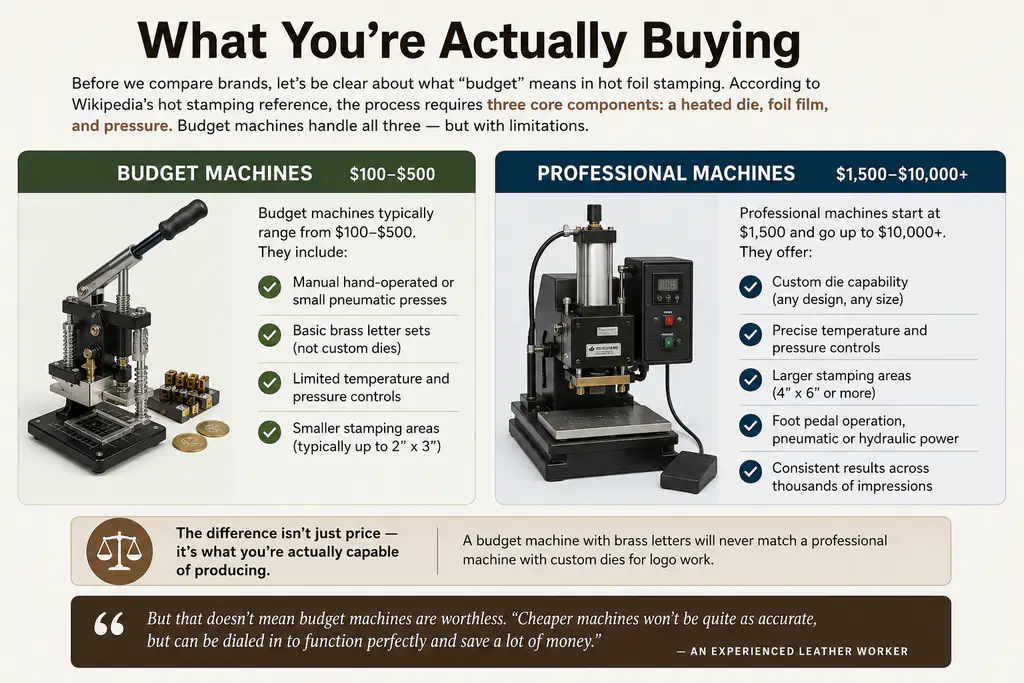
Budget machines typically range from $100–$500. They include:
- Manual hand-operated or small pneumatic presses
- Basic brass letter sets (not custom dies)
- Limited temperature and pressure controls
- Smaller stamping areas (typically up to 2″ x 3″)
Professional machines start at $1,500 and go up to $10,000+. They offer:
- Custom die capability (any design, any size)
- Precise temperature and pressure controls
- Larger stamping areas (4″ x 6″ or more)
- Foot pedal operation, pneumatic or hydraulic power
- Consistent results across thousands of impressions
The difference isn’t just price — it’s what you’re actually capable of producing. A budget machine with brass letters will never match a professional machine with custom dies for logo work.
But that doesn’t mean budget machines are worthless. “Cheaper machines won’t be quite as accurate, but can be dialed in to function perfectly and save a lot of money.” That’s from an experienced leather worker who runs an Amazon budget machine alongside professional equipment.
Budget Machine Options Compared
Here’s a breakdown of the most common budget hot foil stamping machine options:
| Machine | Price Range | Type | Best For | Our Verdict |
|---|---|---|---|---|
| ZoneSun / Generic Chinese | $80–$200 | Manual, tabletop | Complete beginners, very light use | ⚠️ Mixed — quality varies wildly |
| Kwikprint K-5 | $300–$500 | Manual, portable | Small shops, crafters, mobile vendors | ✅ Good starter machine |
| Maxita EC-27 | $400–$700 | Manual, professional-grade | Serious crafters, small business | ✅✅ Recommended |
| Tandy Leather Foil Stamper | $300–$600 | Manual, leather-focused | Leather workers specifically | ✅ Good for leather, limited else |
| DreamFactory Pro | $800–$1,200 | Pneumatic, semi-pro | Growing shops ready to upgrade | ✅✅ Best budget-to-pro bridge |
The key insight: ZoneSun and generic Chinese machines are often the same hardware sold under different brand names. You’re not necessarily getting a worse product — just one without a US-based warranty or customer support.
The Real Pros and Cons
✅ What Budget Machines Do Well
- Great for beginners — Learn the craft without major investment
- Perfect for brass letter stamps — Names, initials, simple text designs
- Ideal for leather work — Wallets, journals, belts, keychains
- Portable — Take to craft shows and markets
- Good enough for many clients — Not every project needs professional quality
❌ Where Budget Machines Fall Short
- Custom logo work is limited — You can’t do the intricate designs a brass die can
- Temperature control issues — “The temperature fluctuated too much with mine.”
- Pressure inconsistency — “It was super difficult to get the table to be even. The stamp was always pushing down harder on one side.”
- Durability concerns — “The tray got super wobbly after a while.”
- Brass letter sourcing — Finding stamps that fit the proprietary holders can be frustrating
That quote about temperature and pressure? That’s from someone who actually owned a budget machine. These aren’t deal-breakers — but they’re real limitations you need to know about before buying.
What to Check Before You Buy
1. Heat Plate Size
What’s the maximum stamping area? Budget machines typically offer 2″ x 3″ or smaller. If you want to stamp larger items (like full-sized notebooks or bag flaps), make sure the machine can handle it.
2. Temperature Range
Different foil types require different temperatures:
- Standard gold/silver foil: 100–130°C
- Pigment foil: 120–150°C
- Holographic foil: 130–160°C
- Leather-specific foil: 100–120°C (leather burns easily)
Make sure the machine can reach the temperatures you need for your foil types.
3. Pressure Mechanism
Manual lever machines are common in the budget range. They’re fine for light use but can cause hand fatigue for larger runs. Pneumatic upgrades (using air pressure instead of manual force) are available for some models but add cost.
4. Compatible Consumables
Can you buy foil, dies, and replacement parts easily? “When I started moving up to custom stamps, it was a pain in the rear to find stamps that worked with the machine since they have their own holder.”
This is a real concern with proprietary systems. Look for machines that accept standard-size brass letters or have widely-available consumables.
5. Return Policy and Warranty
5 Signs of a Quality Budget Machine
Not all budget machines are created equal. Here’s how to spot one worth buying:
1. Solid metal construction
Look for steel or heavy aluminum frames, not thin stamped metal. The machine should feel substantial when you lift it.
2. Adjustable temperature dial (not just on/off)
Fine temperature control is essential for different foil types. Skip machines with just high/medium/low settings.
3. Replaceable heat plates
Heat plates wear out over time. Being able to replace them extends the machine’s life significantly.
4. Standard-size stamp holders
Machines that accept standard 3/4″ or 1″ brass letters give you more sourcing options for consumables.
5. Positive user reviews mentioning durability
Specifically look for reviews from users who’ve had the machine for 6+ months, not just initial impressions.
5 Warning Signs to Walk Away
1. No temperature specification
If the listing doesn’t mention temperature range, assume it has poor thermal control.
2. Only one-size heat plate available
Limited options mean limited versatility.
3. Reviews mentioning electrical issues
A machine that trips breakers or has inconsistent heating is dangerous and unreliable.
4. Difficulty finding foil to fit
If you can’t easily source compatible foil rolls, you’ll waste money on ill-fitting supplies.
5. “Too good to be true” pricing
If a machine that should cost $300 is suddenly $80, something’s wrong. Either the quality is terrible or you’re buying a gray-market product with no support.
Our Honest Recommendation
Here’s our honest take after 15 years in the foil business:
Not sure which foil grade matches your substrate? Send us your material — we’ll test it in our lab and ship back stamped samples with recommended settings.
FAQs: Budget Hot Foil Stamping Machines
Can I use any brand foil in a budget machine?
Mostly yes, but with caveats. Budget machines typically use narrower foil rolls (5mm–25mm width). Standard foil rolls (often 15mm–50mm) may not fit the feed mechanism. Check your machine’s specifications before ordering foil.
How long do budget machines last?
With proper maintenance, a quality budget machine can last 2–5 years with regular use. The most common failure points are: worn heat plates, loose mechanical connections, and failing temperature controls. All are repairable but cost money.
Can I upgrade a budget machine later?
Some budget machines (like certain Tandy models) have upgrade paths to professional accessories. Others are dead ends. Read reviews from long-term users to understand upgrade potential before buying.
What's the biggest mistake beginners make?
Starting with too low temperature because they’re afraid of burning. “I started at 200 degrees C (the lowest this machine goes) and worked my way up to 320 degrees C… My foil won’t stick though even though I’m using as much pressure as I can.” This is usually a temperature calibration issue, not a pressure issue. Buy an infrared thermometer and verify your die face temperature.
Is the Maxita EC-27 really worth the extra money over ZoneSun?
Yes, for most users. The Maxita offers better temperature stability, more consistent pressure, and wider availability of compatible supplies. If you’re serious about foil stamping beyond occasional hobby use, the price difference pays for itself in reduced frustration and better results.
Related guides:
📞 Contact our technical team → — Quote turnaround in 24 hours.