By Liangyu Laser Technical Team | 18-min read
Holographic Cold Foil: Process, Specs, Cost, and Buyer Guide
Table of Contents
When hot stamping foil not stick to coated paper, the usual causes are low surface energy, uncured coating, wax or silicone additives, varnish contamination, insufficient heat, uneven pressure, short dwell time, or a foil adhesive layer that does not match the coating. Test the coated sheet first, then adjust one variable at a time.
Coated paper looks simple from the press operator’s side: smooth sheet, clean artwork, good die, enough foil. But the surface may carry aqueous coating, UV varnish, clay coating, gloss coating, matte coating, soft-touch coating, silicone release contamination, residual solvents, or powder. Each one changes how the foil adhesive wets and anchors to the surface.
Hot stamping foil not stick to coated paper usually means the foil adhesive cannot wet or anchor to the coating. Check coating cure, dyne level, surface contamination, temperature, pressure, dwell time, die condition, and foil grade. If UV varnish, wax, silicone, or low-surface-energy coating is present, use treatment, primer, or a foil formulated for difficult coated stocks.
| Symptom | Likely cause | First fix to test |
|---|---|---|
| Foil peels after tape test | Low surface energy or uncured coating | Check dyne level, cure, and coating age |
| Patchy transfer | Uneven pressure, rough coating, wrong release | Increase pressure evenly, test a different foil grade |
| Dull metallic finish | Too much heat, coating interaction, overpressure | Lower heat or pressure in small steps |
| Ghosting or drag marks | Die too hot, sheet movement, foil release mismatch | Reduce heat, check registration and foil tension |
| Blistering | Trapped solvent, moisture, or uncured varnish | Allow cure time, test moisture and coating condition |
| Fine detail missing | Die issue, low dwell, coating too slick | Check die face, increase dwell, use a sharper foil grade |
Coating Chemistry and Surface Energy
When hot stamping foil not stick to coated paper, start with the coating, not the foil. A coated sheet can look printable but still reject foil because the surface energy is too low, the coating is not fully cured, or additives are blocking adhesion.
Common coated paper surfaces include:
| Coating type | What can go wrong during hot stamping |
|---|---|
| Aqueous coating | May contain waxes or slip additives that reduce wetting |
| UV coating / UV varnish | Can be very slick; uncured UV layers can migrate or block adhesion |
| Clay-coated paper | Usually printable, but surface smoothness and binder chemistry vary |
| Gloss varnish | Can resist foil adhesive if surface energy is low |
| Matte varnish | Can transfer unevenly if the surface is porous or additive-rich |
| Soft-touch coating | Often difficult because of low-energy feel and rubbery surface |
| Laminated film on paper | Behaves more like film than paper; needs film-compatible foil |
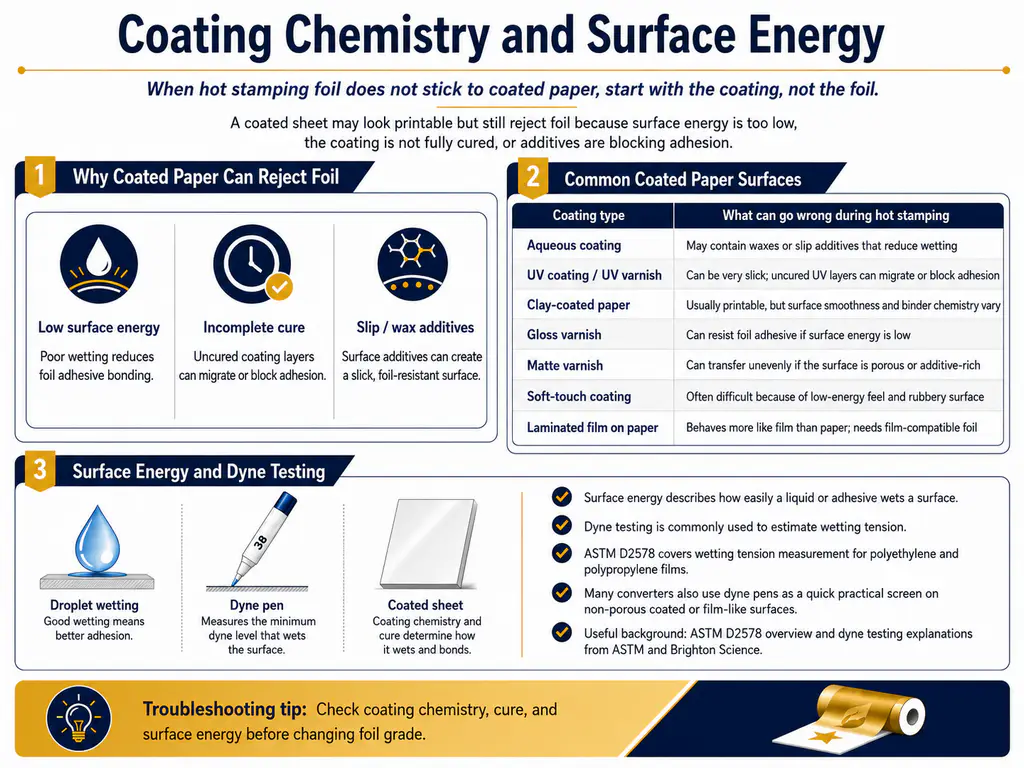
For practical shop-floor screening, many printers treat the following as a starting guide, not a universal rule:
| Surface reading | What it suggests | Action |
|---|---|---|
| Below 36 dynes/cm | High risk for adhesion | Test primer, treatment, or another foil grade |
| 38-42 dynes/cm | Possible, but needs trial | Run tape/rub tests before approval |
| 42+ dynes/cm | Better wetting potential | Still test coating chemistry and cure |
Dyne level is not a guarantee. It predicts wetting, not final bond strength. A sheet can show acceptable dyne reading and still fail because of wax, silicone, uncured UV coating, residual solvent, powder, moisture, or a foil adhesive mismatch.
Press Parameters: Heat, Pressure, Dwell Time, Speed, and Die Condition
If hot stamping foil not stick to coated paper after the coating passes basic checks, move to the press triangle: heat, pressure, and dwell time. Speed and die condition control how consistently those three variables reach the sheet.
Use these starting ranges for testing. They are not final settings; every foil grade, die size, coating, and machine behaves differently.
| Coated paper surface | Starting temperature | Pressure direction | Dwell / speed note |
|---|---|---|---|
| Clay-coated paperboard | 220-280 deg F | Medium, even pressure | Normal dwell, adjust for large solids |
| Gloss aqueous coating | 230-290 deg F | Medium pressure | Increase dwell before raising heat too far |
| Matte aqueous coating | 240-300 deg F | Medium to higher pressure | Watch for pinholes and dullness |
| UV-coated sheet | 250-320 deg F | Medium pressure, tested carefully | Verify UV cure before adding heat |
| Soft-touch coating | 230-300 deg F | Light to medium pressure | Avoid crushing or gloss change |
| Film-laminated coated paper | 220-300 deg F | Medium pressure | Treat like film; test compatible foil |
Safe adjustment method:
- Start with supplier-recommended foil temperature.
- Run a small test at low-to-medium pressure.
- Increase pressure first if the image is incomplete but the foil looks clean.
- Increase dwell time if adhesion is weak but detail is acceptable.
- Raise temperature in small steps only after pressure and dwell are stable.
- Change only one variable per test strip.
- Keep one approved sheet from every setting as a control.
Die condition matters more than many teams expect. A worn, uneven, contaminated, or poorly mounted die creates partial contact. Too much polishing can reduce edge bite. Too little depth can starve textured coated stocks. Uneven makeready can make the operator chase temperature when the real issue is contact pressure.
Foil Types, Primers, Pretreatments, and a Systematic Checklist
If hot stamping foil not stick to coated paper, do not keep raising heat until the sheet burns or the metallic layer dulls. The foil adhesive layer may simply be wrong for the coating. Some foils release well on paper but fail on UV varnish, matte coating, laminated board, or additive-rich aqueous coating.
Material options to test:
| Option | When to use it |
|---|---|
| Standard paper hot stamping foil | Clean coated paper with normal surface energy |
| Difficult-substrate foil | Slick coatings, UV varnish, matte coatings, low-energy surfaces |
| Low-temperature foil | Heat-sensitive coated or laminated sheets |
| High-release foil | Fine detail or lower dwell setups |
| Strong-adhesion foil | Tape-test or rub-test failures |
| Primer before stamping | Low dyne or coating chemistry blocks adhesion |
| Corona / flame / plasma treatment | Film-like laminated surfaces or very low surface energy |
| Cold foil transfer | Roll labels or large metallic areas on compatible printed adhesive |
| Digital foil / sleeking | Short-run coated print where toner/digital adhesive is the bonding layer |
Pretreatment should be tested cautiously on coated paper. Corona and flame are common for films and some laminated surfaces, but they can damage paper coating if overused. Chemical primers can improve adhesion, but they may change gloss, color, ink trapping, odor, or food/cosmetic packaging suitability.
Use this troubleshooting checklist:
| Symptom | Possible cause | First correction |
|---|---|---|
| Foil rubs off cleanly | Low surface energy or wrong adhesive layer | Test stronger-adhesion foil or primer |
| Foil sticks only at edges | Pressure imbalance or die contact issue | Remake makeready, inspect die flatness |
| Foil transfers but peels later | Uncured coating or weak bond | Allow cure time, tape test after 24 hours |
| Large solid area is patchy | Too little pressure, uneven coating, wrong release | Increase pressure, test another foil release |
| Fine lines fill in | Too much pressure or heat | Reduce pressure, check die and artwork |
| Metallic layer looks cloudy | Heat too high or coating interaction | Lower temperature and test another grade |
| Random spots fail | Dust, spray powder, oil, silicone, fingerprints | Clean sheet path and test fresh sheets |
The fastest test protocol is a variable ladder: same sheet, same die, same foil, only one setting changed per strip. Then repeat with a different foil grade if the setting ladder fails.
Alternatives, Run Recipes, and Visual Failure Modes
When hot stamping foil not stick to coated paper, the best fix is not always more hot stamping pressure. Some jobs should move to cold foil, digital foil, primer, or a hybrid process.
Consider alternatives when:
- The sheet has heavy UV coating and refuses to pass tape testing.
- The design needs a large metallic area across a roll-fed label.
- The run is short and the buyer wants fast sampling.
- The substrate is laminated film over paper.
- The finish must sit over digital toner or variable graphics.
- The brand can accept a printed adhesive foil look instead of die-stamped foil.
Example run recipes for testing:
| Surface | Recipe A | Recipe B | Recipe C |
|---|---|---|---|
| Gloss aqueous-coated paper | 250 deg F, medium pressure, normal dwell | 270 deg F, same pressure, longer dwell | Strong-adhesion foil at 250-270 deg F |
| Matte aqueous-coated board | 260 deg F, medium-high pressure | 280 deg F, same pressure | Different foil release for rougher surface |
| UV-coated sheet | Confirm cure, 260 deg F test | 285 deg F with controlled dwell | Primer or difficult-substrate foil |
| Soft-touch coated carton | 240 deg F, light-medium pressure | 260 deg F, same dwell | Low-temperature foil, check gloss change |
| Film-laminated paper | Treat as film, compatible foil | Surface treatment if appropriate | Cold foil/digital foil alternative |
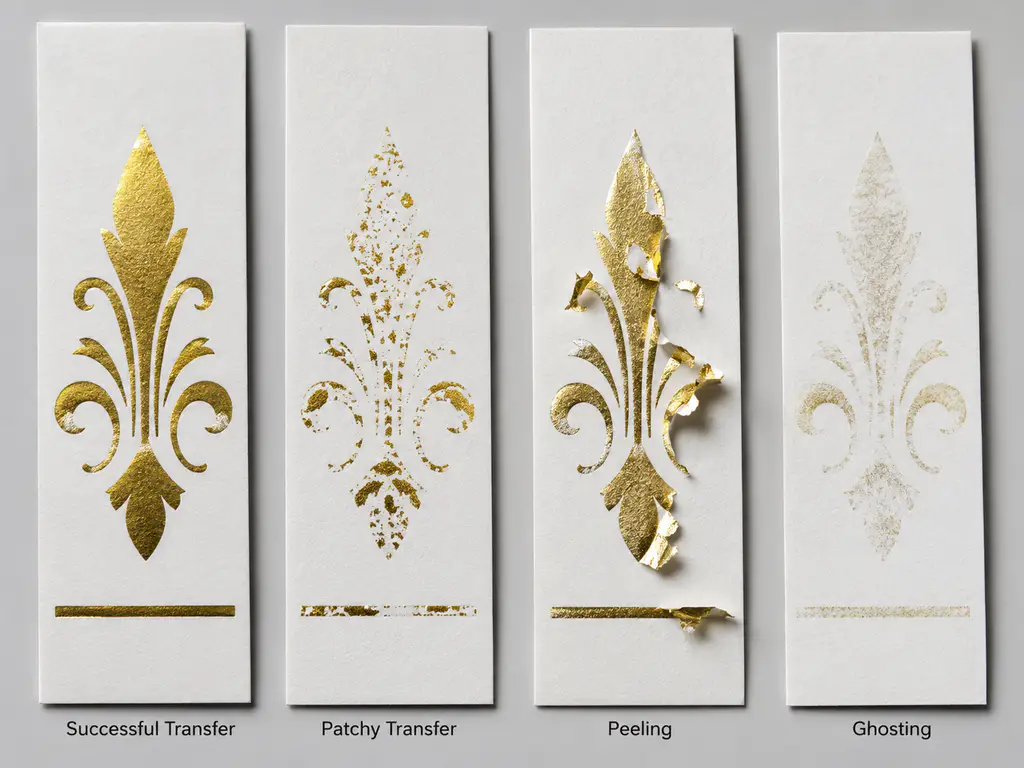
Visual failure guide:
| Visual failure | What it means | Fix |
|---|---|---|
| Partial transfer | Contact or release is inconsistent | Check pressure map, die, foil grade |
| Ghosting | Sheet/foil movement or excessive heat | Check tension, temperature, dwell |
| Blistering | Moisture, solvent, uncured coating, trapped gas | Cure sheet, reduce heat, test fresh stock |
| Wrinkling | Heat or pressure distorts surface | Lower temperature, reduce dwell |
| Colored stain around foil | Coating or ink reacts under heat | Lower heat, change coating/foil combination |
| Peeling after 24 hours | Weak final bond | Test primer, stronger adhesive foil, cure time |
Shop-Floor Test Protocol Before a Full Run
Before approving production, print a small test sheet that isolates variables. This helps prevent wasting a full stack of coated board.
Recommended protocol:
- Confirm coating type: aqueous, UV, varnish, clay coat, soft-touch, or lamination.
- Check cure time and sheet storage conditions.
- Clean the test area and avoid fingerprints.
- Run a dyne or wetting test if the surface is non-porous enough for it.
- Stamp a ladder test at three temperatures.
- Repeat with pressure changes.
- Repeat with dwell/speed changes.
- Test a second foil grade before changing the die.
- Run tape test, rub test, fold test, and 24-hour recheck.
- Record the winning recipe with sheet batch, foil batch, die, machine, and settings.
The key is discipline. Randomly changing heat, pressure, foil, and speed together hides the real cause.
FAQ
What temperature is recommended for hot stamping foil on coated paper?
Most coated paper tests start around 220-320 deg F, depending on coating, foil grade, die area, and machine type. Clay-coated board may start lower, while UV-coated or difficult varnished sheets may need controlled higher testing. Always adjust in small steps.
How do I perform a quick adhesion test before running a full print job?
Run a small foil ladder test, wait for the sheet to cool, then perform a tape test and rub test. For critical packaging, repeat after 24 hours because uncured coating, residual solvent, or weak bonding can show delayed failure.
Which foil works best on UV-coated or varnished stocks?
UV-coated or varnished stocks often need a strong-adhesion foil, difficult-substrate foil, low-temperature foil, primer, or surface treatment. The right choice depends on cure level, surface energy, coating chemistry, and the required finish.
When should I use corona, flame, or primer to improve adhesion?
Use corona, flame, or primer only after testing confirms low surface energy or poor wetting. These treatments are more common on film-like or laminated surfaces. On coated paper, over-treatment can damage gloss, color, or coating integrity.
What are the common failure modes on coated paper?
Common failure modes include partial transfer, ghosting, blistering, peeling, dull metallic effect, wrinkling, cracking on folds, and random unprinted spots. Each points to different causes such as coating cure, pressure, heat, contamination, foil release, or die condition.
Is cold foil or digital foiling better for heavily coated papers?
Sometimes. Cold foil can work well for roll-fed labels with printable adhesive, while digital foil can suit short-run coated prints using toner or digital adhesive. If hot foil keeps failing on slick coatings, test the alternative process before forcing the same recipe.