
Flatbed vs. Cylinder vs. Rotary Hot Stamping: Matching Foil Release Force to Your Press
On This Page
Quick Answer & Technical Summary
Selecting the right hot stamping foil is not just about color or substrate adhesion—it requires matching the foil's release force (how easily the metallic layer separates from the PET carrier film) to your press geometry and dwell time:
- Flatbed & Clamshell Presses: Use easy-to-medium release foils for large solid areas to avoid air entrapment and sticking, and medium release for general packaging.
- Cylinder Presses: Use medium release foils; the rolling line-contact nip peels the carrier progressively, making cylinder presses forgiving for mixed fine-line and solid layouts.
- High-Speed Rotary Presses: Use tight-to-medium release foils engineered for millisecond dwell times and rapid stripping without premature flaking or edge feathering.
1. What Is Foil Release Force?
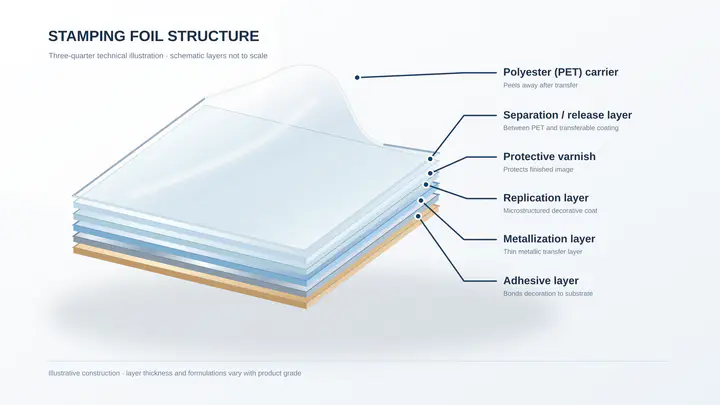
Every hot stamping foil consists of a PET carrier film, a heat-activated release layer, a lacquer/color coat, a vacuum-metallized aluminum layer, and a sizing (adhesive) layer. When heated by the stamping die, the release layer melts or softens so the decorative layers separate cleanly from the PET carrier and bond to the substrate.
Release force measures the peel strength required to separate those decorative layers from the PET carrier under heat and tension (typically benchmarked in the range of 8–15 cN/25mm per ISO 29862, as noted in our foil stamping process guide).
In production, foil grades are grouped into three practical release profiles:
- Easy (Loose) Release: Separates rapidly at lower temperatures and pressures. Ideal for large solid coverage, rough or uncoated paperboard, and slower dwell-heavy presses where clean full-area transfer is the priority.
- Medium (Universal) Release: Balances clean release with sharp edge definition. Handles mixed layouts containing both medium solids and standard typography.
- Tight Release: Requires higher thermal energy or sharper nip pressure to break away from the carrier. Prevents "bridging" (foil filling in between tight letters), making it essential for micro-text, fine filigree, and high-speed rotary label presses.
2. How Press Geometry Changes Release Requirements
The mechanical way your press brings the heated die, foil web, and substrate together dictates how much heat reaches the release layer and how fast the carrier strips away.
Flatbed & Clamshell Presses (Area Contact)
Flatbed presses (vertical platen or clamshell) stamp the entire image area simultaneously. Because the whole die contacts the foil at once:
- Dwell time is longer (typically 0.3–1.0 seconds), giving heat ample time to activate the release layer.
- Air entrapment risk is higher on large solid blocks, because air cannot easily escape from the center of a flat die.
- Recommended Foil: Choose an easy-to-medium release grade for broad solids and heavy coverage so the foil releases cleanly before the platen opens. Reserve tight release only if the job consists strictly of fine serif text or intricate borders on smooth coated stock.
Cylinder Presses (Line Contact)
Cylinder presses wrap the sheet around an impression cylinder that rolls past a flat heated die (or vice versa). Contact happens along a narrow moving line rather than across the entire sheet at once:
- Progressive peeling naturally pushes air out ahead of the nip, reducing pinholing on large solids.
- Higher mechanical shear at the nip helps break the foil cleanly at the edges of fine artwork.
- Recommended Foil: A medium release universal packaging grade covers most commercial carton and greeting card work on cylinder presses.
High-Speed Rotary Presses (Continuous Web)
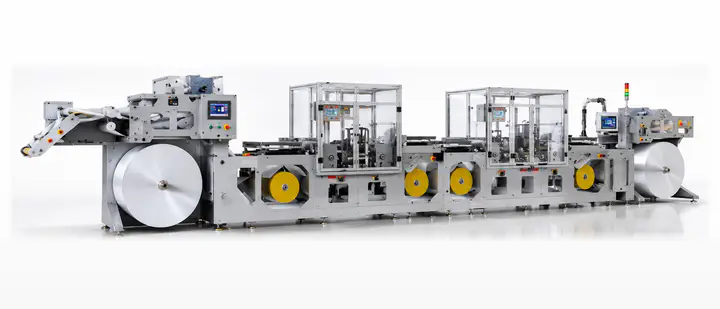
Rotary hot stamping units—common in narrow-web label printing and high-volume carton lines—use a cylindrical engraved brass die spinning continuously against an impression roller:
- Dwell time drops to milliseconds, meaning the foil has a fraction of a second to absorb heat, activate the adhesive, and release.
- Web tension and stripping angles are much higher than on sheet-fed presses. If the release layer is too loose, vibration and web tension can cause premature flaking or dirty edges (feathering) before or after the nip.
- Recommended Foil: Specify a tight-to-medium, high-speed rotary grade paired with higher die surface temperatures (often 130–170°C depending on line speed) and a properly matched brass or engraved rotary die.
3. Press & Release Force Comparison Matrix
| Press Type | Contact Mode | Typical Dwell Time | Key Challenge | Recommended Release Profile | Best Artwork Fit |
|---|---|---|---|---|---|
| Flatbed / Clamshell | Full area (simultaneous) | 0.3 – 1.0 s | Air entrapment on solids; slow peel | Easy to Medium | Large solids, rigid boxes, heavy coverage |
| Cylinder | Moving line contact | 0.05 – 0.2 s | Balancing nip pressure across mixed layouts | Medium | Mixed solids + fine text on folding cartons |
| High-Speed Rotary | Continuous cylinder nip | < 0.02 s | Short heat transfer; high web tension | Tight to Medium (Rotary) | High-speed labels, fine lines, continuous runs |
4. Diagnosing a Release-Force Mismatch on Press
Before changing die temperature excessively, check whether the symptoms on your press point to a release-force mismatch rather than an adhesive or substrate issue:
- Bridging or "Filling In" Between Fine Letters: Your foil release is too easy (loose) for the artwork or press temperature. The heat radiates slightly beyond the die edge and pulls adjacent foil onto the paper. Fix: Lower die temperature slightly or switch to a tighter release grade.
- Incomplete Transfer or Pinholing on Solids: Your foil release is too tight for the dwell time or platen pressure, or air is trapped under a flatbed die. Fix: Increase dwell time/pressure slightly, check die leveling, or switch to an easier release grade.
- Edge Feathering / Stringing on Rotary Lines: Web tension or stripping angle is tearing a loose release layer after the nip. Fix: Check stripper bar angle, stabilize web tension, and test a rotary-formulated tight release foil.
For step-by-step press calibration, see our 7-step hot stamping application guide. If your defect occurs specifically on coated paperboard, review our coated paper adhesion troubleshooting checklist.
5. What to Share When Requesting Samples from LiangyuFoil
Because the same metallic gold shade can be coated with different release formulations, sharing your press details upfront prevents wasted trial runs. When submitting a sample or quote request, include:
- Press type & model (flatbed, clamshell, cylinder, or rotary) and typical running speed.
- Artwork profile (fine text under 0.3 mm, mixed layout, or large solid blocks).
- Exact substrate & surface finish (uncoated paper, coated board, OPP/soft-touch laminate, UV varnish, or plastic).
- Die material (magnesium, copper, brass, or silicone—see our stamping dies guide).
- Roll dimensions (width, length, 1" or 3" core, and winding direction).
Frequently Asked Questions (FAQ)
Can I use the same hot stamping foil on both a flatbed press and a rotary press?
Sometimes on medium-coverage jobs at moderate speeds, a universal medium-release grade will run on both. However, high-speed rotary presses have millisecond dwell times and high web tension, so running a flatbed easy-release foil on a rotary press often causes bridging or dirty edges.
Does a tighter release foil always require higher die temperature?
Generally, yes. Tight-release foils are formulated to resist premature transfer around fine edges, so they typically need slightly higher die temperature or nip pressure to activate cleanly—especially as press speed increases.
Why does my foil bridge between small letters even when the temperature is lowered?
If lowering the temperature causes incomplete transfer before bridging stops, the foil's release layer is too loose for your fine artwork. Switching to a tight-release grade designed for fine detail resolves bridging without sacrificing solid adhesion.