By Liangyu Laser Technical Team | 18-min read
Hot Foil Stamping Dies: How to Choose Magnesium, Copper, Brass or Silicone
Table of Contents
- 1. What Are Hot Foil Stamping Dies?
- 2. Die Materials: Magnesium vs Copper vs Brass vs Silicone
- 3. When to Use Magnesium Dies
- 4. When to Use Copper Dies
- 5. When to Use Brass Dies
- 6. Artwork and Engraving Details Buyers Should Check
- 7. Substrate Matters as Much as Die Material
- 8. Die Ordering Checklist
- 9. Common Die Problems and How to Prevent Them
- 10. Hot Foil Stamping Dies vs Cold Foil and Digital Foil Tooling
Choose magnesium for fast, simple short runs; copper for medium runs and finer detail; brass for long-run, embossing and premium packaging; silicone for curved parts. Confirm artwork, substrate and press conditions before ordering.
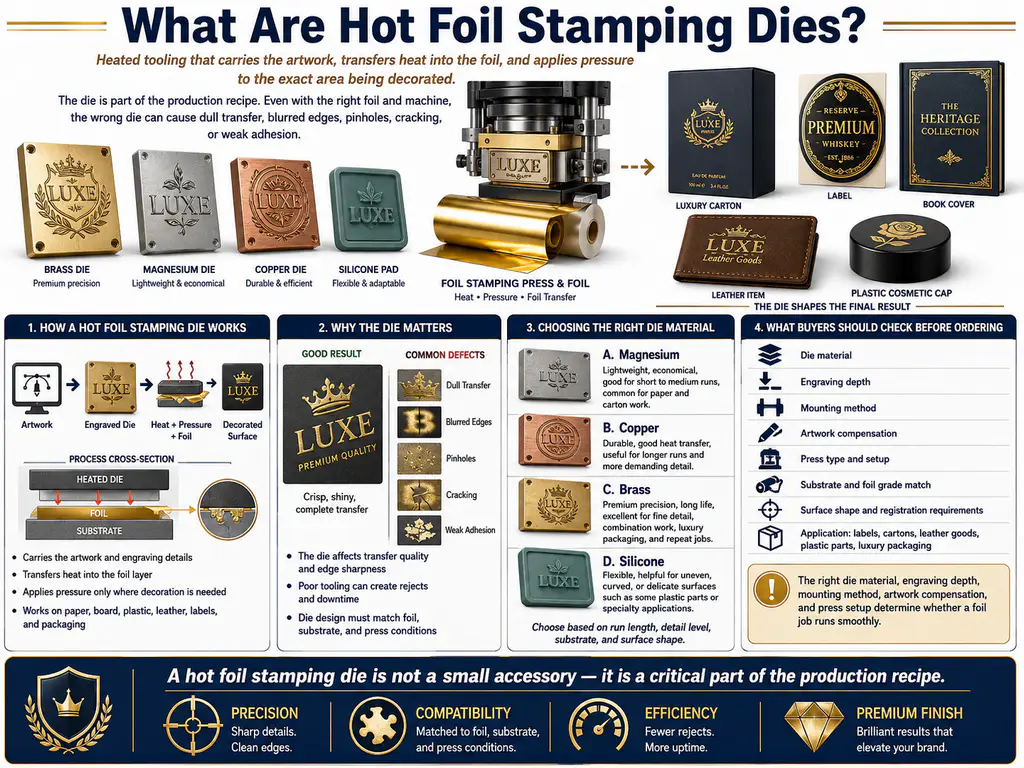
Hot foil stamping dies are the heated tools that press foil onto paper, board, plastic, leather, labels, book covers, and packaging. They carry the artwork, transfer heat into the foil, and apply pressure to the exact area that needs decoration. If the die is wrong, even a good foil roll and a good machine can produce dull transfer, blurred edges, pinholes, cracking, or weak adhesion.
For buyers, the die is not a small accessory. It is part of the production recipe. The right die material, engraving depth, mounting method, artwork compensation, and press setup can decide whether a foil job runs smoothly or becomes an expensive troubleshooting exercise.
This guide explains how to choose hot foil stamping dies, when to use magnesium, copper, brass, or silicone, and what to check before ordering tooling for labels, cartons, leather goods, plastic parts, and luxury packaging.
What Are Hot Foil Stamping Dies?
Hot foil stamping dies are usually metal or silicone tools mounted onto a hot stamping press. The die is heated, the foil passes between the die and substrate, and pressure transfers only the selected foil area to the surface.
Die Materials: Magnesium vs Copper vs Brass vs Silicone
Choosing die material is usually the first decision. Each option has a different balance of cost, speed, durability, heat transfer, and detail.
| Die material | Best for | Strength | Watch out for |
|---|---|---|---|
| Magnesium | short runs, simple artwork, quick samples | low cost and fast production | wears faster, less ideal for long runs |
| Copper | medium runs, fine detail, better durability | strong detail and heat transfer | higher cost than magnesium |
| Brass | long runs, deep engraving, embossing, textured work | excellent durability and detail | higher cost and longer lead time |
| Silicone rubber | curved, uneven, or molded parts | conforms to irregular surfaces | less suitable for sharp flat detail |
When to Use Magnesium Dies
Magnesium dies are often used for short runs, prototypes, small promotional jobs, and simple flat artwork. They are usually cost-effective and quick to produce.
Use magnesium when:
- the run length is short,
- the artwork is not extremely fine,
- the budget is tight,
- the job is a sample or trial,
- the substrate is not abrasive,
- the printer needs fast turnaround.
Avoid magnesium if the job has long production runs, heavy pressure, textured substrates, deep embossing, or repeat orders that need long die life.
When to Use Copper Dies
Copper dies are a good middle ground. They are more durable than magnesium and can hold finer detail. They also transfer heat well, which helps when the artwork needs clean edges and stable coverage.
Use copper when:
- the design has small text or fine lines,
- the job is a medium run,
- the substrate needs better heat transfer,
- the buyer wants better repeatability than magnesium,
- the artwork has mixed solid areas and details.
When to Use Brass Dies
Brass dies are usually chosen for premium packaging, long runs, embossing, combination foil embossing, leather goods, and jobs that need excellent detail and long tooling life. Brass can be CNC engraved and shaped with more control, making it useful for demanding luxury packaging.
Use brass when:
- the job will repeat many times,
- the artwork needs crisp detail,
- the die must handle deep engraving,
- embossing or debossing is involved,
- the substrate is textured or difficult,
- the brand cannot accept visible defects.
Artwork and Engraving Details Buyers Should Check
Good hot foil stamping dies start with good artwork. A die maker can only engrave what the file supports.
Before ordering, check:
- vector artwork instead of low-resolution raster files,
- minimum line thickness,
- minimum gap between letters or design elements,
- whether the artwork includes large solids and fine detail together,
- whether the job needs trapping or compensation,
- correct finished size,
- die orientation for the machine,
- flat stamping, embossing, debossing, or combination work.
Substrate Matters as Much as Die Material
The same die can behave differently across paper, coated board, plastic, leather, and textured stock. A sharp metal die may work beautifully on smooth carton board but struggle on soft leather grain. A silicone die may help on curved plastic but lose some crispness on tiny typography.
| Substrate | Die consideration |
|---|---|
| Coated paper | fine detail and flatness matter most |
| Folding carton | even pressure across solids is critical |
| Label stock | registration and repeat accuracy matter |
| Plastic | heat tolerance, surface shape, and treatment matter |
| Leather | grain, compression, and cracking risk matter |
| Textured paper | pressure balance and die depth matter |
Die Ordering Checklist
Before ordering hot foil stamping dies, give the supplier more than a logo file. A complete die brief saves time and reduces rework.
Send:
- final vector artwork,
- finished stamped size,
- substrate type and coating,
- foil type and color,
- press model or machine type,
- flat, rotary, or hand-fed process,
- expected run length,
- required die material if known,
- embossing or debossing requirement,
- artwork position and registration tolerance,
- deadline and repeat-order expectations.
Common Die Problems and How to Prevent Them
Common issues include:
- Blurred edges: die too hot, pressure too high, artwork too fine, or release too easy.
- Pinholes in solid areas: uneven die contact, rough substrate, weak pressure, or wrong foil grade.
- Incomplete transfer: low temperature, low pressure, tight release, or poor die leveling.
- Cracking on textured stock: die too sharp, pressure too high, foil not flexible enough.
- Uneven shine: poor heat distribution, worn die, or uneven substrate thickness.
- Fast die wear: wrong material for run length or abrasive substrate.
Hot Foil Stamping Dies vs Cold Foil and Digital Foil Tooling
Hot foil stamping dies are best when the job needs crisp metallic decoration, strong tactile impact, repeat production, embossing, or premium packaging detail. Cold foil and digital foil can be better when the project needs high-speed label decoration, short-run changes, variable designs, or die-less production.
Choose hot foil tooling when:
- the artwork is stable,
- the brand wants a premium pressed finish,
- embossing or debossing is required,
- the substrate accepts heat and pressure,
- repeat orders justify tooling cost.
FAQ
What are hot foil stamping dies made of?
Most flat foil stamping dies are made from magnesium, copper, or brass. Silicone rubber dies are also used for curved, molded, or uneven surfaces.
Are brass dies better than magnesium dies?
Brass dies are usually more durable and better for long runs, deep engraving, embossing, and fine detail. Magnesium dies are cheaper and faster for short runs or simple artwork.
Can I use one die for different foils?
Sometimes. The same die may work with different foil colors if the substrate, artwork, and stamping window are similar. But foil release, adhesion, and thickness can change the result, so testing is still needed.
Why is my foil stamping die producing blurred edges?
Blurred edges can come from too much heat, too much pressure, soft stock, easy-release foil, poor artwork spacing, or a die that is not suited to fine detail.
How long do hot foil stamping dies last?
Die life depends on material, run length, pressure, substrate abrasiveness, heat, storage, and cleaning. Brass usually lasts longer than copper, and copper usually lasts longer than magnesium under similar conditions.
Related Technical Resources:
📞 Contact our technical team → — Quote turnaround in 24 hours.
Send Artwork and Substrate for Die & Foil Matching
Choosing hot foil stamping dies is a production decision, not just a tooling purchase. Magnesium can be right for quick short runs, copper for better detail and medium runs, brass for long-run premium work, and silicone for curved or irregular surfaces.