Last updated: June 8, 2026 | By Liangyu Laser Technical Team | 15-min read
Foil Stamping vs Embossing: Which Finish Is Right for Luxury Packaging?
Table of Contents
When designing a premium wine label or a high-end cosmetic box, you inevitably face the “Final Touch” dilemma: Foil Stamping vs Embossing. Should you go for the brilliant metallic shine of gold foil, or the sophisticated tactile depth of a raised logo?
In my 10 years of overseeing high-speed production lines at our 25,000m² Suqian facility, I’ve seen thousands of brand owners struggle with this choice. The truth is, choosing the wrong finish isn’t just a design error—it can lead to substrate warping, registration issues, and unnecessary tooling costs.
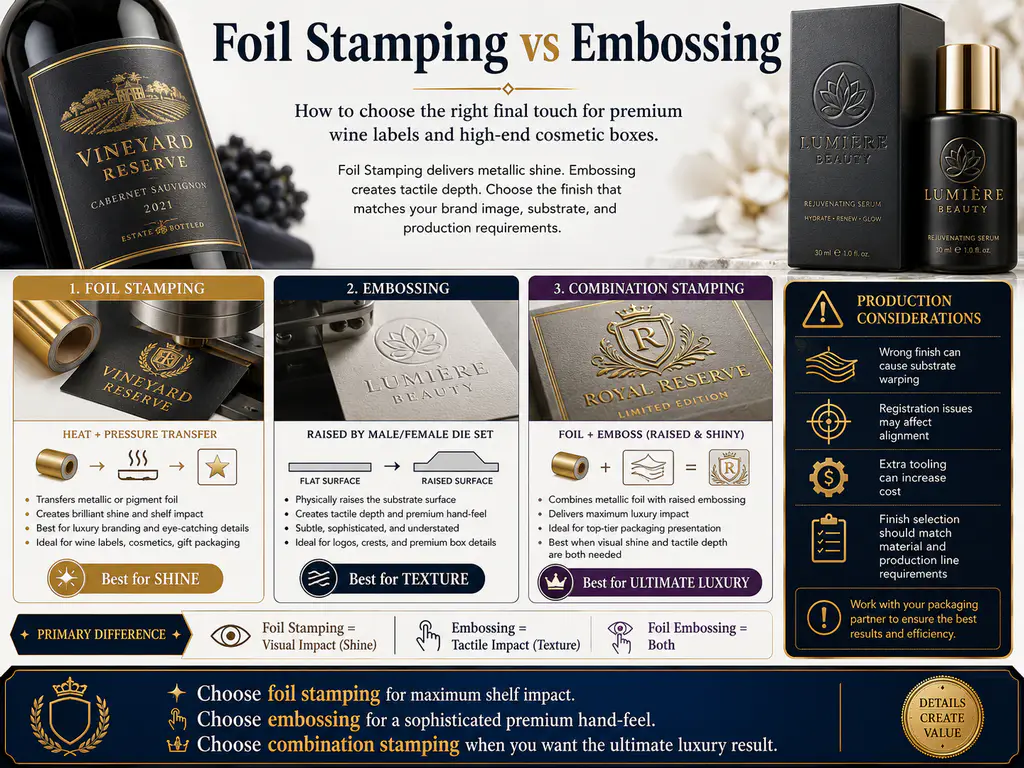
The primary difference between Foil Stamping and Embossing is visual vs. tactile. Foil Stamping uses heat and pressure to transfer a metallic or pigment layer (Shine), while Embossing uses a male/female die set to physically raise the material (Texture). For maximum shelf impact, use foil stamping; for an understated, premium “hand-feel,” choose embossing. For the ultimate luxury result, combine both into Combination Stamping (Foil Embossing).
Technical Comparison: Foil Stamping vs Embossing
To make an informed decision, you must understand the underlying physics of these two processes.
| Feature | Foil Stamping | Embossing |
|---|---|---|
| Primary Effect | Color & Metallic Shine | 3D Texture & Depth |
| Tooling Required | Single Metal Die (Flat) | Matched Die Set (Male/Female) |
| Heat Required | Yes (110°C – 160°C) | Optional (Cold or Warm) |
| Best Substrate | Smooth Paper, PET, PVC | Thick Paperboard, Textured Paper |
| Shelf Visibility | Very High (Light Reflective) | Subtle (Shadow & Touch) |
Foil Stamping vs Embossing: What Is the Difference?
Foil stamping adds a metallic, pigment, holographic, or special foil layer to the surface of a label or package. Embossing raises part of the material to create a three-dimensional texture.
The simple difference is this: foil stamping is mainly about shine and color, while embossing is mainly about touch and depth. Foil catches the eye from a distance; embossing feels premium when the customer holds the product.
For labels and packaging, the better choice depends on the design goal. Use foil stamping when the logo needs high contrast, and use embossing when the packaging needs a subtle tactile effect.
What Is Foil Stamping?
Foil Stamping is a dry transfer process. We use a heated die to release a thin layer of metallic or pigment coating from a PET carrier film onto your packaging.
- Why use it: It provides a level of brilliance that metallic inks simply cannot match. From classic Luxury Packaging Foil in champagne gold to avant-garde holographic effects, foil stamping makes your logo pop under retail lighting.
- Best for: Small details, product names, and luxury seals on wine labels or perfume cartons.
What Is Embossing?
Embossing is all about the “3D” effect. By pressing the paper between two dies, we create a raised image that changes how the consumer interacts with the product.
- Blind Embossing: When you raise a logo without adding any ink or foil. It relies on shadows and the natural texture of the paper. This is the hallmark of “Quiet Luxury.”
- Best for: Monograms on rigid boxes, crests on wine labels, and premium stationery where the “touch” is as important as the “look.”
Embossing can be blind or combined with other effects. Blind embossing uses no color or foil, while foil embossing combines raised texture with a metallic or decorative foil layer.
Which One Looks More Premium?
Foil stamping usually looks more noticeable because it reflects light. Gold foil, silver foil, and holographic foil create a strong shelf impact, especially under retail lighting.
Embossing feels more premium in a quieter way. It does not always shout visually, but it gives the product a more crafted, high-end feel when touched.
For a product that needs to stand out quickly on a shelf, foil stamping is usually stronger. For a brand that wants a clean, understated luxury style, embossing may be the better finish.
Which Is Better for Labels?
For Roll Labels, foil stamping is generally the superior choice. Most high-speed rotary presses can handle Cold Foil or Hot Stamping with high precision.
- Substrate Warning: Embossing on thin film labels (PP/PE) is risky. These materials have “memory” and tend to flatten out over time. Stick to foil stamping for film-based labels.
Which Is Better for Packaging?
In Rigid Boxes and Folding Cartons, embossing truly shines. Thicker paperboard (300gsm+) allows for deep, dramatic embossing that holds its shape.
- The Pro Move: Combine embossing with a matte lamination. This creates a striking contrast between the flat, soft-touch surface and the raised, textured design.
Is Foil Stamping More Expensive Than Embossing?
The cost depends on the foil type, die, stamping area, production quantity, substrate, and machine setup. A small logo in standard gold foil is usually more affordable than a large solid foil area or a custom holographic effect.
Embossing also requires a die, and in many cases it needs a matched male and female die set. This can increase setup cost, especially for detailed artwork or deep embossing.
For short runs, both finishes can feel expensive because the die and setup cost are spread over fewer pieces. For larger production, the unit cost usually becomes more reasonable.
Which Finish Works Better on Paper?
Both foil stamping and embossing work well on paper, but they need different paper conditions. Coated paper usually gives cleaner foil edges, while thicker paperboard holds embossing better.
Uncoated paper can produce a natural luxury look, but it may absorb pressure differently. Rough paper textures should be tested because fine foil lines or small embossed details may lose sharpness.
For paper labels and paper boxes, foil stamping is often easier to control than deep embossing. Embossing needs enough material thickness to keep the raised shape stable.
FAQ: Foil Stamping vs Embossing
What is the main difference between foil stamping and embossing?
Foil stamping transfers a decorative foil layer onto the surface. Embossing raises the surface to create a three-dimensional texture.
Is foil stamping the same as embossing?
No. Foil stamping adds shine or color, while embossing adds raised texture. They can be used separately or combined.
Which is better for packaging, foil stamping or embossing?
Foil stamping is better for visible luxury effects. Embossing is better for tactile premium effects. Many high-end packages use both.
Which is better for labels?
Foil stamping is usually better for label visibility, especially on logos and brand names. Embossing works best on thicker paper labels that can hold a raised shape.
Which finish should I choose for a luxury logo?
Use foil stamping for a bright, eye-catching logo. Use embossing for a subtle tactile logo. Use both for the strongest luxury effect.
Final Recommendation
- Choose Foil Stamping if your main goal is shelf visibility, high contrast, and a bright luxury signal. It is the best choice for Cosmetic Labels and premium stickers.
- Choose Embossing if you want a subtle, tactile, and highly crafted feel. It works best for rigid boxes and thick paper materials.
- Choose Both for your flagship products to create an unboxing experience that is truly unforgettable.
Related guides:
- Request a Sample Book: Compare our hot foil and blind embossing samples side-by-side.
- Send Your Artwork: Our engineering team will advise which finish fits your specific substrate.
- Check out our guides on:
📩 Contact our Technical Team for a Quote → — Global shipping in 14 days.
The Ultimate Finish: Foil Embossing
Why choose when you can have both? Foil Embossing (also known as Combination Stamping) is the pinnacle of luxury packaging. We apply the foil and raise the image in a single pass using a specialized die.
Design Tip: If you are designing a logo for a luxury wine or spirits bottle, use Foil Embossing. It creates a raised gold surface that catches light from multiple angles while providing a premium feel under the thumb.