By Liangyu Laser Technical Team | 12-min read
9 Practical Checks to Approve Hot Stamping Foil Samples Before Production
Table of Contents
- 1. Confirm the Exact Substrate and Surface Condition
- 2. Run a Controlled Transfer Window
- 3. Inspect Complete Transfer and Fine Detail
- 4. Check Adhesion With an Agreed Method
- 5. Test Abrasion and End-Use Exposure
- 6. Verify Colour, Gloss and Visual Match
- 7. Repeat the Trial at Production Speed
- 8. Use a Sampling Plan That Can Detect Variation
- 9. Release the Bulk Order Only After Written Approval
Quick Answer: How to Test Hot Stamping Foil Samples
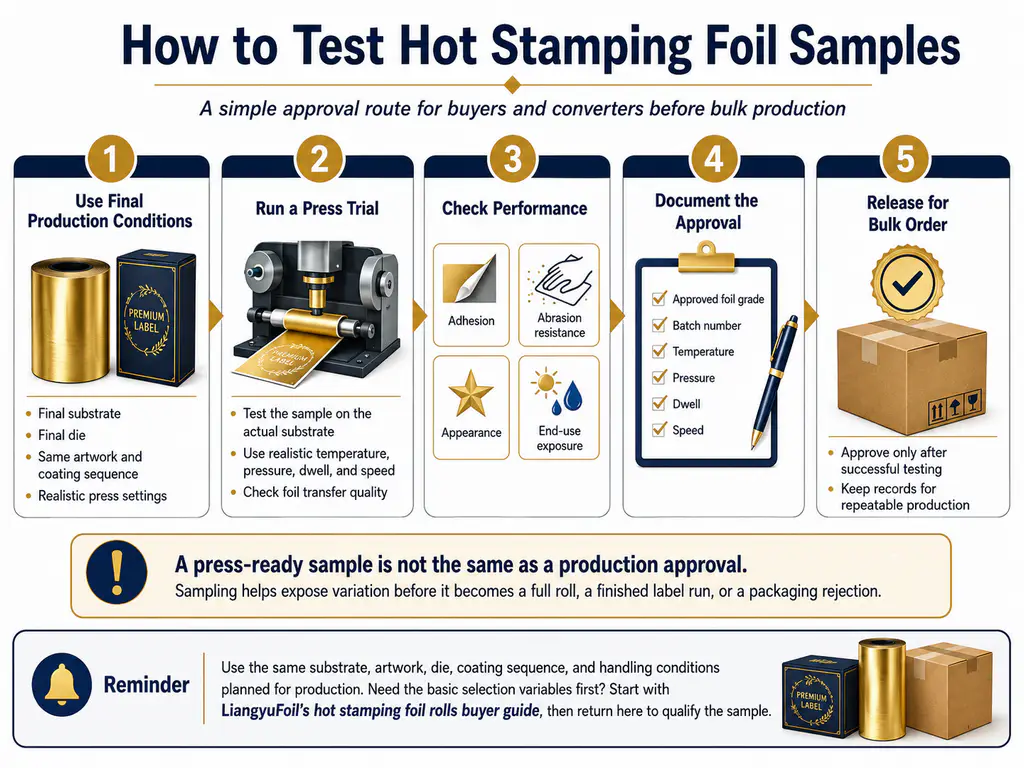
Hot Stamping Foil Samples should be tested on the final substrate, with the final die and realistic press settings. Check transfer, adhesion, abrasion, appearance and end-use exposure, then document the approved foil grade, batch, temperature, pressure, dwell and speed before releasing a bulk order.
A press-ready sample is not the same as a production approval. The purpose of sampling is to expose variation before it becomes a full roll, a finished label run or a packaging rejection. Use the same substrate, artwork, die, coating sequence and handling conditions planned for production. This guide gives buyers and converters a repeatable approval route.
Confirm the Exact Substrate and Surface Condition
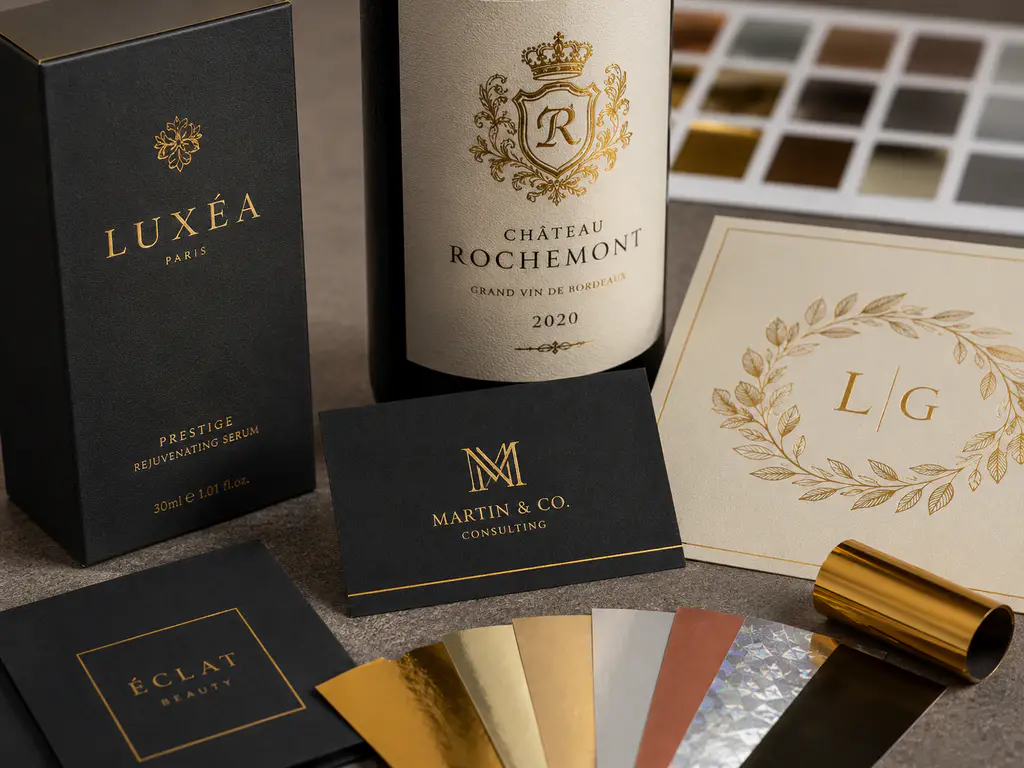
Test on the actual coated paper, PET, PP, PE, ABS, lacquer or laminate intended for the job. A foil can transfer well on a supplier’s reference sheet and fail on a different coating, additive package, paper texture or cure level. Record manufacturer, grade, thickness, colour, surface finish, lot number and any varnish or primer.
| Substrate question | Why it matters | Record in the sample file |
|---|---|---|
| Is this the final commercial substrate? | Coatings and additives change foil adhesion. | Supplier, grade, lot and finish |
| Has the surface been treated? | Corona, plasma, primer and varnish can change wetting. | Treatment method and date |
| Is it clean and fully cured? | Silicone, slip agents, powder, oil and under-cure create a release layer. | Cleaning method and cure condition |
Run a Controlled Transfer Window
Do not search for one universal temperature. Start with the foil supplier’s recommendation, then change one variable at a time: temperature, pressure, dwell and speed. The useful result is a documented operating window that delivers complete transfer without halo, excessive spread, distortion or substrate damage.
| Trial step | Change | Observe |
|---|---|---|
| Baseline | Supplier starting setting | Coverage, edge sharpness, release |
| Temperature ladder | Small, controlled increments | Missing transfer, spread, substrate marks |
| Pressure/dwell check | One adjustment per trial | Fine detail and deformation |
| Production-speed check | Target press speed | Repeatability over the run |
Inspect Complete Transfer and Fine Detail
Inspect under consistent lighting before judging colour or gloss. Check solid blocks, microtext, thin positive lines, reversed gaps, corners and embossed areas. Photograph the same positions on every trial sheet. Mark defects with simple codes: IT for incomplete transfer, EL for edge lift, FD for lost fine detail and SP for spread.
Agree an acceptance sample before production. It should state which defects are unacceptable, where visual inspection occurs, the viewing distance and whether the job is assessed as a luxury pack, a retail label or an industrial component. Never approve a sample simply because it looks good from a distance.
Check Adhesion With an Agreed Method
Use a repeatable tape-pull or cross-hatch method appropriate for the substrate, then compare the result to the approved control. ASTM D3359 describes tape-test methods for assessing coating adhesion; it is a test method, not a universal pass grade for every foil application. Define tape, cut pattern, dwell time, peel angle and acceptance rule in advance.
Test Abrasion and End-Use Exposure
Match the test to the way the finished item will be handled. A cosmetic cap may need repeated hand contact; a wine label may see condensation and wiping; a carton may be abraded in case packing. Run a simple agreed rub test on-site, then use a laboratory method only when the job requires controlled comparative data.
| Exposure | Practical sample check | Decision record |
|---|---|---|
| Handling and carton rub | Dry rub with agreed material and load | Scuff, dulling, foil loss |
| Cleaning or product contact | Spot and wipe test using actual liquid | Liquid, dwell, wipe material |
| Cold or moisture | Condensation / refrigerator cycle | Time, temperature, recovery |
| High-risk abrasion | Controlled lab comparison if required | Method, load, cycles, visual score |

Verify Colour, Gloss and Visual Match
Photographs are supporting evidence, not a substitute for a retained control. Record camera, lighting, angle and image ID. If Delta E or gloss readings are required, set the job-specific tolerance with the brand owner; a single universal value is not appropriate for mirror, brushed, holographic and pigment foils alike.
Repeat the Trial at Production Speed
A successful single impression proves only that one setting can work once. Run enough consecutive impressions at intended speed to reveal heat variation, die contamination, roll tracking and release inconsistency. Include start-up, mid-run and end-of-roll samples. If a defect changes over time, log where it appeared rather than averaging it away.
Use a Sampling Plan That Can Detect Variation
Agree sample quantity from the risk of the job, not from an arbitrary number. Higher-risk work includes fine artwork, textured stock, high-gloss foil, regulated packaging, multiple press shifts and aggressive end-use exposure. For each condition, retain labelled passed and failed examples. Where foil batches or substrate lots change, repeat the key checks.
| Sample label field | Example |
|---|---|
| Test ID | HSF-2026-07-01 |
| Foil and batch | Grade, colour, lot, roll width |
| Construction | Substrate, varnish, die, artwork revision |
| Press conditions | Temperature, pressure, dwell, speed |
| Result | Pass / revise / fail plus defect code |
Release the Bulk Order Only After Written Approval
Attach the approved control, test sheet, photographs and process window to the purchase order or technical specification. State what must be matched in the bulk supply: foil grade, shade or effect, lot traceability, roll dimensions, core, winding direction, splice policy and packing. This is the bridge between a good sample and a repeatable order.
| Observed failure | First checks | Do not do |
|---|---|---|
| Patchy transfer | Surface cleanliness, die contact, temperature window | Raise every setting at once |
| Edge lift after tape test | Cure, additives, primer and foil grade | Assume the foil alone is at fault |
| Fine detail fills in | Artwork, die relief, pressure and dwell | Use more pressure as the only fix |
| Scuffing or dullness | End-use test, foil grade and protective finish | Approve from an untouched press sheet |
| Colour mismatch | Control sample, lighting and substrate lot | Judge only from a phone image |
FAQ
What starting settings should I use for hot stamping foil?
Start from the foil supplier’s recommended window, then run a controlled ladder on the final substrate. Record temperature, pressure, dwell and speed. There is no responsible universal setting for coated paper, PET and polypropylene because construction, coating, die and machine design differ.
How many samples should I approve before a bulk foil order?
Use a risk-based plan. Retain passed and failed examples from the intended substrate lot, and repeat key checks when the foil batch, substrate lot, coating sequence or press shift changes. Fine artwork and high-abrasion packaging require more evidence than a simple solid logo.
Can I use a tape test as the only adhesion test?
No. A tape test is a useful comparative screen when its procedure is agreed, but it does not replace transfer inspection, end-use exposure and a production-speed trial. Use an appropriate documented method and compare against an approved control.
What should appear on a hot stamping foil sample approval record?
Include foil grade and batch, substrate lot, coating or primer, die, artwork revision, machine, temperature, pressure, dwell, speed, test method, photos, result and approver. Keep a physical control with the record.
What if the sample passes but the bulk run fails?
Compare the production variables against the approval record first: substrate lot, foil batch, coating cure, die, machine settings, speed and environmental conditions. Then isolate one variable per repeat trial. A documented sample record makes this investigation much faster.
Send Your Sample Brief Before Ordering
Share your final substrate, application, machine and die details, target foil effect, production speed, and photos of any trial result. LiangyuFoil can help you create a practical sample-evaluation plan before you commit to a bulk order.
- Substrate and surface finish
- Machine, die type, and production speed
- Packaging or label application
- Trial sample or defect photos