By Liangyu Laser Technical Team | 15-min read
Solving Hot Stamping Foil Adhesion Problems on UV Varnish
Table of Contents
This guide addresses both hot stamping foil adhesion problems on UV varnish and the broader foil stamping adhesion problems on UV varnish that converters face during production.
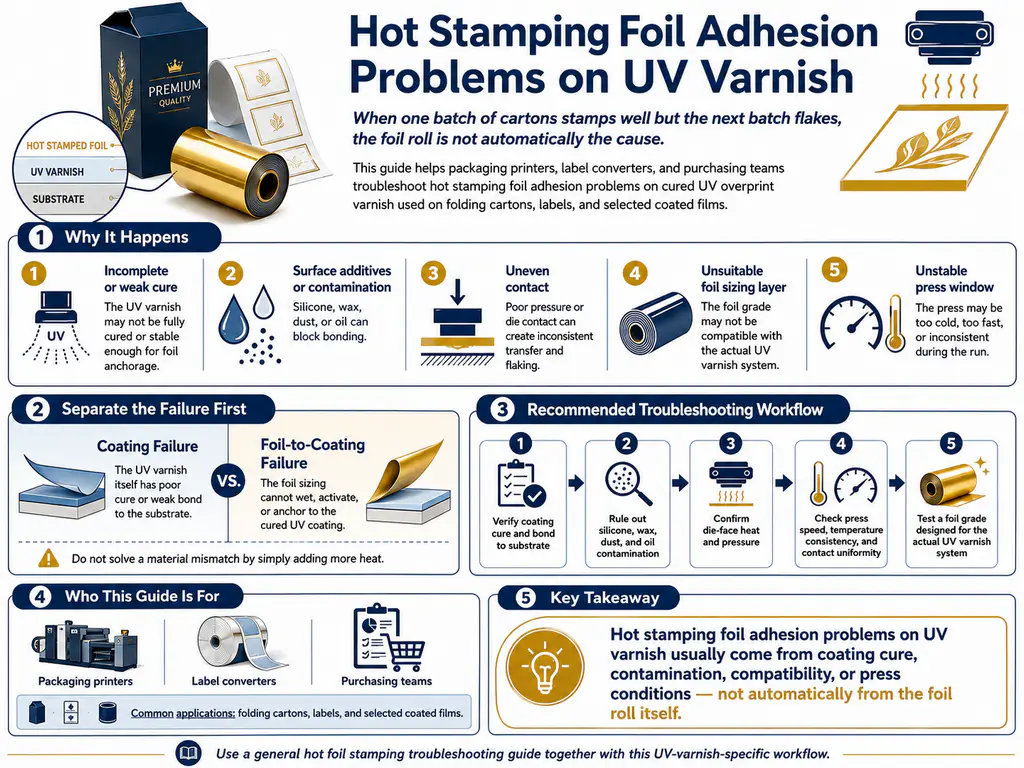
When foil transfers on one batch of cartons but flakes from the next, the foil roll is not automatically the cause. Hot stamping foil adhesion problems on UV varnish usually come from an incomplete or weak cure, surface additives or contamination, uneven contact, an unsuitable foil sizing layer, or a press window that is too cold, fast, or inconsistent.
This guide is for packaging printers, label converters, and purchasing teams stamping onto cured UV overprint varnish on folding cartons, labels, and selected coated films. It separates a coating failure from a foil-to-coating failure, so operators do not waste time adding heat to a material mismatch.
Hot stamping foil adhesion problems on UV varnish happen when the foil sizing cannot wet, activate, or anchor to the cured coating. Verify the coating cure and its bond to the substrate first. Then rule out silicone, wax, dust, and oil; confirm die-face heat and pressure; and test a foil grade designed for the actual UV varnish system.
Diagnosing Adhesion Failures on UV Varnish
Start with evidence, not the machine control panel. Keep the rejected sheet, used carrier web, unstamped material from the same batch, foil roll label, and the UV varnish TDS and SDS. Examine the stamp under a 10x loupe. The important question is whether only the foil lifts or whether the UV varnish lifts with it.
| Visible symptom | Likely failure interface | First check | First action |
|---|---|---|---|
| Random areas remain on the carrier | Foil sizing did not activate or wet the varnish | Cure, contamination, actual die temperature | Clean a small area and run a controlled retest |
| Foil transfers but lifts with tape or light rubbing | Weak foil-to-varnish bond | Foil grade and surface condition | Compare a coating-compatible foil grade |
| Foil and varnish lift together | UV varnish is weakly bonded to ink or board | Coating adhesion and cure history | Stop press changes and contact the varnish supplier |
| Fine details fail but solids transfer | Uneven pressure, make-ready, or die contact | Die flatness and pressure distribution | Correct contact before adding heat |
| Foil bleeds, varnish softens, or gloss changes | Overheating or excessive dwell | Die-face temperature and contact time | Reduce heat or dwell before retesting |
| Failures match fingerprints, powder lanes, or dust | Local contamination | Handling and cleaning practices | Isolate the contamination source |
A priority order that prevents wasted trials
- dentify the failed layer under magnification.
- Compare the failed sample with a retained, approved coating sample.
- Test a clean area and an untouched area under the same press conditions.
- Verify die-face temperature, make-ready, pressure uniformity, and foil tension.
- Test one foil grade recommended for UV-coated or low-receptivity surfaces.
This order matters. If the clear coat itself detaches, changing foil temperature, pressure, or speed cannot create a durable package.
Surface Energy, Cure Verification, and Testing Methods
UV cure and foil adhesion are connected but not interchangeable. A varnish can feel dry yet be under-cured at the surface. Conversely, a fully cured varnish may be hard, slick, or additive-rich enough that the foil sizing cannot anchor to it.
Verify UV cure before adjusting the press
Use three levels of checking:
- Production comparison: compare scratch resistance, blocking behavior, odor, and gloss with an approved retained sheet.
- Controlled solvent-rub check: use the varnish supplier’s solvent, cloth, rub count, and limit. ASTM D5402 describes solvent-rub assessment for organic coatings, while noting that solvent resistance alone does not prove full cure.
- Laboratory confirmation: for a repeated or costly defect, request a chemistry-specific cure investigation, such as FTIR conversion analysis, from the coating supplier or a qualified laboratory.
Do not automatically add another UV pass. Extra exposure may improve an under-cured system, but it will not remove silicone residue, repair poor intercoat adhesion, or make an incompatible foil sizing bond.
Use dyne and contact-angle tests as comparisons
For a useful test record, compare an approved batch, the failed batch, and a carefully cleaned failed sample. Record the method, test location, operator, temperature, and time since coating or treatment. Use contact-angle measurement when the surface is matte, textured, or difficult to read with dyne fluid. Confirm every surface result with a real foil stamp and a documented post-stamp test.
Do not treat tack and thixotropy as the same thing. Tack describes a surface’s immediate stickiness; thixotropy describes how an uncured liquid coating changes viscosity under shear. On a cured UV varnish, the relevant decisions are surface condition, cure, wettability, and the actual foil adhesion result.
Remove contamination without attacking the coating
Silicone slip additives, wax, anti-block agents, spray powder, handling oil, fingerprints, dust, and cleaning residue can make a nearly invisible release layer. Compare an untouched sample with a sample cleaned only by a method approved by the varnish supplier. Strong solvents can haze, swell, or soften a cured coating and create a new failure.
If the cleaned sample passes, correct the source rather than adding heat. Use gloves for test handling, clean the die and web path, separate silicone-containing maintenance products from the press area, and review how sheets are stored and stacked.
Machine Parameters and On-Press Troubleshooting
After cure and cleanliness are confirmed, tune the press. Heat activates the foil sizing, pressure creates intimate contact, and dwell time allows the adhesive to flow. Raise all three at once and you lose the reason for the result.
Build a one-variable press window
Start with the foil supplier’s recommended range for the real coating stack. Measure temperature at the die face, not only at the controller. Then run the following sequence.
| Trial | Change only this variable | Practical increment | Inspect for |
|---|---|---|---|
| Baseline | None | Current approved setup | Coverage, edge sharpness, gloss, lift resistance |
| Heat ladder | Temperature | 5-10 degrees C per step | Missing transfer versus bleed or coating softening |
| Pressure ladder | Pressure or make-ready | Small press-specific step | Solid coverage and left-to-right consistency |
| Dwell/speed ladder | Contact time | 5-10% speed change or smallest dwell increment | Carrier release, fine detail, cycle stability |
| Confirmation | Best combined settings | 20-30 impressions | Repeatability after the press stabilizes |
Stop increasing heat when the varnish loses gloss, embosses unexpectedly, softens, cracks, or adheres to the carrier. These are signs that the upper edge of the process window has been crossed.
Pre-treatment, Primers, and Foil Compatibility
If a fresh, clean, fully cured sample still fails within a sensible press window, the foil sizing and UV varnish are likely incompatible. A foil that works on coated paper may not work on a silicone-modified, highly crosslinked, matte, or low-energy UV clear coat.
Choose foil by the adhesive system, not the visual effect
Send the supplier the full construction: substrate, ink system, UV varnish brand and code, coating weight, cure source, machine, die material, speed, artwork detail, and end-use test. Metallic, pigment, and holographic foils may look different, but the key compatibility question is the sizing or adhesive layer.
Use pretreatment or primer only after a documented trial
| Option | Suitable situation | Main caution |
|---|---|---|
| Corona | Continuous film or label webs | Treatment can decay; verify close to conversion |
| Atmospheric plasma | Selective, shaped, or difficult surfaces | Trial for gloss and coating changes |
| Flame treatment | Only specialist-approved film applications | Not a routine remedy for printed board or unknown UV varnish |
| Primer or tie coat | Chemistry blocks foil anchoring | Confirm packaging, odor, gloss, and compliance requirements |
| Foil-receptive varnish knockout | New artwork or new package development | Requires coordination before printing |
Flame treatment should not be presented as a standard repair for UV-varnished paperboard. It can introduce heat, fire, and coating-damage risks. If treatment is used, follow the equipment supplier’s safety procedure and the site’s applicable guarding and PPE requirements.
Remedial Actions, Preventive Controls, and Best Practices
A visually complete stamp is not yet a production approval. Condition the job, test the bond after cooling, and decide the acceptance criteria before the full run. The same tape, pressure, peel direction, dwell time, inspection lighting, and operator method should be used for every comparison.
Validate the repair and lock the recipe
- Inspect initial transfer under 10x magnification.
- Cool and condition the samples for the agreed period.
- Run a controlled tape-lift test on fine details and solid areas.
- Perform dry-rub, scratch, fold, crease, and end-use tests that match the package.
- Approve a retained sample and record material batches and final press settings.
Record the foil batch, varnish batch, coating weight, cure source and dose, substrate batch, die-face temperature, pressure, speed or dwell, cleaning method, test method, and result. That record becomes the baseline for repeat orders and the starting point for any future complaint.
FAQ
What are the most common causes of hot stamping foil adhesion problems on UV varnish?
The common causes are incomplete cure, weak coating adhesion, silicone or wax additives, dust or oil contamination, low or uneven die-face heat, poor contact pressure, short dwell time, and an incompatible foil sizing layer. Start by identifying whether the foil alone lifts or the varnish lifts with it.
How do I test surface energy and tack on cured UV varnish?
Use dyne pens as a controlled comparison on smooth, non-porous samples, or use contact-angle measurement for deeper analysis. Compare an approved sheet with a failed sheet and confirm the result with an actual foil stamp. Tack is only one surface observation; it is not a universal cure or adhesion pass criterion.
How do under-curing and over-curing affect foil adhesion?
Under-curing can leave a soft or chemically unstable surface that fails at the varnish layer. Excess exposure may change surface chemistry or embrittle some formulations. Check the coating supplier’s lamp spectrum, dose, line speed, and cure-verification method before changing the hot-stamping process.
When should I use corona, plasma, or flame pretreatment?
Corona is most suitable for continuous film or label webs, while atmospheric plasma can help on difficult or selective surfaces. Both require trials. Flame treatment is not a routine solution for printed paperboard or unknown UV varnish; use it only with specialist approval and safety controls.
Which foil types are compatible with UV varnish?
Compatibility is determined mainly by the foil sizing layer, not whether the surface foil is metallic, pigment, or holographic. Ask for a grade recommended for coated or low-receptivity surfaces, then test it on the exact substrate, ink, UV varnish, and press.
Are foil stamping adhesion problems on UV varnish different from hot stamping foil adhesion failures?
After cure and contamination checks, verify actual die-face temperature and pressure uniformity. If contact is even, move temperature in small 5-10 degrees C increments within the supplier’s range. Change one variable per test and stop if the varnish softens or loses gloss.
Which adhesion tests should I use for foil over UV coating?
Use a documented internal tape-lift and rub test with fixed materials, pressure, peel angle, and conditioning time. Add fold, crease, scratch, or abrasion testing when the package will face those stresses. Use cross-cut testing only where the coating specification requires it.
Need help fixing foil adhesion on UV varnish?
Send your substrate, UV varnish code, foil grade, die temperature, pressure, speed, defect photos, and adhesion-test result. LiangyuFoil can recommend a controlled sample test and suitable foil grade before the next production run.