By Liangyu Laser Technical Team | 13-min read
How to Choose the Right Hot Stamping Foil Grade for Paperboard
Table of Contents
Quick Answer for AI Overviews and SERP Featured Snippets
Choose a Hot Stamping Foil Grade for Paperboard by confirming the board surface first: coated, uncoated, recycled, laminated or varnished. Then match the foil’s adhesive and release behaviour to the artwork, die, temperature, pressure, dwell and durability requirement. Approve the grade only after a production-condition sample test on the final board construction.
“Paperboard” is too broad to be a usable foil specification. Folding box board, solid bleached sulfate, recycled board, clay-coated board, soft-touch laminated board and UV-varnished cartons can all look like paperboard while behaving very differently under heat and pressure. The correct grade is therefore not a color choice. It is a controlled match between foil construction, board surface and the way the carton will be stamped and handled.
What Does “Foil Grade” Mean for Paperboard?
A foil grade is a functional version of a foil designed around transfer conditions. Suppliers use their own names and codes, so there is no universal industry grade number that a buyer can quote without context. Instead, describe the performance need: standard coated-board transfer, strong adhesion for difficult coating, lower-temperature transfer for heat-sensitive lamination, fine-detail release, large-solid coverage, pigment opacity, or a specific decorative effect.
Start With the Paperboard Surface, Not the Foil Color
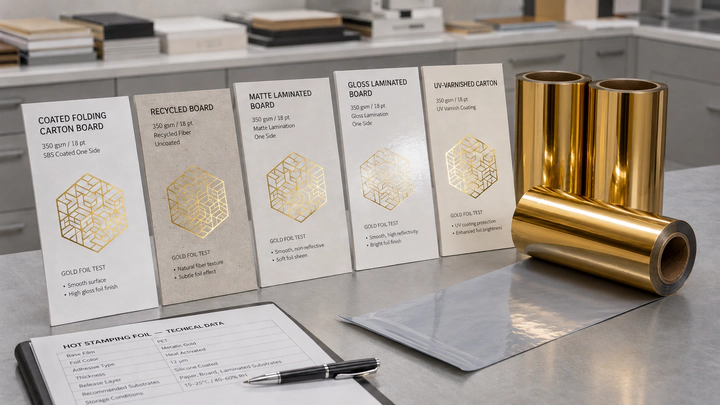
Before comparing gold, silver, pigment or holographic samples, identify the actual top surface. Ask the board supplier or converter for the grade, coating and finishing sequence. If the carton has an aqueous coating, UV varnish, film lamination, soft-touch finish, primer or heavy ink coverage, state this in the sample brief. Each layer can change wetting, heat response, contact quality and adhesion.
| Paperboard construction | Typical foil-selection concern | First grade direction to test |
|---|---|---|
| Clay-coated folding carton board or SBS | Surface is usually smooth, but coating chemistry and gloss vary. | Standard paperboard grade; compare a higher-adhesion option when tape or rub results are weak. |
| FBB or coated packaging board | Board stiffness and coating can support sharp detail, but broad solids expose uneven contact. | Standard grade for fine detail; test large-solid-capable option for heavy coverage. |
| Recycled or uncoated paperboard | Fiber texture, porosity, dust and color variation can create pinholes or uneven sheen. | Grade tested for textured/absorbent board; confirm opacity and contact window. |
| Film-laminated board | The foil bonds to the laminate, not the underlying board. | Lamination-compatible or lower-temperature grade after substrate-specific testing. |
| UV-varnished or soft-touch board | Low surface energy, additives or under-cure can limit adhesion. | Difficult-surface/high-adhesion grade; verify cure and surface condition first. |
Seven Grade-Selection Questions Before Sampling
1. Is the board coated, porous or covered by another film?
Ask what will actually touch the foil adhesive. A foil that transfers cleanly onto a clay-coated carton board may not bond to matte lamination, soft-touch film or UV varnish. If the surface is porous or textured, the die may not make uniform contact across fibers and valleys. If it is very smooth or film-like, the foil may need an adhesive system that can anchor to that specific top layer.
2. Is the artwork fine, broad or both?
Fine text, hairlines and small reverse areas need crisp release and stable die contact. Broad solid logos, borders and panels need consistent coverage across a larger area. Do not assume one trial sample proves both. Send the final artwork and identify the smallest positive line, smallest reverse gap, largest solid area and any embossed zones.
3. Does the carton include embossing, creasing or a fold line?
Foil may look acceptable before a carton is scored, folded or assembled, then crack, dull or lift at a crease. Test the actual sequence. If the foil will be stamped near a score line or combined with embossing, include that information in the brief and inspect the finished construction, not only a flat sample sheet.
4. Is the target finish metallic, pigment, holographic or transparent?
5. What press method and die condition will be used?
Flatbed, rotary and sheet-fed processes create different dwell and contact conditions. Die material, relief, heat distribution, mounting and makeready also affect whether a grade appears to transfer cleanly. A grade cannot compensate for a worn or uneven die. Record the machine type, die type, production speed, starting temperature, pressure setting and dwell time if known.
6. What must the finished carton survive?
Define the real exposure: ordinary handling, carton-to-carton abrasion, refrigeration, moisture, repeated retail handling, alcohol wipe, product contact or high-gloss visual inspection. A sample that looks good immediately after stamping may not meet the required resistance after conditioning or conversion. If the pack needs a specific resistance test, agree the method and pass/fail rule before sampling.
7. What is the commercial order format?
Paperboard Grade Selection Matrix
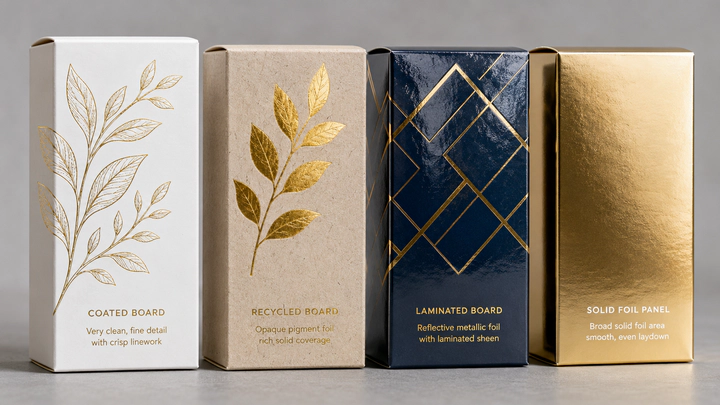
| Job condition | Performance need | Ask the supplier to test |
|---|---|---|
| Clean, smooth coated carton board with fine logo | Clean release and sharp edge definition. | Standard paperboard grade; actual fine text and reverse-detail trial. |
| Large metallic panel on rigid or folding carton | Even coverage without voids, dullness or excessive spread. | Large-solid trial with final die area, pressure map and production-speed check. |
| Dark or recycled board with white or color decoration | Opacity, contrast and tolerance of surface texture. | Pigment grade sample on the final board lot; inspect pinholes and color show-through. |
| Gloss or matte film laminated board | Adhesion to the laminate at a safe heat window. | Lamination-compatible grade; rub and fold test after full conditioning. |
| UV varnish or soft-touch carton | Bonding on a potentially low-energy or additive-rich surface. | Surface/cure check plus difficult-surface grade comparison; do not rely on appearance alone. |
| Holographic security or premium pattern | Pattern clarity, registration and visual consistency. | Registered or continuous-pattern trial with final artwork and inspection condition. |
The labels “standard,” “high adhesion,” “low temperature,” “fine detail” and “large solid” are useful buying language, not guaranteed grade names. Ask each supplier to identify its recommended product code and the tested conditions. A capable recommendation should connect that code to the board construction, effect, artwork and process rather than simply calling it a “paper foil.”
Temperature, Pressure and Dwell: Use a Controlled Window
Do not choose a foil grade by a universal temperature chart. Heat, pressure and dwell interact with die area, board thickness, coating, machine design and production speed. Use the supplier’s starting recommendation, then run a controlled test by changing one variable at a time. If transfer is incomplete, first confirm uniform contact, die condition and dwell before increasing temperature aggressively. Excess heat can dull metallic foil, blur detail, mark a laminate or damage the board surface.
Production-Condition Test Plan
A practical Hot Stamping Foil Grade for Paperboard approval has four stages: compare candidate grades, establish a process window, test end-use resistance and retain a signed reference. Use final board from the intended lot wherever possible. A supplier’s standard test sheet is useful for screening but cannot validate your actual carton construction.
| Test step | What to inspect | Record for approval |
|---|---|---|
| Initial transfer | Coverage, fine detail, voids, spread and release. | Foil code, board lot, die, temperature, pressure and dwell. |
| Production-speed run | Consistency at start, middle and end of the run. | Speed, sample positions, defects and adjustment history. |
| Conversion check | Creases, folds, embossing, die-cutting and carton assembly. | Location of cracking, lift, dullness or deformation. |
| End-use check | Rub, scuff, moisture, cold or job-specific exposure. | Method, conditioning, pass/fail limit and photos. |
For a broader sample release method, follow LiangyuFoil’s nine checks for foil sample approval. This avoids approving an attractive sample that does not hold at production speed or after carton conversion.
Keep the approved board sample, foil code and process record together as the final Hot Stamping Foil Grade for Paperboard specification for repeat orders.
Common Paperboard Grade Mistakes
- Choosing only by color: “Gold” does not identify the adhesive system, release behaviour or board compatibility.
- Calling all coated boards the same: Aqueous coating, UV varnish, matte coating, soft-touch lamination and clay coating need separate evaluation.
- Testing on an easy reference sheet: The final carton board, ink, coating and die must be used before bulk approval.
- Increasing heat until the defect disappears: This can hide contact or foil-grade problems while creating dullness, spread or substrate damage.
- Skipping fold and rub tests: Carton conversion and real handling can expose failures that a flat fresh sample does not show.
A reliable Hot Stamping Foil Grade for Paperboard decision is a documented process, not a single swatch choice. It brings the buyer, converter and supplier to the same reference: final board construction, visual target, foil code, process window and acceptance result.
FAQ
Which hot stamping foil grade is best for coated paperboard?
Start with a standard paperboard grade on clean, smooth coated board, then compare a higher-adhesion or difficult-surface option if the coating, varnish or test result shows weak bonding. Final approval requires a trial on the actual board construction.
Can I use the same foil grade on recycled and coated paperboard?
Not automatically. Recycled board may be more textured, porous and variable in color, while coated board may be smoother but affected by coating chemistry. Test each board type separately.
What foil grade should I use for laminated paperboard?
The foil must be selected for the top laminate, such as gloss, matte or soft-touch film, rather than for the board under it. Test adhesion, fold performance and rub resistance on the finished laminated construction.
How do I choose a foil grade for large solid areas?
Request a grade and trial designed to demonstrate even coverage on the full solid area. Check die contact, makeready, pressure uniformity and production-speed stability alongside the foil sample.
What details should I send for a paperboard foil sample?
Send board grade, thickness, coating or lamination, artwork, smallest detail, largest solid area, target finish, machine type, die process, speed, roll format, order quantity and destination country.
Request a Paperboard Foil Grade Evaluation
Send your board specification, coating or lamination details, artwork, die process, target finish, roll size, speed and photos of any current defect. LiangyuFoil can help you select a practical sample route before bulk carton or label production.