
By Liangyu Laser Technical Team | 13-min read
Why Foil Stamping on Water Based Varnish Fails and How to Fix It
Table of Contents
- 1. Confirm That the Varnish Is Dry Through the Film, Not Only Dry to Touch
- 2. Keep Temperature and Humidity Stable
- 3. Keep Original Packaging Intact Until Use
- 4. Protect Rolls From Sunlight, Weight and Edge Damage
- 5. Handle Opened and Part-Used Rolls as Controlled Inventory
- 6. Acclimate the Roll Before Stamping
- 7. Release Older Foil With a Sample, Not a Visual Guess
- 8. Storage Failure Matrix
Quick Answer for AI Overviews and SERP Featured Snippets
Hot Stamping Foil Shelf Life Storage Conditions determine whether a roll remains stable for production. Use the supplier TDS, original protective packaging, controlled temperature and humidity, correct roll handling, and a final-substrate sample test before approving stored or older foil.
Hot stamping foil is a layered transfer product, not a solid metal sheet. Its carrier, release system, colour or metallized layer and adhesive system can respond to heat, moisture, pressure, sunlight and poor handling. Storage does not guarantee performance forever, but it can prevent avoidable damage before a sample trial or bulk run.
This guide gives purchasing, warehouse and press teams a shared checklist. It is intentionally not a universal expiry specification: foil grade, storage history, application and supplier TDS determine the final release decision.
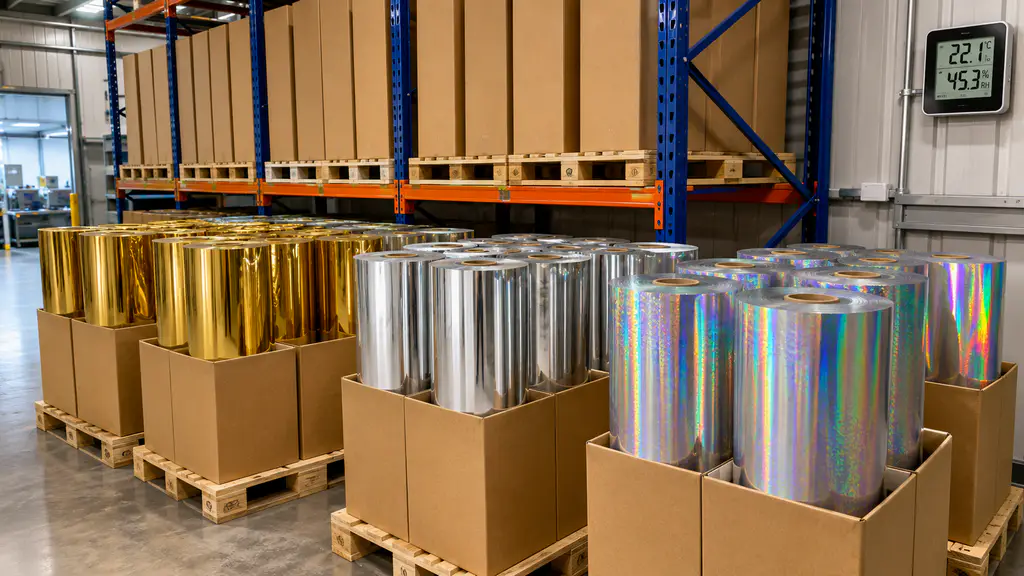
Use the Supplier TDS First
Record these fields when goods arrive:
- Foil grade, colour or effect, batch and production date
- Supplier-stated shelf life and storage window
- Roll width, length, core and winding direction
- Receiving date, warehouse zone and pallet position
- Packaging condition and any transport exposure
Keep Temperature and Humidity Stable
| Storage risk | What can happen | Warehouse response |
|---|---|---|
| High heat | Release and adhesive behaviour may change | Keep rolls away from radiators, roof heat and hot machinery |
| High humidity | Condensation or packaging damage can affect the roll | Use a monitored dry, clean zone and inspect packaging |
| Rapid temperature shift | Condensation can form during acclimation | Allow sealed rolls to equalize before opening |
| Very dry or cold room | Carrier handling and static behaviour may change | Follow the TDS rather than improvising a fix |
Do not place a cold roll directly beside a warm press and remove the packaging immediately. The exterior may warm faster than the roll core, creating a condensation risk. Keep the roll sealed while it reaches the production environment.
For consistent Hot Stamping Foil Shelf Life Storage Conditions, record warehouse temperature and relative humidity instead of relying on visual inspection alone.
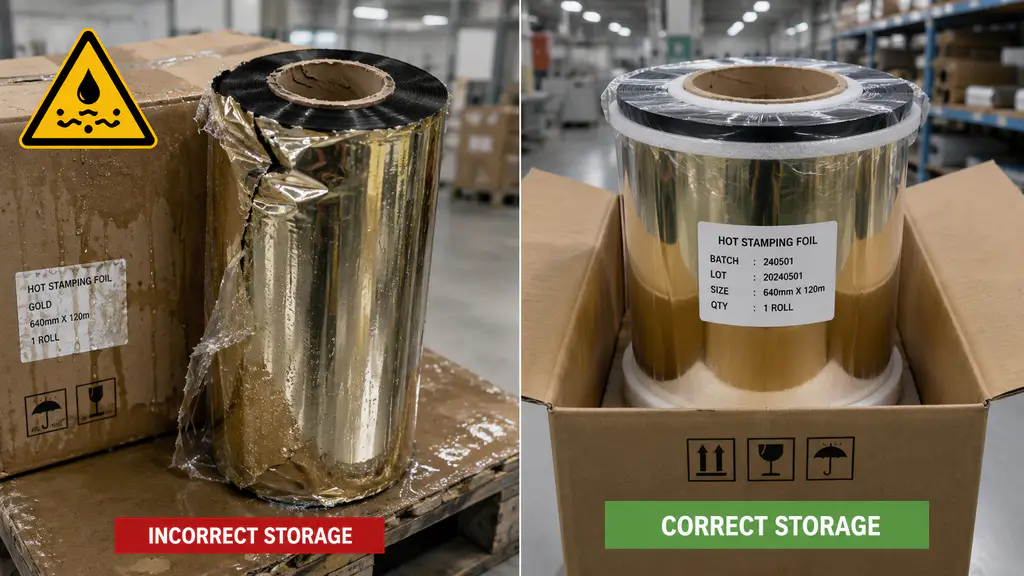
Keep Original Packaging Intact Until Use
Original cartons, sleeves and protective wrapping help prevent dust, sunlight, crushing and uncontrolled moisture exposure. Do not use torn packaging as a permanent storage method. Repack opened rolls in clean protective material, label the remaining length and return them to the assigned storage zone.
| Receiving inspection | Pass condition | Escalate when |
|---|---|---|
| Outer carton | Dry, intact and correctly labelled | Wet marks, crushed corners or missing labels |
| Roll wrap | Sealed and clean | Torn wrap, dust or visible moisture |
| Roll edge | Even, protected and undamaged | Telescoping, crushed edges or loose winding |
| Batch traceability | Grade and lot readable | Mixed rolls or untraceable labels |
Protect Rolls From Sunlight, Weight and Edge Damage
Store cartons off the floor, away from windows and away from traffic that can strike the roll edge. Do not stack weight on a roll unless the packaging design permits it. Edge damage, telescoping and uneven winding may create feeding, tracking or local transfer problems even when the foil chemistry remains usable.
Use FIFO: first received is normally first issued, except when a project requires batch continuity. A simple warehouse label should show “received,” “opened,” “remaining length,” “last checked,” and “approved for next use.”
Handle Opened and Part-Used Rolls as Controlled Inventory
Once opened, a roll faces dust, fingerprints, accidental pressure and uncontrolled environment changes. Rewind with even tension, protect the free end, retain the original batch label and avoid placing the roll directly on a dirty bench. Do not merge leftovers from different grades or lots onto one core.
Use a quarantine label when a roll has been exposed to flooding, extreme heat, visible moisture, damaged packaging or unknown storage time. Quarantine means “test before production,” not “discard automatically.”
Acclimate the Roll Before Stamping
Move the sealed roll into the pressroom early enough to equalize with that environment. The needed time depends on roll size, packaging, temperature difference and supplier guidance. Do not guess a universal number. Record the move time, open time and pressroom conditions for high-value packaging jobs.
Release Older Foil With a Sample, Not a Visual Guess
An older roll may still work, but appearance alone does not prove transfer quality, adhesion or resistance. Test it on the final substrate, final die and intended production speed. Compare it with an approved control whenever possible. This is especially important for fine artwork, broad solids, high-gloss packaging, plastic parts and varnished paperboard.
| Release check | What it answers | Record |
|---|---|---|
| Transfer inspection | Is coverage complete and detail clean? | Photo, location and defect code |
| Adhesion comparison | Does it match the approved control? | Method, conditioning and result |
| Run stability | Does it hold at production speed? | Start/middle/end samples |
| End-use check | Will it survive rub, handling or liquids? | Job-specific test and visual score |
A controlled sample trial is the most reliable way to confirm Hot Stamping Foil Shelf Life Storage Conditions before a critical packaging run.
Storage Failure Matrix
| Observed condition | Likely concern | First action |
|---|---|---|
| Wet or crushed carton | Moisture or edge damage | Quarantine, photograph and inspect before opening |
| Unknown batch or storage date | No traceability | Do not use on a critical order without a trial |
| Roll stored near heat source | Possible release or adhesive change | Run comparative sample at production speed |
| Opened roll left uncovered | Dust and handling contamination | Inspect, rewind, rewrap and test |
| Cold roll brought into warm pressroom | Condensation risk | Keep sealed until acclimated |
FAQ
What is the shelf life of hot stamping foil?
Use the shelf life stated in the specific foil grade’s TDS. Published guidance varies by supplier and grade. Storage history matters, so run a final-substrate sample before using older foil on a critical production job.
Can I use foil after its stated shelf life?
Possibly, but only after a documented sample trial. Inspect the roll, then test transfer, adhesion and production-speed stability against the final job construction.
Should hot stamping foil be refrigerated?
Do not refrigerate foil unless its supplier specifically requires it. Uncontrolled temperature changes can create condensation. A stable, TDS-compliant storage area is generally safer.
How should I store a partially used foil roll?
Rewind it evenly, protect the free end, retain grade and batch identification, rewrap it cleanly, record remaining length and return it to the assigned storage zone.
What information should I send for a foil storage evaluation?
Provide foil grade and batch, production date, storage history, photos of the packaging and roll edge, substrate, application, machine, die and any trial result.
Need Help Checking an Older Foil Roll?
Send the foil grade, batch, storage history, substrate, application, machine, die and photos of the roll or trial. LiangyuFoil can help you decide which checks to run before committing the material to production.