By Liangyu Laser Technical Team | 18-min read
Hot Stamping Foil Price per Kg: 2026 U.S. Cost Guide
Table of Contents
- 1. Current U.S. Hot Stamping Foil Price per Kg Benchmarks
- 2. Domestic stock versus direct import
- 3. Three-to-six-month price outlook
- 4. Price by Foil Type and Finish
- 5. How to Convert Roll Price into Price per Kilogram
- 6. MOQ, Bulk Discounts, and Landed Cost per Kg
- 7. Request a Comparable Price Quote
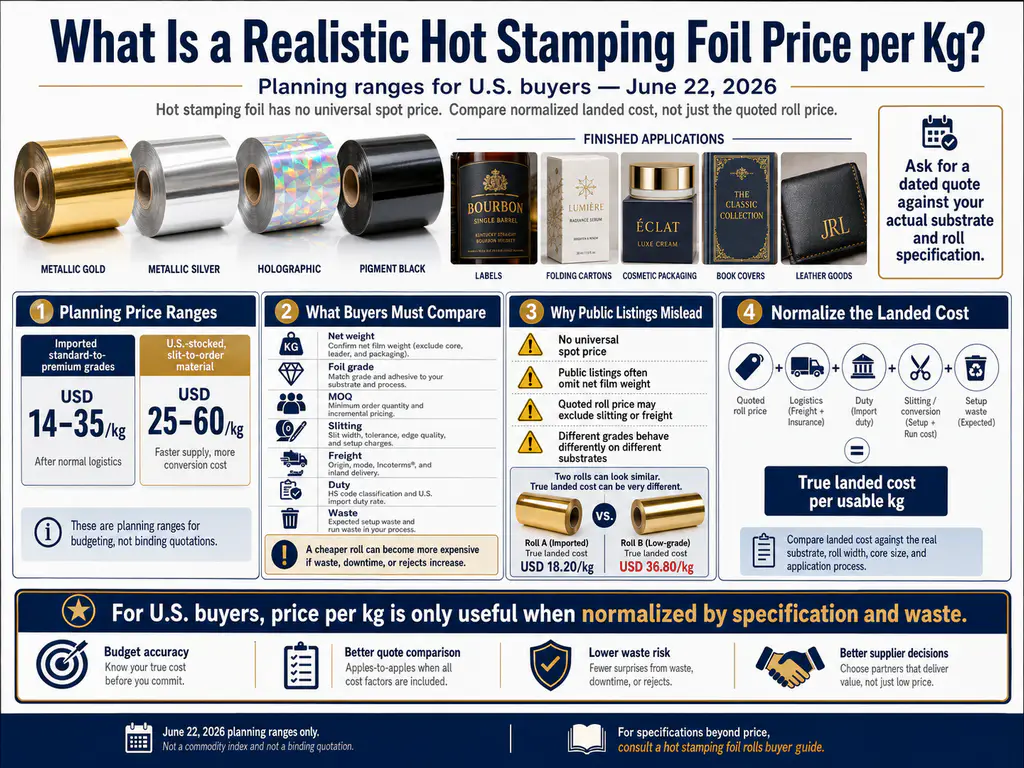
For a U.S. buyer, a realistic hot stamping foil price per kg is commonly budgeted at USD 14-35/kg for imported standard-to-premium grades after normal logistics, or USD 25-60/kg for U.S.-stocked, slit-to-order material. Compare net weight, grade, MOQ, slitting, freight, duty, and waste before comparing quotes.
These are June 22, 2026 planning ranges, not a commodity index or binding quotation. Hot stamping foil has no universal spot price, and public listings often omit net film weight. Ask for a dated quote against the actual substrate and roll specification.
This guide normalizes roll prices and landed cost. For specifications beyond price, use our hot stamping foil rolls buyer guide.This guide explains how to choose hot foil stamping dies, when to use magnesium, copper, brass, or silicone, and what to check before ordering tooling for labels, cartons, leather goods, plastic parts, and luxury packaging.
Current U.S. Hot Stamping Foil Price per Kg Benchmarks
The planning answer is USD 9-28/kg at factory export, USD 14-35/kg for ordinary imported landed stock, and USD 25-60/kg through a U.S. stocking channel. Security, chemical-resistant, custom-color, and low-MOQ orders can cost more.
| Buying route or grade | Indicative June 2026 range | Usually included | Common exclusions |
|---|---|---|---|
| Standard metallic, factory export | USD 9-18/kg | master or standard slit roll, export packing | international freight, duty, local delivery |
| Plastic, scratch-resistant, or chemical-resistant grade | USD 14-28/kg | application-specific coating system | testing, freight, custom color setup |
| Decorative holographic or pearl grade | USD 16-35/kg | standard pattern or finish | registered pattern tooling, security features |
| Imported wholesale, landed in the U.S. | USD 14-35/kg | product plus ordinary logistics assumptions | unusual tariffs, remote delivery, rush service |
| U.S.-stocked and slit-to-order foil | USD 25-60/kg | local inventory, smaller quantities, faster dispatch | custom development and special testing |
| Registered holographic or proprietary security foil | USD 30-80+/kg | project-specific optical effect | origination, embossing master, artwork security |
Domestic stock versus direct import
U.S. inventory carries warehousing, local slitting, technical service, and small-order convenience. Direct importing can reduce material cost above several hundred kilograms, but the buyer assumes customs, transit, and inventory risk. See the hot stamping foil sourcing guide for the USA for the wider decision.
Three-to-six-month price outlook
Price by Foil Type and Finish
Gold and silver are the baseline. Special pigments, optical patterns, tighter release, stronger adhesion, chemical resistance, and compliance documents add premiums.
| Foil type | Relative cost | Why the price changes | Typical U.S. demand |
|---|---|---|---|
| Gold or silver metallic | Baseline | established colors, high-volume production | folding cartons, labels, books, greeting cards |
| Copper, rose gold, champagne | Baseline to medium | pigment matching and lower batch volume | cosmetics, spirits, luxury packaging |
| Pigment or pearl | Medium | opacity, pigment dispersion, finish control | stationery, branded cartons, dark substrates |
| Decorative holographic | Medium to high | embossed optical pattern and tighter QC | labels, promotions, cosmetics |
| Registered security holographic | High | master origination, registration, controlled artwork | authentication and anti-counterfeit labels |
| Plastic or chemical-resistant foil | Medium to high | substrate-specific adhesive and durability testing | caps, tubes, appliances, cosmetic components |
| Cold foil | Separate cost model | adhesive, plate, press speed, overprint, and waste affect yield | high-volume narrow-web labels and cartons |
How to Convert Roll Price into Price per Kilogram
To calculate hot stamping foil price per kg, use net foil weight, not the shipping weight of the roll, carton, or pallet.Brass dies are usually chosen for premium packaging, long runs, embossing, combination foil embossing, leather goods, and jobs that need excellent detail and long tooling life. Brass can be CNC engraved and shaped with more control, making it useful for demanding luxury packaging.
Net film weight (kg) = width (m) x length (m) x total areal mass (g/m2) / 1,000
Price per kg = roll price / net film weight (kg)
The best input is total areal mass from the supplier’s data sheet. If only PET carrier thickness is available, estimate the carrier with:
Carrier areal mass (g/m2) = thickness (microns) x PET density (g/cm3)
Example 1: a 72-meter roll
Suppose a roll is 0.64 m wide and 72 m long, and the supplier declares a total areal mass of 18 g/m2:
- Area = 0.64 x 72 = 46.08 m2.
- Net foil weight = 46.08 x 18 / 1,000 = 0.829 kg.
- At USD 12.50 per roll, normalized price = 12.50 / 0.829 = USD 15.08/kg.
Exclude the core. A low-priced 72 m roll can still have a higher kilogram price because every roll needs setup, slitting, labeling, and packing.
Four-step quote conversion checklist
- Record roll width, usable length, core ID, and foil grade.
- Obtain total areal mass or verified net roll weight.
- Divide the roll price by net foil kilograms.
- Add slitting, packing, freight, insurance, duty, brokerage, and local delivery.
MOQ, Bulk Discounts, and Landed Cost per Kg
MOQ depends on stock status, slitting, and custom coating. These are negotiation guides, not commitments.
| Order profile | Planning MOQ | Typical pricing effect |
|---|---|---|
| Samples or trials | 1-5 rolls | highest unit cost; sample fee may be credited later |
| Standard stock color | 20-50 rolls or 20-100 kg | limited discount, flexible assortment |
| Normal wholesale order | 100-500 kg | roughly 3-8% below small-order basis |
| Production volume | 500-1,000+ kg | roughly 8-15% below small-order basis |
| Custom shade or coating | often 200-500+ kg | setup and development may apply |
Urgent production, air freight, split shipments, and custom slitting can erase a bulk discount. A letter of credit or extended terms may also add bank or financing cost.
Landed cost formula
Landed cost per kg = (goods + slitting + packing + freight + insurance + duty/tariffs + brokerage + local delivery) / received net kg
For illustration, assume 500 kg of foil at USD 15/kg, USD 1,250 freight and insurance, USD 450 brokerage and delivery, and an illustrative USD 525 duty/tariff amount:
(7,500 + 1,250 + 450 + 525) / 500 = USD 19.45/kg landed
The duty figure is an example, not tariff advice. Stamping foils are commonly reviewed within heading 3212, but classification, origin treatment, and additional duties must be confirmed for the product. Check the current U.S. International Trade Commission HTS and CBP guidance on determining duty rates, preferably with a customs broker.
Four-step quote conversion checklist
| Criterion | Suggested weight | Evidence to request |
|---|---|---|
| Tested substrate compatibility | 30% | stamped sample on actual stock |
| Landed cost and quote clarity | 25% | itemized Incoterm and exclusions |
| Batch consistency | 20% | shade tolerance and traceability |
| Lead time and support | 15% | dispatch history and technical response |
| Packing and claims | 10% | roll protection and written terms |
Request a Comparable Price Quote
For a meaningful hot stamping foil price per kg, send LiangyuFoil the substrate, finish, roll size, core ID, monthly volume, machine, destination, and Incoterm. We can normalize the quote, recommend a test grade, estimate landed cost, and arrange a sample.
A comparable quote connects material price with usable kilograms, application fit, yield, delivery risk, and finished quality.
FAQ
What is a typical hot stamping foil price per kg for a 72-meter roll in the U.S. market?
A 72-meter roll has no fixed kilogram price. In the 0.64 m-wide example, a USD 12.50 roll with 0.829 kg net foil equals USD 15.08/kg before delivery.
How do I convert foil roll length, width, and thickness into kilograms?
Multiply width by length and total areal mass, then divide by 1,000. Obtain coating mass from the supplier or subtract the empty core when checking by scale.
Which foil types are most expensive per kilogram?
Registered holographic, security, custom-color, plastic-specific, and chemical-resistant grades cost more because of origination, coatings, smaller runs, and testing.
How do I calculate landed cost per kg for imported foil?
Add goods, slitting, packing, freight, insurance, duties, brokerage, and delivery, then divide by received net kilograms. Confirm classification with a customs professional.
Do eco-friendly or certified foils cost more?
They can when traceability, testing, or segregated production adds cost. Ask for the named standard, scope, certificate owner, and valid document.
Related Technical Resources:
📞 Contact our technical team → — Quote turnaround in 24 hours.
Conclusion
A useful hot stamping foil price per kg uses net foil mass, performance, MOQ, slitting, freight, customs, and waste. USD 14-35/kg is a reasonable U.S. imported-landed planning range for standard-to-premium grades, but a dated, application-specific quote is the dependable number.