By Liangyu Laser Technical Team | 15-min read
How to Specify Hot Stamping Foil for Wine Labels Before Production
Table of Contents
- 1. Start With the Wine Bottle's Actual Handling Conditions
- 2. Specify Abrasion and Alcohol Resistance as a Test Plan, Not a Marketing Claim
- 3. Protect Fine Detail
- 4. Match the Foil Grade to the Wine Label Substrate and Finish
- 5. Use Temperature, Pressure and Dwell Time as Controlled Starting Windows
- 6. Choose Finish and Cost by the Approved Use Case
- 7. Send a Better Sample Request to Avoid Unusable Results
Wine labels are handled in stores, cases, cellars, ice buckets and bars. A foil that looks perfect on a dry press sample may scuff in transit, lose edge definition on textured paper, or change after a wine spill and wipe-down. The right specification joins foil grade, paper, die, artwork, press settings and end-use testing.
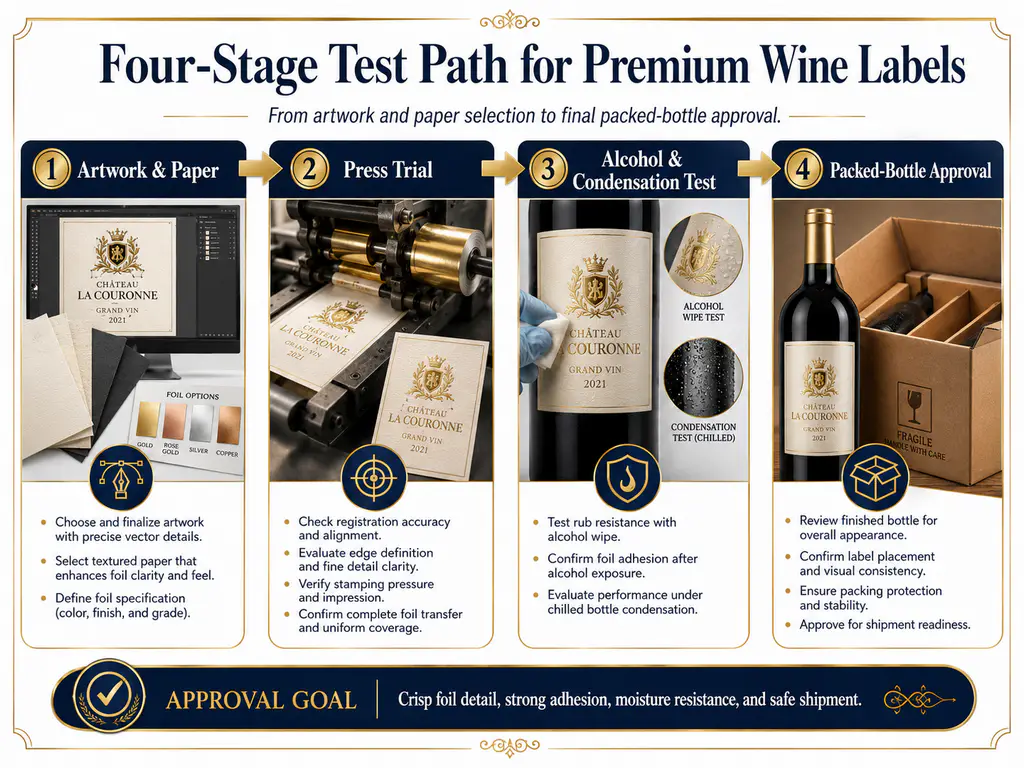
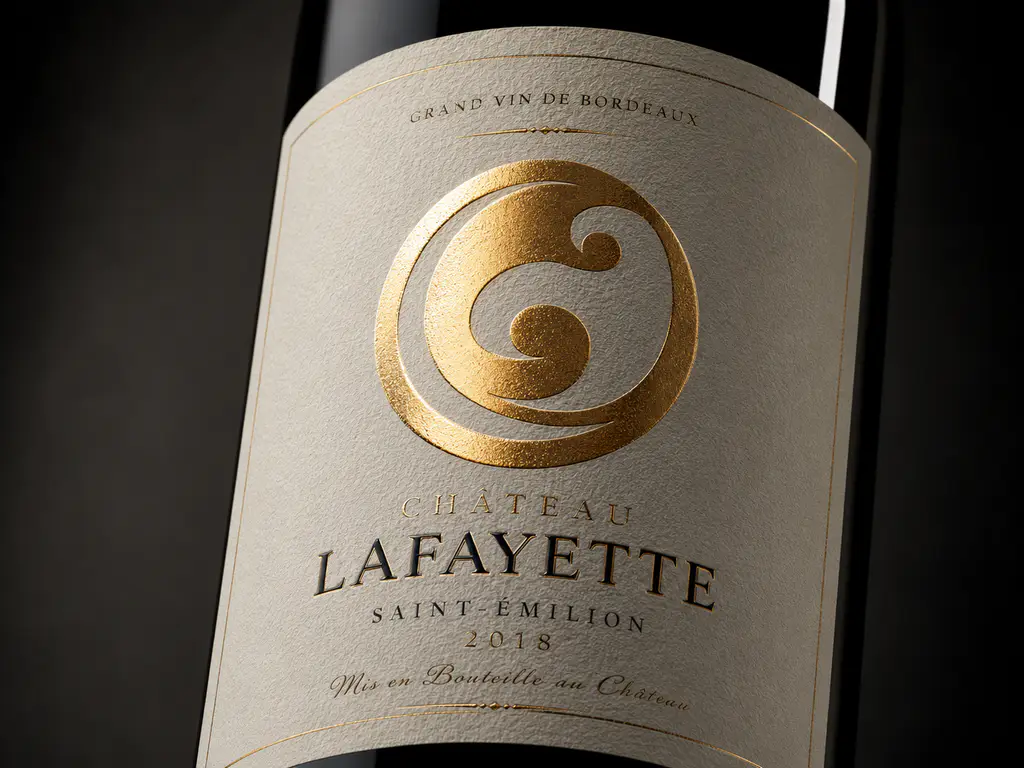
Hot stamping foil for wine labels should be selected against the actual paper or film, foil artwork, bottle environment and finishing sequence. Start with a foil grade matched to the label stock, test scuffing, alcohol contact and condensation on finished labels, and approve fine detail only after production-speed trials with the final die and varnish.
Start With the Wine Bottle's Actual Handling Conditions
A wine label may face carton abrasion, manual handling, refrigerator moisture, an ice bucket, bar wiping and occasional wine or alcohol contact. Put those conditions in the sample brief before choosing foil.
| End-use condition | What can fail | What to put in the sample brief |
|---|---|---|
| Case packing and transport | Scuffing, dull metallic sheen, edge damage | Case configuration, label-to-label contact and expected transport route |
| Refrigerator or ice bucket | Condensation, paper distortion, edge lift | Exposure time, temperature range and whether the bottle is wiped dry |
| Bar service | Alcohol or wine splash, repeated wiping | Liquid type, contact time and wipe material |
| Retail shelf or window | Fading or visual change over time | Indoor/outdoor exposure and target display period |
| Premium gifting | Fingerprints, abrasion and visual scrutiny | Foil color, gloss level, embossing and acceptable defect limit |
Specify Abrasion and Alcohol Resistance as a Test Plan, Not a Marketing Claim
“Scratch resistant” is not a purchasing specification. Define the liquid or friction source, exposure, load and visual acceptance rule in the quotation and sample request.
| Test | What it simulates | Record at minimum | Practical acceptance question |
|---|---|---|---|
| Taber abrasion, where suitable | Repeated dry surface wear | Standard, wheel, load, cycles and visual score | Is the metallic layer still continuous and commercially acceptable? |
| Dry rub / wet rub | Case friction, hand contact and wipe-down | Rub material, load, cycle count and direction | Are there visible scratches, color transfer or foil loss? |
| Alcohol or wine spot test | Spills at service | Liquid, concentration, dwell time and wipe method | Does the foil dull, smear, lift or change color? |
| Condensation cycle | Refrigerator or ice-bucket use | Temperature, moisture exposure and recovery time | Does the label remain visually sound after drying? |
| Packed-bottle trial | Real logistics | Bottle, carton, pack-out and route | Does the label survive the actual handling sequence? |
For alcohol contact, test the finished label, not foil alone. Define liquid, dwell time, wipe material and drying time, then compare with an unexposed control. Alcohol strength, varnish and paper absorbency can change the result.
Protect Fine Detail: Design Limits for Crests, Microtext and Borders
Fine foil detail can fail on rough paper, thin strokes, weak die relief or an unsuitable foil grade. Treat the minimum as an artwork-and-tooling decision, not a number copied from another job.
For a qualified trial, start positive lines around 0.2 mm (200 microns) or wider and give reversed gaps and textured stocks more margin. Confirm final minimums with the die, press, paper and foil combination.
| Artwork feature | Safer starting approach | Common failure if it is too fine |
|---|---|---|
| Positive line | Start around 0.2 mm or wider, then proof | Broken or incomplete transfer |
| Reversed gap | Make it wider than the positive line where possible | Filled-in gaps and muddy detail |
| Microtext | Use a solid, open typeface; avoid hairline serifs | Letters close up or lose legibility |
| Fine border | Add enough width for die relief and registration | Uneven line weight or missing corners |
| Halftone or distressed foil | Approve from a production-equivalent proof | Dots bridge, drop out or vary across the sheet |
Match the Foil Grade to the Wine Label Substrate and Finish
The same gold foil may perform differently on smooth coated paper, felt-marked stock, uncoated cotton paper, metallized label film or a varnished synthetic label. Surface texture, coating chemistry, moisture behavior and the final varnish can all change transfer and rub resistance.
| Wine label construction | Initial foil approach | Watch during testing |
|---|---|---|
| Smooth coated paper | Standard paper-compatible hot foil can be a starting point | Coating softness, varnish compatibility and rub resistance |
| Uncoated or cotton paper | Use a grade proven for porous or textured paper | Pinholes, broken solids and loss of fine detail |
| Laid, felt-marked or heavily textured stock | Test larger artwork features and appropriate die pressure | Texture can interrupt metallic coverage |
| Wet-strength paper | Test after moisture exposure and final varnish | Wet/dry cycling can expose weak adhesion |
| Synthetic label stock | Use a foil grade matched to the polymer and coating | Heat sensitivity, surface energy and distortion |
| UV-varnished or soft-touch surface | Qualify the exact coating with the foil | Poor adhesion, cracking or altered gloss |
Also specify whether foil is applied before or after varnish, receives a protective overprint, or will be embossed, die-cut or high-speed applied. See LiangyuFoil’s hot stamping foil rolls buyer guide and how to apply hot stamping foil.
Use Temperature, Pressure and Dwell Time as Controlled Starting Windows
There is no single production setting for every wine label. Temperature, pressure and dwell time are interdependent; compensating with one can create fuzzy edges, crushed texture or foil spread. Start with the qualified foil range, run a small matrix and change one variable at a time.
| Variable | What to look for | If the setting is too low | If the setting is too high |
|---|---|---|---|
| Die temperature | Complete release and clean edge | Missing foil, weak transfer | Spread, dullness, coating damage |
| Pressure | Contact across the foil image | Pinholes, incomplete areas | Crushed texture, dirty edges, paper marking |
| Dwell time | Sufficient heat transfer | Patchy image or edge loss | Over-transfer, slower cycle or paper stress |
| Machine speed | Stable quality at production rate | N/A: confirm against dwell | Quality can fall if dwell becomes too short |
| Foil tension | Flat, stable foil feed | Wrinkles or inconsistent release | Stretching, registration drift or tearing |

Choose Finish and Cost by the Approved Use Case
Compare foil grades against final paper, finish and performance tests, not roll price alone. Reprints, scuffs and rejected labels change the total cost.
| Foil option | Wine-label use | Selection question |
|---|---|---|
| Bright gold or silver | Crests, medal marks and classic luxury cues | Does it hold gloss after rub and condensation testing? |
| Champagne, copper or rose gold | Heritage, boutique or premium positioning | Does the hue remain consistent across repeat rolls? |
| Matte pigment foil | Quiet, tactile or minimalist designs | Is contrast strong enough on the chosen paper? |
| Holographic or patterned foil | Limited editions and security accents | Are pattern direction and registration specified? |
| Enhanced protective grade | High-touch or aggressive distribution routes | Does its durability value exceed its added material cost? |
Send a Better Sample Request to Avoid Unusable Results
A complete job brief lets a sample match the real production system. Include:
- Label stock brand, grade, caliper and surface finish.
- Foil artwork at final size, including smallest line, text and reversed gap.
- Stamping press, die type, expected production speed and current process window.
- Varnish, coating, overprint, embossing and die-cut sequence.
- Bottle use: dry retail, refrigeration, ice bucket, bar service or export distribution.
- Required tests and acceptance rule: rub, alcohol spot, condensation, packing trial or other agreed method.
- Target color/effect, roll width, estimated quantity and destination country.
FAQ
What abrasion tests should I require for hot stamping foil on wine labels?
Use dry or wet rub for handling, a packed-bottle trial for transport, and Taber only when the construction and agreed method make it useful. Record the method and visual pass/fail rule; one cycle count cannot qualify every wine label.
How do I test hot stamping foil for alcohol and wine-spill resistance?
Test the finished label with the liquid and wipe sequence that matches use. Define liquid, exposure, wipe material, number of wipes and drying time; compare exposed and unexposed areas.
What minimum line width can hot stamping achieve on a wine label?
Around 0.2 mm is a starting point for positive lines on a qualified smooth-stock job, not a guarantee. Textured paper, reversed gaps, fine serifs, die quality and foil grade can require wider artwork.
What settings are recommended for hot stamping on wine-label paper?
Use the supplier’s starting range, then qualify temperature, pressure, dwell and speed on the actual stock. Coating, texture, die relief and press condition change the workable window.
Do varnishes and overprints affect foil adhesion on wine labels?
Yes. Aqueous, UV, soft-touch and other coatings can change transfer, gloss and rub resistance. Test the exact production sequence.
Should I choose hot foil or cold foil for wine labels?
Choose hot foil for crisp crests, fine logos, embossing or textured premium papers. Choose cold foil for stable inline jobs with larger metallic areas or overprinted metallic graphics. Prove the choice on the intended finishing line.
Approve foil performance before your label run.
end your wine-label stock, artwork, press details, coating sequence and end-use conditions. LiangyuFoil can help match a foil sample to the actual test plan instead of a generic gold-foil request.