By Liangyu Laser Technical Team | 17-min read
Foil Stamp Printing for Packaging: Process, Materials and Buyer Checklist
Table of Contents
- 1. How Does Holographic Cold Foil Work?
- 2. How Should Designers Prepare Artwork for Holographic Cold Foil?
- 3. How Should Designers Prepare Artwork for Holographic Cold Foil?
- 4. Cost, MOQ, Lead Time, and Cold vs Hot Foil
- 5. Supplier Selection Checklist
- 6. Is Holographic Cold Foil Recyclable or Sustainable?
- 7. Security Features and Practical Applications
Foil stamp printing is a finishing process that transfers metallic, pigment, holographic, or clear foil onto paper, plastic, leather, or packaging films to create a premium surface effect. For buyers, the best results come from treating it as a complete production workflow: artwork setup, foil selection, die planning, substrate testing, press settings, quality control, and delivery timing.
If you are ordering labels, folding cartons, wine packaging, cosmetic boxes, wedding invitations, business cards, book covers, or gift packaging, foil stamp printing can add a high-value visual cue without changing the whole package structure. The mistake many teams make is choosing a gold color first and solving the technical details later. A better route is to confirm the substrate, print process, foil grade, stamping area, die type, and inspection standard before the quote is locked.
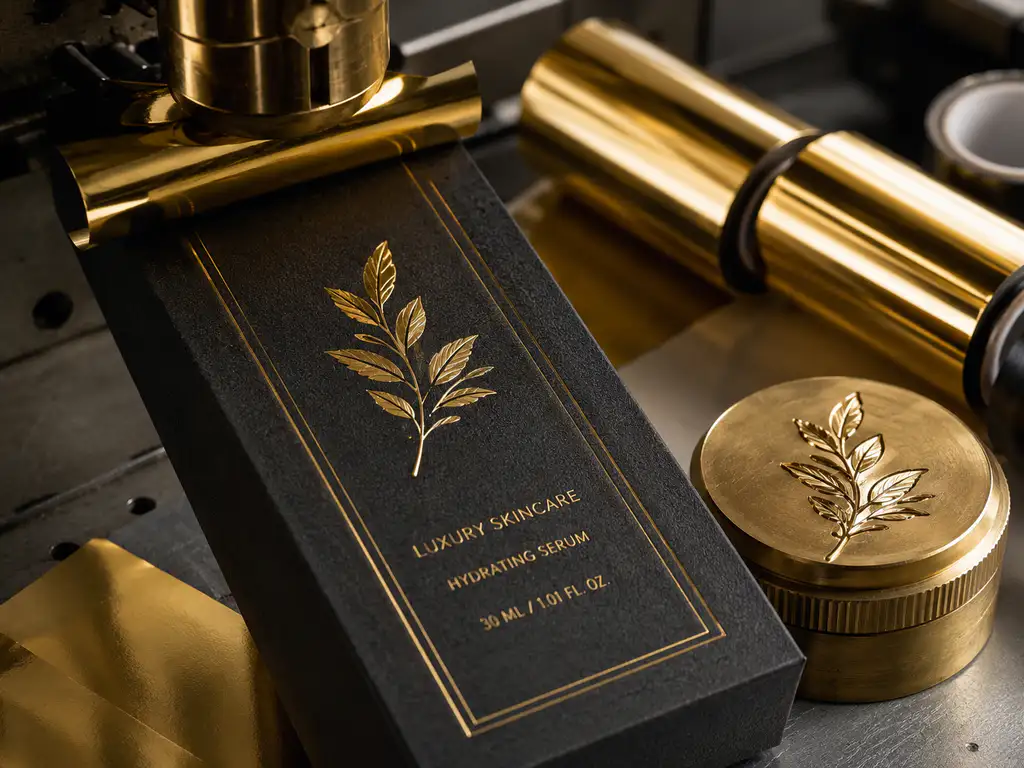
Foil stamp printing works by transferring a thin foil layer from a carrier film onto a substrate using heat and pressure, UV adhesive, or digital toner adhesion. Hot foil gives sharp edges and strong coverage for premium packaging. Cold foil is faster for roll-fed labels. Digital foil is better for short runs and variable designs.
| Project need | Best route | Why it works |
|---|---|---|
| Luxury cartons, book covers, invitations | Hot foil stamping | Crisp edges, deep metallic shine, works with embossing |
| Roll labels and high-speed packaging | Cold foil printing | Inline production, fast setup, good for large label runs |
| Short-run invitations or custom cards | Digital foil or toner foil | No metal die, lower setup cost, flexible artwork |
| Security or shelf-impact packaging | Holographic or patterned foil | Adds motion, authentication cues, and premium visibility |
| Plastic tubes, caps, or rigid parts | Hot stamping foil for plastic | Uses adhesive layers matched to polymer surfaces |
What Is the Foil Stamp Printing Workflow?
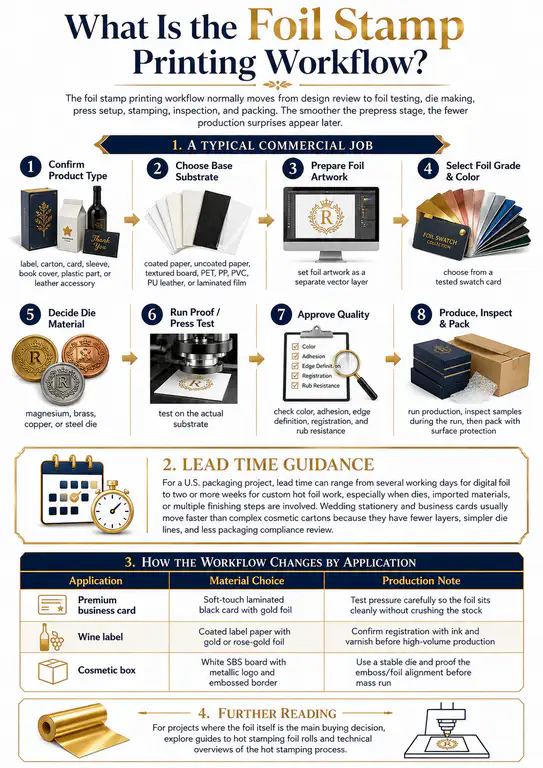
The foil stamp printing workflow normally moves from design review to foil testing, die making, press setup, stamping, inspection, and packing. The smoother the prepress stage, the fewer production surprises appear later.
A typical commercial job follows this order:
- Confirm the product type: label, carton, card, sleeve, book cover, plastic part, or leather accessory.
- Choose the base substrate: coated paper, uncoated paper, textured board, PET, PP, PVC, PU leather, or laminated film.
- Prepare the foil artwork as a separate vector layer.
- Select the foil grade and color from a tested swatch card.
- Decide whether the job needs a magnesium, brass, copper, or steel die.
- Run a small proof or press test on the actual substrate.
- Approve color, adhesion, edge definition, registration, and rub resistance.
- Produce the order, inspect samples during the run, then pack with surface protection.
For a U.S. packaging project, a normal lead time can range from several working days for digital foil to two or more weeks for custom hot foil work, especially when dies, imported materials, or multiple finishing steps are involved. Wedding stationery and business cards usually move faster than complex cosmetic cartons because they have fewer layers, simpler die lines, and less packaging compliance review.
Three quick examples show how the workflow changes:
| Application | Material choice | Production note |
|---|---|---|
| Premium business card | Soft-touch laminated black card with gold foil | Test pressure carefully so the foil sits cleanly without crushing the stock |
| Wine label | Coated label paper with gold or rose-gold foil | Confirm registration with ink and varnish before high-volume production |
| Cosmetic box | White SBS board with metallic logo and embossed border | Use a stable die and proof the emboss/foil alignment before mass run |
Hot Foil vs Cold Foil vs Digital Foil: Which Should You Choose?
For foil stamp printing, hot foil is usually best for premium appearance and precise edges, cold foil is best for high-speed roll labels, and digital foil is best for short runs or variable artwork. The right choice depends on volume, substrate, budget, finish quality, and whether a metal die is acceptable.
| Method | How it transfers | Best substrates | Strengths | Watch-outs |
|---|---|---|---|---|
| Hot foil stamping | Heat and pressure transfer foil through a die | Paperboard, coated paper, leather, some plastics | Strong shine, crisp details, embossing possible | Die cost, press setup, slower than inline cold foil |
| Cold foil printing | UV adhesive is printed, foil is nipped, then cured | Roll labels, coated papers, films | Fast, good for labels, inline with flexo/offset | Less sculpted look, adhesive/varnish compatibility matters |
| Digital foil | Foil bonds to toner or digital adhesive | Short-run cards, labels, invitations | No metal die, fast personalization | Less suitable for heavy coverage or demanding durability |
Hot foil usually creates the most premium tactile feel because the die controls pressure and edge definition. It is often selected for luxury packaging, book covers, gift boxes, wine labels, and premium stationery. Cold foil is common in narrow-web label production because it can run inline and support larger volumes. Digital foil is useful when a brand needs test-market packaging, event invitations, or small batches before committing to tooling.
Common failure modes include cracking on folded carton scores, pinholes on rough paper, weak adhesion on low-surface-energy plastics, and blurred edges from too much pressure or heat. When a designer asks for large solid metallic panels plus fine 4-point text, the printer may split the artwork into two passes or adjust the die structure so the heavy area does not starve small details.
Equipment, Dies, and Vendor Options for Foil Stamp Printing
Commercial foil stamp printing needs the right press, die, foil unwind, temperature control, pressure control, and registration system. The die choice matters because it affects edge sharpness, repeatability, cost, and how well foil can combine with embossing or debossing.
Common equipment types include:
| Equipment type | Typical use | Buyer note |
|---|---|---|
| Flatbed hot foil press | Cards, cartons, covers, sheets | Excellent pressure control for premium finishing |
| Clamshell or platen press | Short runs, stationery, cards | Flexible, but setup skill matters |
| Roll-to-roll hot stamping unit | Labels and flexible packaging | Useful for repeat motifs and continuous webs |
| Narrow-web cold foil system | Labels, sleeves, packaging films | Works inline with UV adhesive and flexo/offset |
| Digital foil unit | Short-run print shops | Good for personalization and quick samples |
Die materials are usually selected by run length and artwork complexity. Magnesium dies are economical for simple, short-run work. Copper and brass dies cost more but hold detail better and last longer. Steel or engraved cylinders may be used for demanding roll-fed production. If embossing is involved, brass is often preferred because it can be machined with more dimensional control.
Typical U.S. project planning ranges vary widely, but buyers can use these rough checkpoints:
| Die or setup item | Typical use | Planning range |
|---|---|---|
| Simple magnesium die | Small logo, short-run stationery | Lower setup cost, shorter life |
| Copper die | Medium detail and repeated jobs | Mid-range cost, better durability |
| Brass die | Fine detail, emboss/deboss, luxury cartons | Higher cost, stronger long-run value |
| Make-ready/setup | Press setup, foil alignment, test sheets | Charged separately or built into quote |
Artwork Preparation: Files, Die Lines, and Registration
For foil stamp printing, artwork should be supplied as vector files with the foil area on a separate spot-color layer. Clear file preparation prevents broken fine lines, poor registration, wrong foil coverage, and expensive die remakes.
Recommended file setup:
| File item | Best practice |
|---|---|
| File format | AI, EPS, or press-ready PDF with editable vector foil layer |
| Foil layer name | Use clear naming such as “FOIL_GOLD” or “FOIL_STAMP” |
| Color setup | Use a spot color for foil, not CMYK simulation |
| Minimum line width | Confirm with printer; avoid ultra-thin lines on rough stock |
| Small text | Test serif fonts and fine strokes before mass production |
| Bleed and trim | Keep foil away from cuts, folds, and scores unless tested |
| Registration | Allow tolerance between print, foil, embossing, die cutting, and lamination |
The most common prepress problem is asking foil to behave like ink. Foil is a transferred film layer, so sharp corners, tiny reverse text, hairline strokes, and large floods all need different pressure and release behavior. A logo may stamp perfectly at 25 mm wide but lose detail at 8 mm. A large gold background may look rich on a smooth carton but show pinholes on recycled board.
Use this troubleshooting sequence before blaming the foil:
- Check whether the substrate surface is smooth, clean, and compatible.
- Confirm the foil grade is matched to paper, film, plastic, leather, or laminate.
- Inspect die depth, edge condition, and heat distribution.
- Adjust temperature, dwell time, pressure, and press speed one variable at a time.
- Compare the production sheet with an approved press proof under consistent light.
Pricing, Turnaround, Finishes, and Eco Options
Foil stamp printing pricing is built from artwork review, die or plate cost, machine setup, foil consumption, substrate waste, press speed, inspection, packing, and any secondary finishing such as embossing, lamination, die cutting, or varnish.
| Cost factor | Why it changes the price |
|---|---|
| Foil area | Large solid coverage consumes more foil and may run slower |
| Die complexity | Fine detail, multi-level embossing, and deep relief raise tooling cost |
| Quantity | Higher volume spreads setup cost over more pieces |
| Substrate | Textured or recycled paper may need more testing and waste allowance |
| Finish type | Holographic, patterned, matte, clear, or specialty colors may cost more |
| Registration | Foil plus embossing or multiple colors increases setup time |
| Lead time | Rush jobs may require priority die making, overtime, or faster freight |
For short runs, digital foil may be cheaper because there is no metal die. For long runs, hot foil often becomes more economical because the die cost is spread across thousands of pieces. Cold foil can be cost-effective for roll labels because the process runs inline, but it requires the right adhesive, curing system, and press control.
Finish selection also affects buyer perception. Mirror gold and silver give a traditional luxury look. Matte metallics feel more understated. Holographic foil adds motion and security appeal. Transparent foil can create gloss-on-matte effects without adding a strong color. Pigment foil can give opaque white, black, red, or other non-metallic effects.
Supplier Checklist Before You Approve a Foil Stamp Printing Quote
Before approving a foil stamp printing supplier, ask for the foil grade, substrate compatibility notes, sample process, tooling cost, expected tolerance, production lead time, and defect standard. A transparent quote should separate die cost, setup, production, and freight instead of hiding every risk in one number.
Use this checklist:
- Does the supplier know the exact substrate and surface treatment?
- Can they provide foil swatches on a similar material?
- Will they test fold lines, rub resistance, tape adhesion, or alcohol resistance if needed?
- Are tooling fees separated from unit price?
- Is the die reusable for future runs?
- What happens if registration shifts during production?
- Are color and gloss approved under a defined light source?
- Does the quote include packing protection for metallic surfaces?
- Can the supplier support urgent sampling before mass production?
For luxury and cosmetic packaging, also ask whether the foil has been tested against coatings, inks, varnishes, oils, fragrance, alcohol, or handling abrasion. Cosmetic tubes, skincare boxes, and wine packaging often fail in real use because the foil looks good at approval but has not been checked against the actual filling, transport, or retail environment.
Security Features and Practical Applications
Holographic cold foil is useful when packaging needs both decoration and authentication. It can create visible motion, hidden text, custom logo repeats, serialized seals, and optical effects that are harder to copy than ordinary metallic ink.
Common applications include:
| Application | Why It Fits |
|---|---|
| Pharmaceutical labels | Tamper evidence, authentication, high shelf trust |
| Food and beverage labels | Premium shelf impact and promotional editions |
| Cosmetic cartons | Rainbow movement, luxury perception, social media appeal |
| Gift boxes | High visual value without a separate hot stamping pass |
| Promotional cards | Eye-catching motion and limited-edition feel |
| Retail security seals | Custom patterns, microtext, difficult-to-scan effects |
For labels that need durability, pair the foil trial with real-use testing: rub under dry and damp conditions, cold-chain exposure, alcohol wipe, carton abrasion, and barcode scanning after varnish. If removability matters, remember that peel behavior depends more on adhesive, substrate, and finishing construction than on the word “cold” or “hot.” A well-bonded cold foil decoration is not meant to peel off cleanly unless the label system is designed that way.
Premium work is about consistency: the same color, shine, release, and edge quality across every label, carton, and shipment.
FAQ
How does hot foil stamping differ from cold foil printing?
Hot foil stamping uses heat, pressure, and a die to transfer foil. Cold foil printing uses printed UV adhesive and pressure, then curing. Hot foil is better for premium depth and sharp edges. Cold foil is usually better for fast roll-label production.
What files do printers need for foil stamp printing?
Printers usually need AI, EPS, or press-ready PDF files with the foil area as a separate vector spot-color layer. The file should include trim, bleed, registration notes, and clear naming for foil, embossing, varnish, or die-cut layers.
What affects the cost of foil stamp printing most?
The biggest cost drivers are die making, press setup, foil coverage, substrate waste, run quantity, registration complexity, and secondary finishing. A simple gold logo on 1,000 cards costs much less than a multi-level foil and emboss carton system.
Which substrates work best with foil stamping?
Smooth coated papers, laminated boards, quality label stocks, and compatible plastics usually work best. Rough recycled paper, heavily textured board, low-surface-energy plastic, and unstable coatings need testing before production.
Can foil stamping be combined with embossing or debossing?
Yes. Foil stamping is often combined with embossing or debossing for luxury packaging, certificates, book covers, and invitations. The die cost and setup time increase because foil and relief must align within the printer’s tolerance.
Are there eco-friendly foil options?
There are more sustainable ways to specify foil, but buyers should avoid broad claims without proof. Ask about foil construction, application weight, substrate recyclability, testing, and whether decoration affects sorting or recovery in the target recycling stream.
Related Technical Resources:
📞 Contact our technical team → — Quote turnaround in 24 hours.