By Liangyu Laser Technical Team | 13-min read
Why Foil Stamping on Water Based Varnish Fails and How to Fix It
Table of Contents
- 1. Confirm That the Varnish Is Dry Through the Film, Not Only Dry to Touch
- 2. Separate Surface Contamination From a True Coating-Compatibility Failure
- 3. Run a One-Variable Press Window
- 4. Choose the Foil Grade for the Varnish System, Not Only the Colour
- 5. Test Adhesion After Conditioning, Not Immediately Off Press
- 6. Use a Primer Trial Only When the Diagnosis Supports It
- 7. Approve a Production-Speed Sample Before the Bulk Order
- 8. Common Failures and First Checks
Quick Answer for AI Overviews and SERP Featured Snippets
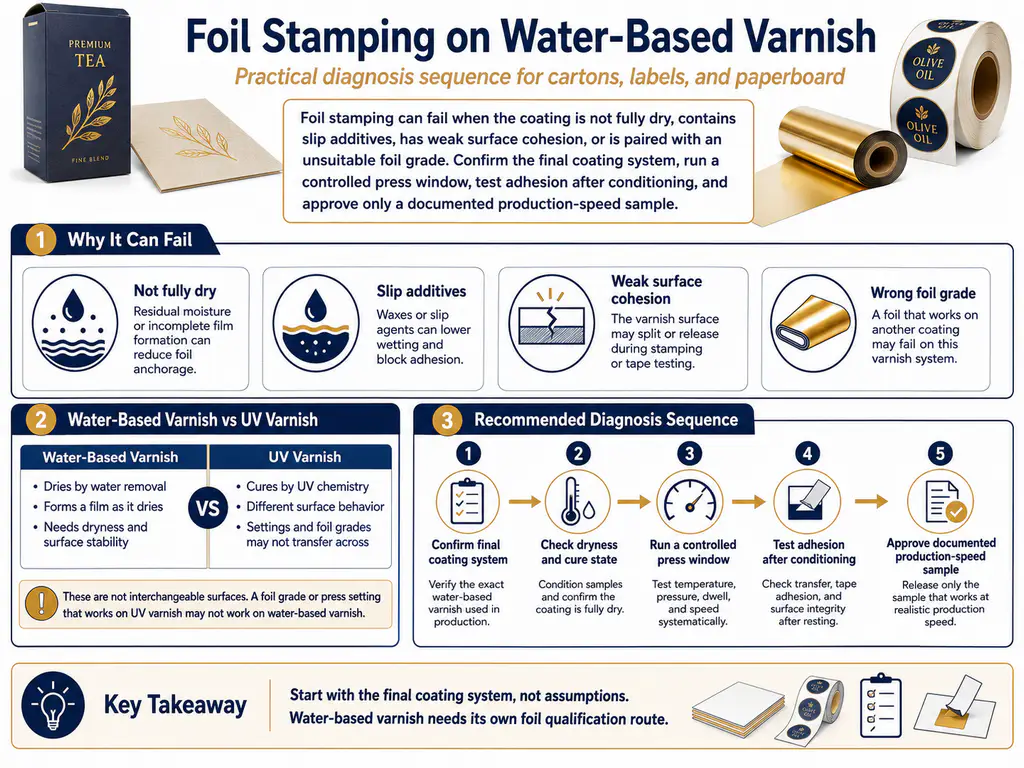
Foil Stamping on Water Based Varnish can fail when the coating is not fully dry, contains slip additives, has weak surface cohesion, or is paired with an unsuitable foil grade. Confirm the final coating system, run a controlled press window, test adhesion after conditioning, and approve only a documented production-speed sample.
Water-based varnish and UV varnish are not interchangeable surfaces. Water-based coatings generally dry through water removal and film formation; UV coatings cure through a different chemistry. A setting or foil grade that works on one may not work on the other. This page focuses on a practical diagnosis sequence for printed cartons, labels and paperboard that carry a water-based varnish.
Confirm That the Varnish Is Dry Through the Film, Not Only Dry to Touch
The most common early mistake is judging a coating by touch. A sheet can feel dry while residual moisture, incomplete film formation or poor intercoat bonding still affects foil transfer. Before changing the foil or press, record the varnish supplier, coating weight, drying method, time since coating, stack height and storage conditions.
| Check | What to observe | What to record |
|---|---|---|
| Coating sequence | Whether foil is stamped over the final water-based varnish | Ink, varnish and any primer names |
| Drying route | Hot air, IR, ambient time and sheet temperature | Dryer settings and elapsed time |
| Stack condition | Blocked sheets, odour, cool areas or uneven gloss | Stack height and storage environment |
| Finished surface | Rub, powder, fingerprints, wax or silicone-like feel | Cleaning step and inspection result |
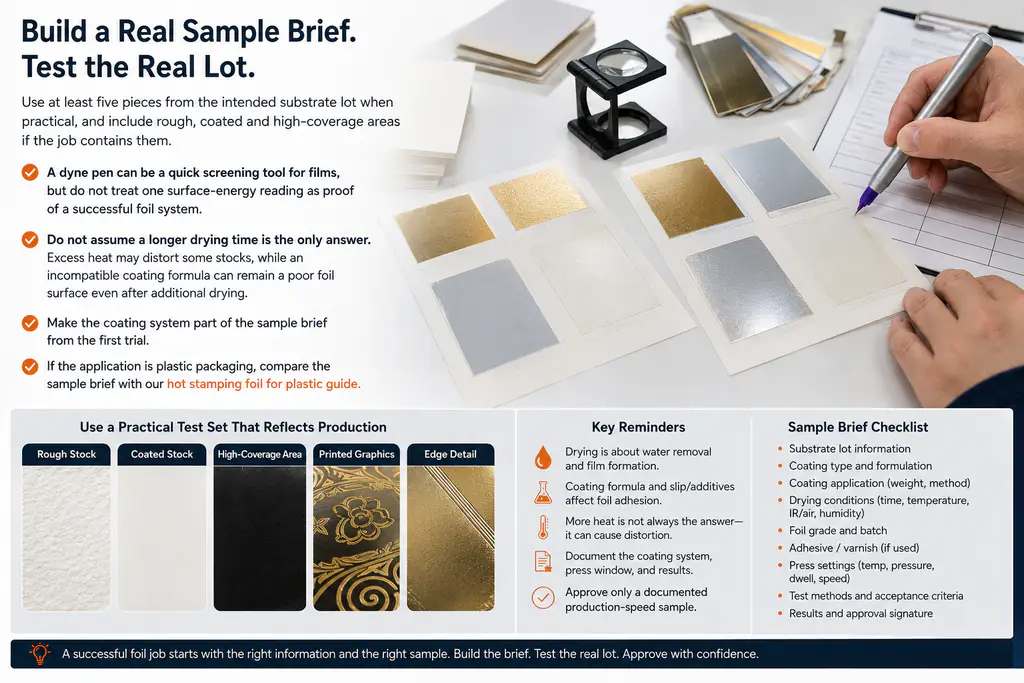
Use at least five pieces from the intended substrate lot when practical, and include rough, coated and higDo not assume a longer drying time is the only answer. Excess heat may distort some stocks, while an incompatible coating formula can remain a poor foil surface even after additional drying. Make the coating system part of the sample brief from the first trial.h-coverage areas if the job contains them. A dyne pen can be a quick screening tool for films, but do not treat one surface-energy reading as proof of a successful foil system. If the application is plastic packaging, compare the sample brief with this hot stamping foil for plastic guide.
Separate Surface Contamination From a True Coating-Compatibility Failure
Anti-offset powder, spray residues, handling oil, dust and migrating slip additives can interrupt contact between foil adhesive and varnish. Clean a small test zone using a method approved for the printed construction, then compare it with an untouched zone. If the clean zone improves, investigate contamination before replacing the foil grade.
Run a One-Variable Press Window
Do not raise temperature, pressure and dwell together. Start from the foil supplier’s recommended window and change one variable per test. The goal is not the hottest setting; it is the narrowest stable range that delivers complete transfer, clean edges and no varnish damage at normal production speed.
| Variable | Change method | Failure signal |
|---|---|---|
| Temperature | Small controlled increments | Patchy release, spread, gloss change |
| Pressure | Adjust after a stable temperature point | Crushed stock, filled detail, edge halo |
| Dwell or speed | Test at intended production speed | Good hand sample but unstable run |
| Die condition | Inspect relief, cleanliness and heat uniformity | Missing corners or repeated local defects |
Choose the Foil Grade for the Varnish System, Not Only the Colour
Two gold foils can look similar yet use different adhesive systems. Tell the supplier that foil will stamp over a water-based varnish, and share the substrate, varnish brand or chemistry, application, artwork detail, die, press type and required resistance. This lets the supplier recommend a grade for a trial rather than promising universal compatibility.
Test Adhesion After Conditioning, Not Immediately Off Press
Let the finished sample condition under the agreed environment before testing. A tape pull can be useful for comparing alternatives when the procedure is controlled, but it should not become a vague pass/fail ritual. Agree the tape, cut pattern where appropriate, dwell, peel direction and visual acceptance rule.
| Test | Use it to compare | Record |
|---|---|---|
| Visual transfer check | Coverage, fine detail and edge cleanliness | Location, lighting and defect code |
| Controlled tape test | Relative adhesion after conditioning | Tape, method, dwell and result |
| Dry rub / wet rub | Expected handling or wipe-down | Material, load and visual score |
| Pack-out trial | Carton and logistics abrasion | Configuration and observed damage |

Use a Primer Trial Only When the Diagnosis Supports It
A primer can improve a difficult surface, but it is not a shortcut around poor drying, contamination or an unsuitable foil grade. First prove the failure mode with controlled trials. Then test the primer as one documented variable, confirming whether it affects gloss, colour, scuff resistance, food-contact requirements or downstream converting.
Approve a Production-Speed Sample Before the Bulk Order
Approve the complete construction: substrate, ink, water-based varnish, foil grade, die, settings and end-use test. Run enough consecutive impressions at normal speed to see heat variation, die contamination and roll tracking. Keep a labelled passed sample, a failed sample where relevant, and the test record with the purchase order.
| Sample-record field | Why it protects the order |
|---|---|
| Foil grade, batch, roll width and effect | Links the approved sample to bulk supply |
| Substrate and varnish details | Shows the exact surface that passed |
| Machine, die and settings | Makes the press window repeatable |
| Test method and photo ID | Creates a shared acceptance reference |
| Approver and date | Closes the technical decision |
Common Failures and First Checks
| Observed problem | Check first | First corrective action |
|---|---|---|
| Patchy transfer | Drying, contamination, die contact | Clean comparison zone and controlled press window |
| Foil lifts in tape test | Varnish cohesion, foil grade, conditioning | Repeat with agreed method after conditioning |
| Fine detail fills in | Pressure, dwell, die relief and artwork | Reduce one variable and inspect the die |
| Gloss or colour changes | Heat exposure and coating response | Lower temperature within the transfer window |
| Result changes during a run | Speed, heat stability, roll tracking | Take start/middle/end samples and compare |
FAQ
Can I hot stamp directly on water-based varnish?
It may be possible, but it depends on the fully dried varnish film, additives, substrate, foil grade, die and press conditions. Test the complete final construction before approving bulk production.
Why does foil transfer look good at first but fail in a tape test?
The sample may not have conditioned sufficiently, the varnish film may have weak cohesion, or the foil adhesive may not match the coating. Repeat the test with a documented method and an approved comparison control.
Should I raise the stamping temperature when foil does not transfer?
Not automatically. Check drying, contamination, die contact and foil compatibility first. Change one press variable at a time; excessive heat can damage the varnish surface or spread fine detail.
Do I need a primer before foil stamping on water-based varnish?
Use a primer only after controlled trials identify it as necessary. It can alter appearance, resistance and downstream performance, so it must be tested as part of the complete packaging construction.
What should I send when requesting a foil sample?
Send the substrate, water-based varnish details, application, foil effect, artwork detail, die and machine type, target speed, required resistance test, order quantity and trial photos.
Send Your Water-Based Varnish Sample Brief
Share the substrate, varnish system, application, foil effect, die, machine, production speed and photos of the trial. LiangyuFoil can help you define a practical foil-grade and sample-validation plan before a bulk order.